Daily Pulse | October 6, 2026
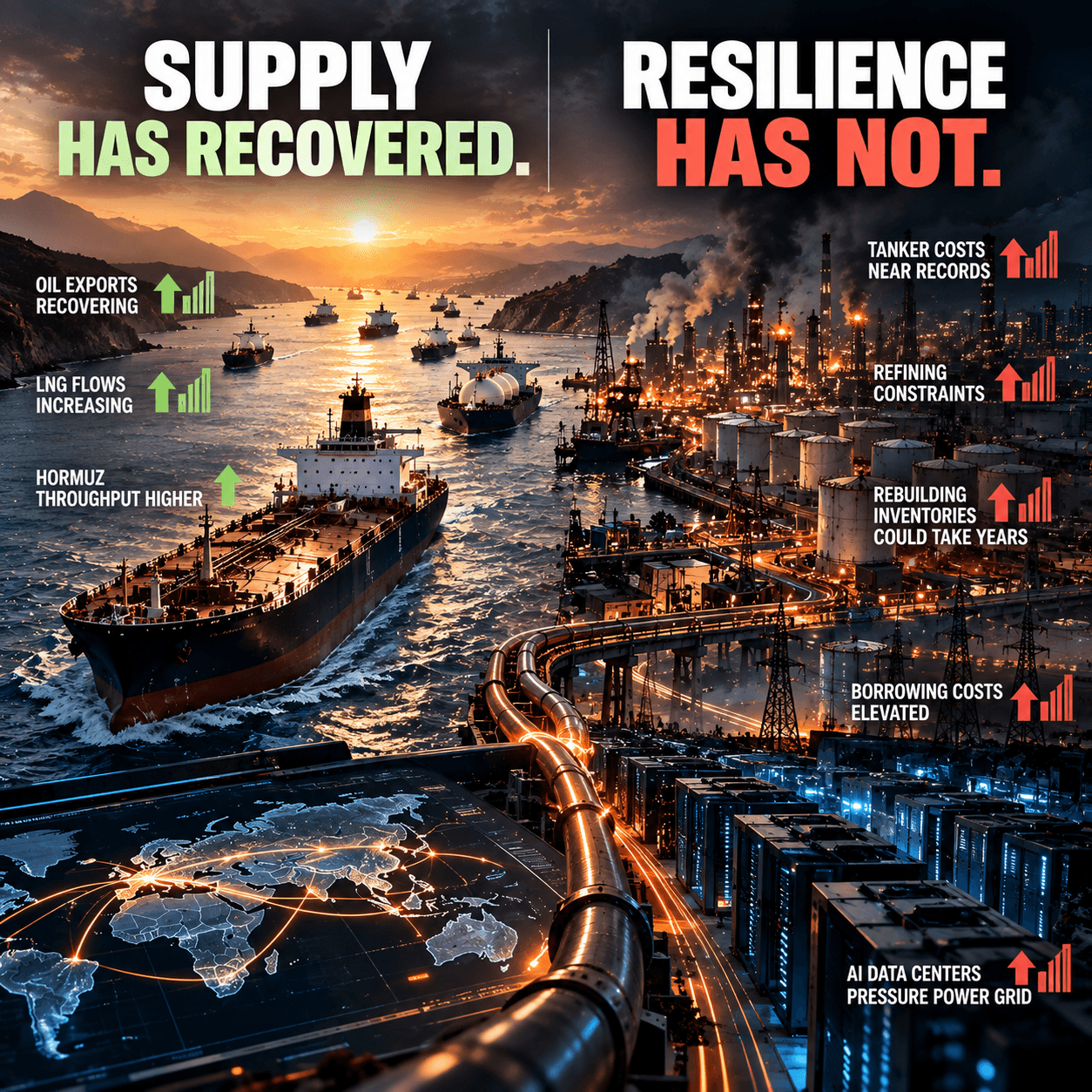
Oil is moving again. Gulf crude flows have recovered strongly. Alternative routes are being used. Governments are preparing emergency reserve releases. Companies are finding replacement suppliers. If we looked only at physical supply, this would be a story of recovery. But the economic system is telling us something different. Refined fuel supply remains much weaker than crude supply. Replacement barrels are expensive. Freight and insurance remain elevated. Strategic reserves are being consumed. Commercial shipping risks are spreading. Financing remains expensive.
14 min read

THE SUPPLY IS MOVING. THE COST IS MOVING WITH IT.
TIC Daily Pulse — October 6, 2026
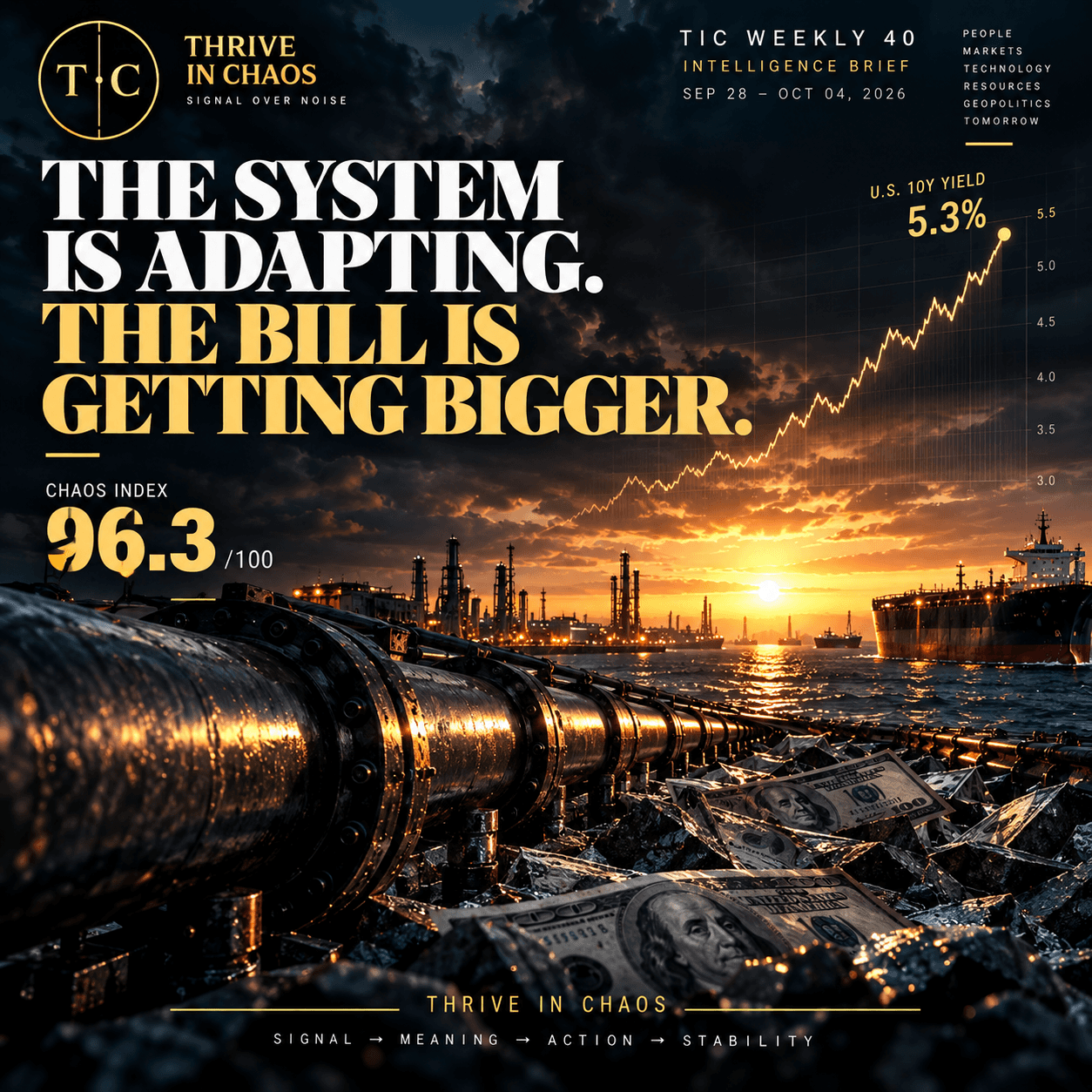
The Chaos Index (THRIVE IN CHAOS) — 99.2 / 100 | Phase R
System Type: Multipolar Compression
Adaptation Mode: DEFENSIVE
Daily change: +0.5
Outlook: Pressure remains extremely high, but it is increasingly moving downstream rather than appearing as outright physical shortage.
Horizon: 7–30 days
Confidence: High
01 — Daily Status
The global system is doing something important: it is adapting.
Oil is moving again. Gulf crude flows have recovered strongly. Alternative routes are being used. Governments are preparing emergency reserve releases. Companies are finding replacement suppliers.
If we looked only at physical supply, this would be a story of recovery.
But the economic system is telling us something different.
Refined fuel supply remains much weaker than crude supply. Replacement barrels are expensive. Freight and insurance remain elevated. Strategic reserves are being consumed. Commercial shipping risks are spreading. Financing remains expensive.
The system is avoiding outright failure.
It is doing so by moving the cost somewhere else.
That distinction explains today's Daily Chaos Index reading of 99.2, up 0.5 points from October 5.
02 — Thesis of the Day
The main problem is no longer simply whether energy can move.
Increasingly, it can.
The more important question is what has to become more expensive, less efficient or less secure to keep it moving.
This is becoming one of the defining patterns of the current environment:
Shock → Adaptation → Cost Migration → Buffer Regeneration
The first three stages are already visible.
The fourth may become the next major constraint.
03 — What Changed Today
Several developments over the last 24 hours reinforce the same mechanism.
Gulf energy exports have recovered substantially, but the recovery is uneven. Crude and condensate flows are much closer to pre-war levels than refined fuel exports.
Chinese refiners are replacing lost Iranian barrels with supplies from Iraq and Qatar, but at significant delivered premiums.
Oil benchmarks have fallen as physical flows improve, while actual delivered energy costs remain much higher in several markets.
Commercial shipping risk has expanded further into the Black Sea.
At the same time, trade negotiations between India and the United States remain entangled with energy sourcing and geopolitical alignment.
None of these developments alone explains today's reading.
Together, they show a system that is becoming better at maintaining throughput while becoming more expensive to operate.
04 — The Energy System Is Recovering — Unevenly
The strongest positive signal today is real.
Gulf energy flows excluding Iran recovered to roughly 81% of pre-war levels in September.
But the aggregate hides the more important story.
Crude and condensate flows recovered to approximately 91%.
Refined fuel exports recovered to only about 60%.
That gap matters enormously.
The world is becoming increasingly capable of moving crude oil again.
It has not yet restored the entire industrial system required to turn that crude into usable energy at normal cost.
This is the difference between physical availability and economic availability.
05 — Crude Oil Is Only the Beginning of the Chain
Oil does not power the economy simply because a tanker leaves a Gulf terminal.
It must be transported, insured, financed, unloaded, refined, stored and distributed.
Each stage introduces another potential bottleneck.
That is why a recovering crude market can coexist with expensive diesel, aviation fuel and gasoline.
The original shortage is being solved.
The downstream system is now absorbing the pressure.
06 — The Bottleneck Is Moving
At the beginning of the energy disruption, the main question was straightforward:
Can enough oil physically reach the market?
Today the question is different:
Can enough usable energy reach the economy at a sustainable cost?
This is a more complicated problem because it involves multiple systems simultaneously.
Shipping matters.
Insurance matters.
Refining matters.
Inventory matters.
Credit matters.
Infrastructure matters.
A system with sufficient crude oil can therefore remain economically constrained.
07 — China Shows What Adaptation Actually Costs
China provides a useful real-world example.
Independent refiners have been replacing disrupted Iranian supplies with barrels from Iraq and Qatar.
That is resilience working.
The refineries did not simply stop operating because one supply channel weakened.
They found another.
But replacement supplies have reportedly carried substantial delivered premiums.
At the same time, utilisation among independent refiners in Shandong has fallen, while refining economics have deteriorated sharply.
The physical problem was partially solved.
The financial cost migrated into another part of the system.
08 — Substitution Is Not the Same as Normalization
This distinction is becoming increasingly important.
A company can replace a supplier.
A country can replace an energy source.
A shipping company can reroute a vessel.
A government can release strategic reserves.
All of these actions increase resilience.
But none automatically restores the previous cost structure.
The new supplier may charge more.
The new route may be longer.
The insurance premium may be higher.
The backup inventory must eventually be replenished.
Adaptation prevents failure.
It does not necessarily restore efficiency.
09 — Why Falling Oil Prices Can Mislead
Brent moved back below $100 today as traders reacted to improving Gulf exports and expected emergency reserve releases.
That is a genuine easing signal.
But it should not be confused with complete energy normalization.
Benchmark prices measure one part of the system.
Businesses and households experience something else:
delivered cost.
That includes the commodity itself plus refining, transportation, insurance, storage, financing, taxes and local distribution.
Those layers can remain stressed even after the headline commodity price begins falling.
10 — The Physical Price Can Be Very Different
This distinction is already visible in Asia.
Physical delivered oil prices have remained dramatically above headline futures benchmarks in some transactions.
That tells us something important.
Markets can begin pricing future normalization while the physical economy is still paying for today's disruption.
Financial markets move on expectations.
Infrastructure moves at physical speed.
Inventories move at logistical speed.
Household costs move even more slowly.
That is why the same crisis can appear to be ending in one dataset while remaining very real in another.
11 — Strategic Reserves Are Buying Time
Emergency reserves are performing their intended function.
The G7 has announced a major coordinated release of crude and diesel inventories.
This should reduce immediate pressure.
But the details matter.
The International Energy Agency is still expected to determine the precise composition and country contributions around October 14–15.
Until those barrels physically reach markets, we should distinguish three stages:
announcement → release → delivered relief
They are not interchangeable.
Policy can move quickly.
Physical systems cannot.
12 — Every Barrel Released Creates a Future Obligation
Strategic reserves solve today's problem by borrowing resilience from the future.
That is not necessarily a mistake.
This is exactly why reserves exist.
But eventually they must be rebuilt.
And replenishment competes for the same supply that consumers and businesses need.
The important question therefore changes from:
How large is the buffer?
to:
How quickly can the buffer be regenerated?
This is likely to become increasingly important across energy, inventories, fiscal capacity and corporate balance sheets.
13 — Buffer Regeneration May Become the Next Bottleneck
The same mechanism exists well beyond oil.
A company can survive disruption by drawing down inventory.
A household can survive an income shock by spending savings.
A government can absorb an energy crisis through subsidies.
A grid can survive peak demand using reserve generation.
A military can sustain operations by consuming stored ammunition.
In each case, resilience is real.
But resilience is being consumed.
If shocks arrive faster than buffers can be rebuilt, the system may remain functional while becoming progressively more fragile.
That is a very different risk from sudden collapse.
It is slower, harder to see and potentially more important.
14 — Black Sea Risk Is Expanding
Commercial shipping risk also broadened today.
A merchant vessel sank after a drone strike in Bulgaria's Black Sea economic zone, while another vessel was damaged.
Attribution remains under investigation and should not be assumed.
But the economic mechanism does not depend entirely on attribution.
Commercial operators respond to risk.
Insurers respond to risk.
Crews respond to risk.
Shipping companies respond to risk.
If incidents spread geographically, the commercial risk perimeter can expand even without a formal closure of shipping routes.
15 — A Route Can Remain Open and Become Less Useful
This is another recurring feature of modern disruption.
Infrastructure does not need to be completely destroyed to lose economic capacity.
A port can remain open but become expensive to insure.
A shipping corridor can remain technically navigable while operators avoid it.
A refinery can remain operational while margins make production unattractive.
A pipeline can function while security costs rise.
This is why binary descriptions — open or closed, operating or destroyed — increasingly fail to capture real economic capacity.
What matters is usable capacity at acceptable cost.
16 — Security Is Becoming an Operating Expense
Drone threats illustrate the same problem.
Cheap systems can impose expensive defensive requirements.
The defender must protect airfields, ports, power plants, warehouses, refineries, pipelines, communications networks and transport nodes.
The attacker needs only to identify a vulnerable point.
This creates an uncomfortable economic asymmetry.
Even when attacks fail, the cost of preventing them can rise.
Security therefore moves from being an occasional capital expense toward becoming a permanent operating expense.
That change matters far beyond defence budgets.
17 — Trade Is Becoming Part of the Security System
India–US trade negotiations provide another example of cost migration.
Energy sourcing is increasingly connected to geopolitical alignment.
Geopolitical alignment is increasingly connected to tariffs.
Tariffs affect market access.
Market access affects investment and supply-chain decisions.
A barrel purchased from one supplier can therefore influence the economics of an unrelated export industry.
This is what fragmentation looks like when it becomes institutional rather than rhetorical.
Trade, energy and security are no longer separate systems.
They are increasingly one decision environment.
18 — The World Is Paying for Redundancy
For decades, efficiency was built around removing redundancy.
Companies reduced inventories.
Production was concentrated.
Supply chains were optimized.
Capital was allocated toward the highest immediate return.
The new environment rewards something different.
Backup suppliers.
Strategic inventories.
Alternative routes.
Domestic capacity.
Spare electricity.
Multiple financing channels.
Cybersecurity.
Physical protection.
These systems are less efficient in normal conditions.
But they are more resilient during disruption.
The world is therefore beginning to exchange some efficiency for optionality.
That exchange has a price.
19 — Financial Markets Are Sending a Different Signal
Today's financial markets are not behaving as if a systemic crisis is imminent.
That matters.
US Treasury yields eased.
Oil declined.
Major US equity indices reached new highs.
AI-related assets remain extremely strong.
These are significant counter-signals to any simplistic collapse narrative.
The system is still functioning.
Capital is still taking risk.
Markets still expect adaptation to succeed.
Our analysis must include that evidence.
But markets answer a different question.
They price expectations about future cash flows.
They do not necessarily measure the current cost of operating physical systems.
20 — Funding Pressure Has Not Disappeared
Beneath strong asset prices, financing remains expensive.
Long sovereign yields remain near levels not seen for many years.
The US Treasury continues to require substantial market funding.
Money-market flows are no longer expanding at the extraordinary pace seen in previous years.
This does not mean a funding crisis is imminent.
It means capital itself is becoming a more contested resource.
Governments need it.
Infrastructure needs it.
Defence needs it.
Energy systems need it.
AI needs it.
The competition between those demands is becoming strategically important.
21 — AI Is Becoming Part of the Physical Economy
AI is often discussed as software.
Increasingly, that description is incomplete.
Data centres require land.
They require electricity.
They require grid connections.
They require transformers.
They require cooling.
They require construction.
They require chips.
And they require enormous amounts of capital.
Large data-centre investment plans in regions such as Aragón in Spain show how quickly AI infrastructure can become a regional physical-development question rather than merely a technology story.
AI is becoming infrastructure.
22 — The Constraint on AI May Move
For the last several years, the dominant AI constraints were compute and advanced semiconductors.
Those remain important.
But the next constraint may increasingly be the physical economy around them.
Can electricity generation grow quickly enough?
Can grids be expanded?
Can transformers be produced?
Can permits be issued?
Can construction capacity keep pace?
Can capital remain available at acceptable cost?
The AI race may therefore become another example of the same pattern we see in energy:
solving one bottleneck exposes the next one.
23 — First-Order Effects
The immediate effects are relatively clear.
Energy continues to move.
Oil benchmarks can ease.
Emergency reserves reduce immediate scarcity.
Alternative suppliers gain business.
Shipping and insurance remain expensive.
Refiners face uneven margins.
Commercial operators spend more on security.
These effects are visible now.
But they are not the most important part of the story.
24 — Second-Order Effects
The second-order effects begin when adaptation becomes permanent.
Companies maintain larger inventories.
Governments rebuild strategic reserves.
Shipping routes acquire persistent risk premiums.
Countries subsidize domestic capacity.
Infrastructure security spending rises.
Supply chains become less optimized but more redundant.
Capital expenditure increases even without proportional increases in productive output.
The economy becomes more resilient.
It also becomes structurally more expensive.
25 — Third-Order Effects
The third-order effect is a change in what constitutes competitive advantage.
For several decades, advantage came from maximizing efficiency.
Increasingly, advantage may come from controlling optionality.
Countries with abundant energy gain leverage.
Companies with multiple suppliers gain leverage.
Businesses with strong balance sheets gain leverage.
Regions with spare electricity gain leverage.
Governments with fiscal capacity gain leverage.
Households with liquidity gain leverage.
Resilience becomes an economic asset.
But because building resilience consumes resources, the ability to regenerate buffers becomes an asset as well.
That distinction will matter increasingly if shocks remain frequent.
26 — Forecast Gate
7–30 Day Outlook
Direction: Headline energy and market pressure can continue to ease while delivered-cost, refining, financing and security pressure remain elevated.
Confidence: High.
The central expectation is not an immediate return to acute physical shortage.
It is divergence.
Crude supply can continue recovering faster than refined fuels.
Oil benchmarks can decline faster than delivered costs.
Markets can recover faster than household purchasing power.
Governments can release reserves faster than they can rebuild them.
Formal Forecast Ledger
No open Forecast Ledger item falls due between October 6 and October 13.
No new formal forecast is added today.
Today's evidence strengthens an existing causal pattern, but creating another forecast from the same cluster of energy and logistics signals would increase correlated observations rather than improve the track record.
The next important evidence will come from actual transmission:
Does physical recovery begin reducing delivered cost?
That is the test.
27 — Scenarios
These are decision scenarios rather than precise predictions.
Scenario A — Uneven Normalization
The most constructive path is continued improvement in Gulf crude flows, lower benchmark oil prices and gradual recovery in refined products.
Freight and insurance premiums decline more slowly.
Household and business costs eventually follow.
This would represent genuine normalization, but with a significant lag between markets and the real economy.
Signal to watch: refined-fuel recovery begins closing the gap with crude recovery.
Scenario B — High-Cost Resilience
Physical supply remains sufficient, but the system continues paying higher costs for replacement supply, insurance, security, inventory and financing.
No dramatic global shortage occurs.
Instead, businesses and households absorb a permanently higher operating-cost structure.
This remains the central structural risk.
Signal to watch: benchmarks decline while delivered prices remain stubbornly elevated.
Scenario C — Buffer Exhaustion
A new geopolitical or infrastructure shock arrives before strategic inventories and commercial buffers have been rebuilt.
The system can still adapt, but it begins the next disruption with less optionality.
That would make the next shock disproportionately more expensive than the previous one.
Signal to watch: reserve drawdowns continue while replenishment schedules move further into the future.
Scenario D — Renewed Multi-Channel Escalation
Energy disruption, Black Sea shipping risk, trade fragmentation and financing pressure intensify simultaneously.
The danger here is not any individual shock.
It is synchronization.
Multiple systems begin drawing on their buffers at the same time.
That is the environment in which resilience itself becomes scarce.
Signal to watch: simultaneous deterioration in physical shipping, refined-fuel availability and funding conditions.
28 — Decision Intelligence
The practical question is not whether today's headlines are good or bad.
It is whether improving headline indicators are actually reducing the cost of the decisions people and organizations must make.
Individuals
Do not treat a lower crude benchmark as proof that household conditions have normalized.
If Brent remains below $100 but household fuel, heating or variable borrowing costs fail to decline meaningfully by October 13, keep the winter liquidity buffer intact through October 14.
Reassess using the prices you actually pay, not the benchmark quoted in financial media.
Why it matters: household resilience depends on delivered cost and liquidity, not commodity-market symbolism.
Reversibility: High.
Business
Separate the commodity price from the rest of the delivered cost.
If the benchmark price of a critical input falls for three trading sessions while your delivered price remains elevated, request a new quotation by October 13 that separates commodity, freight, insurance, processing and financing.
The objective is not simply to negotiate a lower price.
It is to identify where the constraint has migrated.
That determines whether the correct response is a new supplier, a new route, more inventory, different financing or simply patience.
Reversibility: Medium.
Capital
The strategic distinction is increasingly between assets that benefit from scarce physical capacity and assets whose valuation depends heavily on cheap long-duration capital.
AI infrastructure illustrates the problem.
Demand may remain extraordinary while financing and physical constraints become progressively more important.
Separate exposure to infrastructure cash flows from exposure that requires both continued AI enthusiasm and falling discount rates.
Reversibility: Medium.
Final Assessment
Today's strongest signal is not that the global system is failing.
It is that the system is becoming increasingly sophisticated at preventing failure.
That is an important difference.
Oil is rerouted.
Suppliers are replaced.
Reserves are released.
Infrastructure is protected.
Trade routes adjust.
Capital finds alternatives.
These mechanisms make the world more resilient than a simple reading of crisis headlines would suggest.
But adaptation has a cost.
And increasingly, that cost does not disappear when the original problem is solved.
It migrates.
From crude supply into refining.
From refining into delivered fuel prices.
From shipping disruption into insurance.
From geopolitical alignment into trade.
From infrastructure vulnerability into security spending.
From AI innovation into electricity, construction and capital.
The next stage of the global resilience story will therefore not be determined simply by whether systems can absorb shocks.
We already know many of them can.
The more important question is:
Can they rebuild their buffers faster than they are consuming them?
Because a system that survives every shock by spending more reserves, more capital and more optionality can remain operational for a long time.
But each successful adaptation can make the next decision more expensive.
That is the mechanism THRIVE IN CHAOS is designed to measure.
THRIVE IN CHAOS
Signal Over Noise.
The Chaos Index (THRIVE IN CHAOS) is an AI-assisted Decision Intelligence system with human editorial oversight. Daily readings are indicative and separate from the official weekly series.
Join the newsletter
Be the first to read our articles.