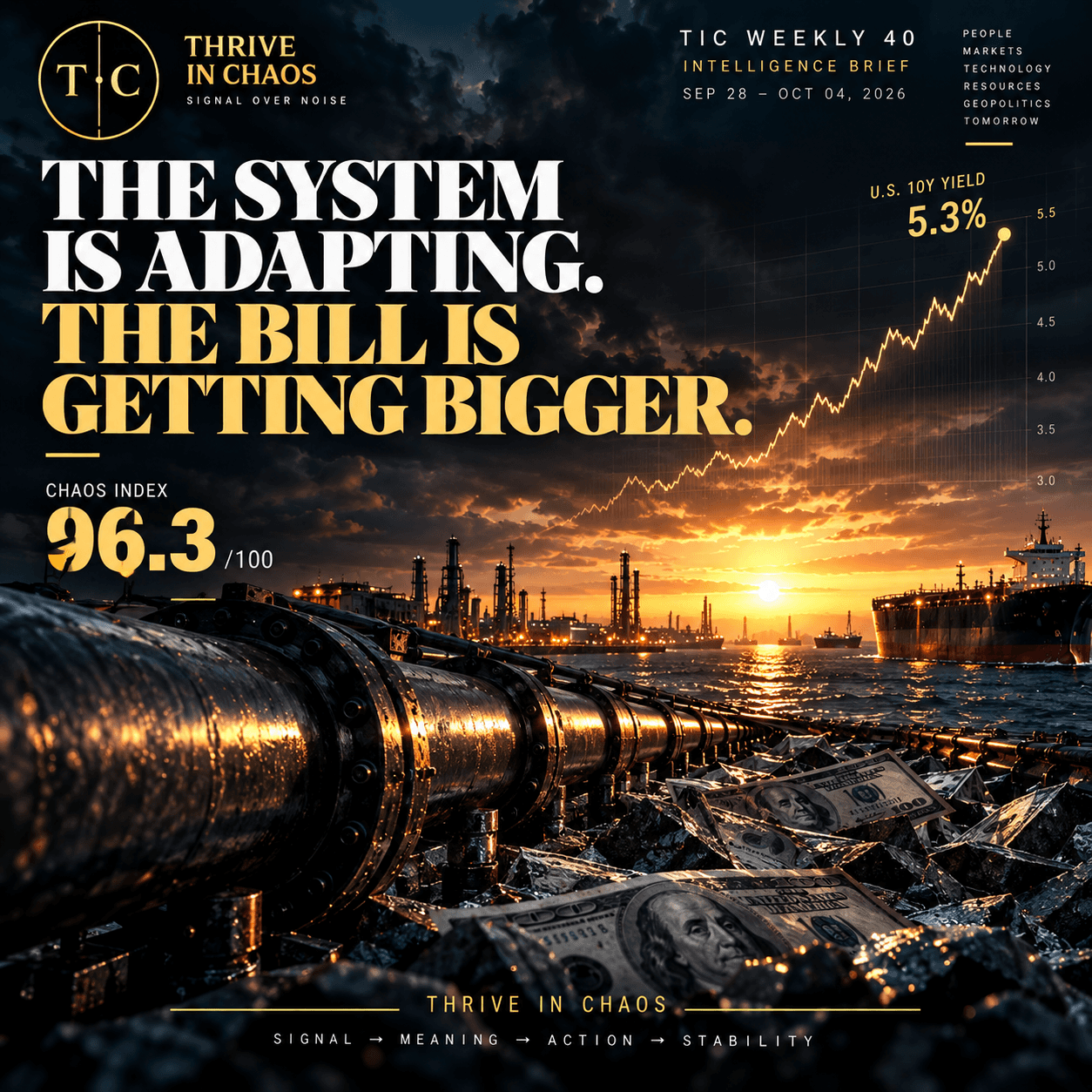
DAILY PULSE | October 5, 2026
Oil is moving through the Middle East again. LNG traffic through Hormuz has recovered. Governments are releasing strategic reserves. Companies are finding alternative routes. Economic activity in parts of Europe remains surprisingly resilient. But the cost of making all of this work has not returned to normal. That distinction is becoming increasingly important. The problem is no longer simply whether the world can move enough energy, goods and capital. The emerging question is how much infrastructure, inventory, money and redundancy must be consumed to keep those flows moving.
13 min read
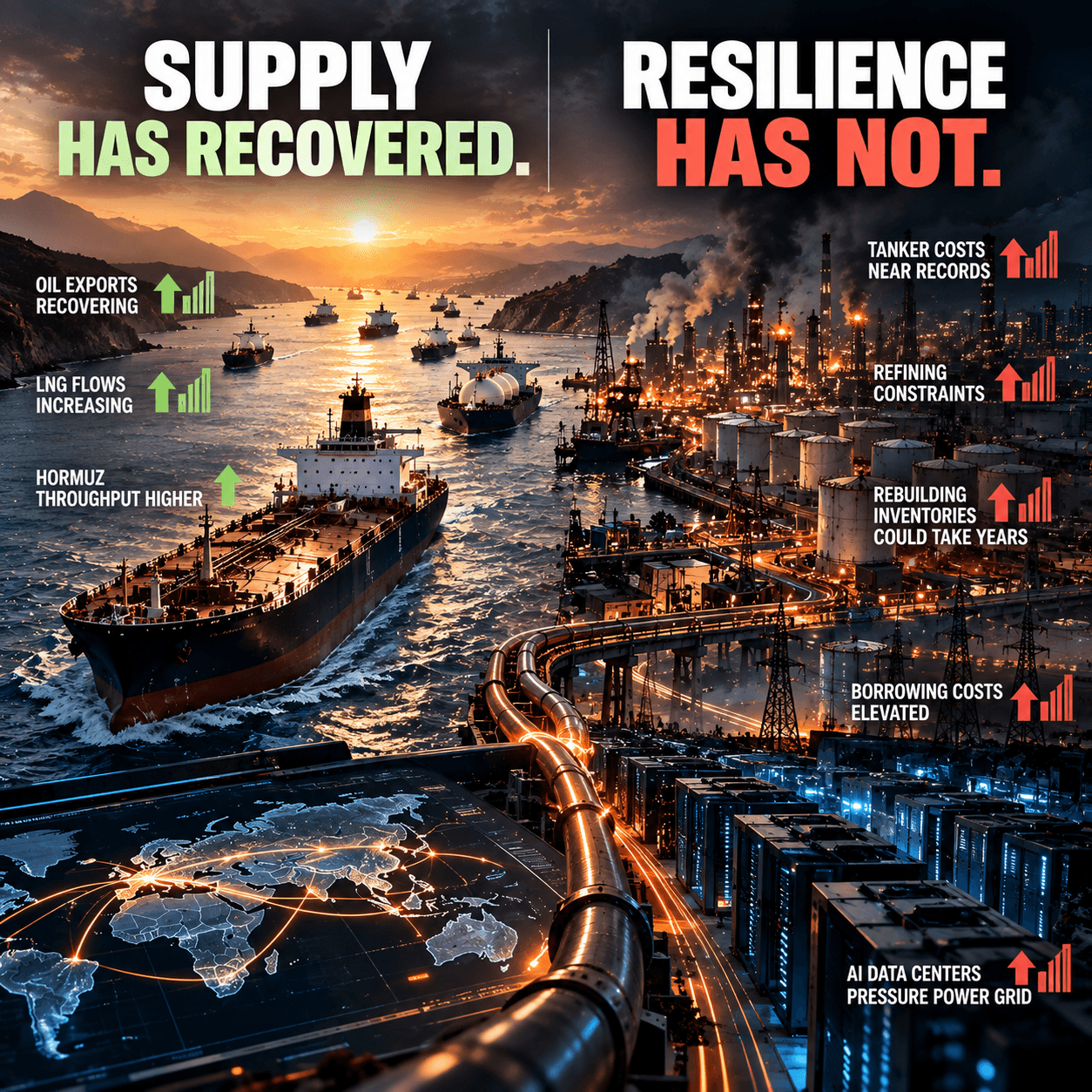
Supply Has Recovered. Resilience Has Not.
THRIVE IN CHAOS — DAILY PULSE | October 5, 2026
The Chaos Index (THRIVE IN CHAOS) — 98.7 / 100 | Phase R
Daily indicative reading, October 5, 2026. This is not a point in the weekly series. The last approved Daily reading was 96.9 on October 3; October 4 has no reproducible Daily reading, so no D/D change is stated. Weekly series value: 95.5, last approved weekly reading.
System Type: Multipolar Compression
Adaptation Mode: DEFENSIVE
Outlook: 7–30 days
Confidence: High
01 — The Thesis
The global system is proving more adaptable than many expected.
Oil is moving through the Middle East again. LNG traffic through Hormuz has recovered. Governments are releasing strategic reserves. Companies are finding alternative routes. Economic activity in parts of Europe remains surprisingly resilient.
But the cost of making all of this work has not returned to normal.
That distinction is becoming increasingly important.
The problem is no longer simply whether the world can move enough energy, goods and capital. The emerging question is how much infrastructure, inventory, money and redundancy must be consumed to keep those flows moving.
Physical supply is recovering faster than resilience.
02 — What Changed
Several developments over the past 24 hours strengthen the same underlying pattern.
Middle Eastern oil exports have recovered strongly despite continuing regional disruption.
At the same time, tanker freight remains extraordinarily expensive on some routes, refining capacity remains constrained, and rebuilding depleted energy inventories could take much longer than restoring physical flows.
Long-term borrowing costs have also returned toward extreme levels.
Meanwhile, AI infrastructure is encountering an increasingly physical constraint: electricity.
And Europe is moving toward faster mechanisms for defending itself against trade coercion and external industrial dependence.
These are different stories on the surface.
Underneath, they are all about the same scarce resource:
spare capacity.
03 — The Chaos Index Rose to 98.7
The Daily Chaos Index moved from the last approved reading of 96.9 on October 3 to 98.7 today.
This is not a normal day-over-day comparison because no reproducible Daily reading exists for October 4.
More importantly, the increase should not be interpreted as meaning the world suddenly became dramatically more dangerous over the weekend.
The change reflects something more structural.
Several previously elevated systems are now simultaneously pressing against their available buffers.
The strongest additional pressure came from logistics and refining constraints, trade fragmentation, financial conditions, AI infrastructure requirements and the expanding cost of security.
The system is still functioning.
But functioning and recovering are not the same thing.
04 — Hormuz Is No Longer Just a Supply Story
One of the most important positive developments is easy to miss.
Middle Eastern oil exports have recovered much more strongly than might have seemed possible during the earlier phase of the conflict.
Kpler data reported by Reuters indicate that oil flows reached levels that on some days exceeded those seen before the war.
LNG shipments through Hormuz have also recovered substantially.
That matters.
It suggests that the physical energy system has adapted.
Ships are moving. Procedures have changed. Routes and operating practices have adjusted.
A prolonged complete physical interruption of Gulf energy exports therefore looks less likely than it did during the initial shock.
But this does not mean the energy problem has disappeared.
It has moved.
05 — Moving Oil Is Not the Same as Moving It Cheaply
The next bottleneck is increasingly logistics.
Before the disruption, a tanker on some Middle East–Asia routes might cost roughly tens of thousands of dollars per day.
On heavily stressed routes, current charter costs have reached dramatically higher levels.
That changes the economics even when the same barrel eventually arrives.
The distinction matters because consumers do not buy a global crude benchmark.
They buy delivered energy.
Between the oil field and the consumer sit:
shipping, insurance, refining, storage, financing and distribution.
Every layer can become a bottleneck.
The physical barrel can therefore become available again while the economic barrel remains scarce.
06 — The Bottleneck Is Moving Downstream
This is the mechanism we need to watch.
During the first phase of an energy shock, attention naturally focuses on production and transport.
Can oil leave the region?
Can LNG pass through the corridor?
Can alternative suppliers compensate?
Once those problems are partially solved, pressure migrates downstream.
Refineries become important.
Tankers become important.
Insurance becomes important.
Storage becomes important.
Financing becomes important.
The crisis does not necessarily disappear when the original bottleneck improves.
The bottleneck moves.
07 — Refining May Matter More Than Crude Supply
This is why crude inventories alone can give a misleading picture.
Consumers do not run trucks on crude oil.
Aircraft do not fly on crude oil.
Factories do not directly consume crude oil.
They need refined products.
If refining capacity is constrained, additional crude supply cannot immediately solve a diesel or jet-fuel shortage.
This helps explain why governments can release strategic petroleum reserves and markets can see more crude supply while delivered fuel prices remain stubborn.
The system may have enough molecules.
It may not have enough capacity to transform and deliver them where they are needed.
08 — Strategic Reserves Are Doing Their Job
The release of emergency fuel and crude reserves should not be interpreted as evidence that the system has failed.
It is evidence that the buffer exists.
Strategic reserves are designed precisely for periods like this.
They buy time.
They reduce the probability that temporary disruption becomes physical shortage.
They can also reduce market panic and prevent companies from bidding aggressively against one another for scarce immediate supply.
In that sense, the buffer is working.
But using a buffer creates another problem.
Eventually it has to be rebuilt.
09 — Rebuilding the Buffer Is the Next Constraint
Saudi Aramco's chief executive has warned that replenishing depleted crude and fuel inventories could take as long as two years.
That deserves more attention than another daily move in oil prices.
Using inventory is fast.
Building inventory is slow.
If a government releases ten units from a reserve today and can restore only two units before the next disruption, the system survives the first shock while becoming more vulnerable to the second.
This leads to a more useful way of thinking about resilience.
The size of the buffer matters.
But so does its regeneration rate.
10 — Buffer Regeneration May Become a Core Risk Metric
Consider two systems.
Both begin with 100 units of reserve capacity.
Both experience a shock requiring 30 units.
Both survive.
System A can rebuild those 30 units within six months.
System B needs three years.
Immediately after the shock they may look identical.
They are not.
System B carries much less optionality into the next disruption.
This principle applies far beyond energy.
It applies to ammunition stocks.
Electricity reserve margins.
Corporate cash.
Government fiscal capacity.
Alternative supply chains.
Emergency medical capacity.
Cybersecurity teams.
Infrastructure maintenance.
Institutional attention.
A system can successfully absorb repeated shocks while quietly losing the ability to absorb the next one.
11 — This Changes How We Should Read “Resilience”
For years, resilience has often been treated almost as a binary condition.
A system either breaks or it does not.
That is too crude.
There are at least three separate questions:
Can the system absorb the initial shock?
Can it continue operating while the shock persists?
Can it rebuild the capacity consumed during adaptation?
The world is demonstrating considerable strength on the first two.
The third is becoming less certain.
That is why apparent stability can coexist with an extremely high Chaos Index.
12 — Financial Resilience Is Under Similar Pressure
The same mechanism is visible in financial markets.
The U.S. 10-year Treasury yield has returned toward roughly 5.3%, despite signs of a weaker labour market.
Normally, softer employment data should strengthen expectations of easier monetary policy and push longer-term yields down.
That effect has become less reliable.
Markets are increasingly forced to price several other pressures simultaneously:
persistent inflation risk, large government borrowing requirements, energy costs and the enormous supply of sovereign debt.
The implication is important.
Long-term capital costs are becoming less dependent on a simple Federal Reserve cycle.
13 — Fiscal Capacity Is a Buffer Too
Governments also have reserves.
Not warehouses filled with fuel, but balance-sheet capacity.
A government with low debt, low interest costs and strong market confidence has more room to respond to recession, war or natural disaster.
A government already refinancing large debts at high yields has less room.
The United States can still borrow on an enormous scale.
But the cost of maintaining that capacity has risen.
This is the financial equivalent of the energy problem.
The system works.
The buffer becomes more expensive to maintain.
14 — France Shows Why This Is Not Only an American Problem
France provides another example.
Its borrowing premium relative to Germany has widened sharply as markets respond to fiscal and political uncertainty.
France is not facing an immediate sovereign crisis.
That would be an exaggerated conclusion.
The signal is subtler.
Investors are becoming more willing to differentiate between the fiscal capacity of major developed economies.
That means fragmentation is entering sovereign finance as well.
The euro area still has a common currency.
It does not have a common fiscal balance sheet.
15 — The Economy Can Still Grow
There is an important counter-signal.
Eurozone business activity has strengthened.
Recent PMI readings indicate the fastest expansion in several years.
That matters because it prevents us from making a common analytical mistake:
assuming that extreme systemic pressure must immediately produce recession.
It does not.
An economy can continue growing while becoming more expensive to operate.
Companies can continue investing while their cost of capital rises.
Energy can continue flowing while its delivery becomes more expensive.
Consumers can continue spending while drawing down savings.
Resilience can postpone the visible consequences of pressure.
16 — This Is High-Cost Resilience
That gives us a better description of the current regime.
It is not collapse.
It is not normalization.
It is increasingly high-cost resilience.
The global economy continues functioning because governments, companies and households are spending more resources to preserve continuity.
Inventories are larger.
Supply chains are duplicated.
Energy systems require backup capacity.
Companies hold more liquidity.
Governments maintain larger strategic reserves.
Critical infrastructure requires more protection.
Each decision makes sense individually.
Together they increase the amount of capital required simply to maintain the same level of economic activity.
17 — AI Is Joining the Competition for Physical Capacity
Artificial intelligence is now becoming part of this system.
The popular image of AI remains largely digital.
Models.
Software.
Algorithms.
Chips.
But large-scale AI is increasingly a physical infrastructure industry.
Data centres need electricity.
They need grid connections.
They need transformers.
Cooling.
Land.
Construction.
Backup generation.
Semiconductors.
And enormous amounts of capital.
That changes the AI story.
18 — Electricity Could Become an AI Bottleneck
Morgan Stanley has warned that electricity constraints could delay U.S. data-centre deployments and affect parts of the semiconductor supply chain.
The important point is not that AI investment is about to stop.
There is little evidence of that.
The important point is that AI growth increasingly depends on systems outside the technology industry.
A faster chip does not solve a missing transmission line.
A better model does not create a transformer.
More venture capital does not instantly produce a new power plant.
The digital economy is colliding with the construction speed of the physical economy.
19 — AI Is Now Competing With Other Strategic Priorities
This creates a broader resource competition.
AI needs electricity and capital.
Defence needs factories and capital.
Energy security needs grids and capital.
Supply-chain resilience needs new industrial capacity and capital.
Infrastructure repair needs construction capacity and capital.
Domestic manufacturing policy needs many of the same resources.
None of these priorities is likely to disappear.
That means the constraint may increasingly be less about finding worthwhile projects and more about deciding which projects receive scarce physical capacity first.
The next limitation on AI may not be intelligence.
It may be the economy required to support it.
20 — Trade Fragmentation Is Becoming Institutional
Europe is moving in the same structural direction.
France and Germany are proposing faster mechanisms for responding to dumping, subsidies, economic coercion and strategic external dependencies.
This matters because temporary responses can eventually become permanent institutions.
The sequence often looks like this:
shock → emergency measure → repeated use → institutional mechanism.
Once that happens, fragmentation stops being an exception to the global trading system.
It becomes part of the operating system.
Companies then have to plan around it permanently.
21 — India Shows the New Cost of Optionality
The difficult U.S.–India trade negotiations illustrate the same transformation.
India wants access to major Western markets.
It also wants affordable energy.
And it wants to preserve strategic autonomy.
Those objectives increasingly collide.
Russian oil may offer economic advantages.
Closer U.S. trade relations offer different advantages.
Geopolitical alignment introduces another layer.
The result is a world where countries can preserve optionality, but preserving it becomes more expensive.
The same is true for companies.
Redundancy is valuable.
Independence is valuable.
Multiple suppliers are valuable.
But optionality has a price.
22 — Security Is Becoming an Infrastructure Cost
Europe is also treating a broader range of infrastructure as potentially exposed to hybrid disruption.
Energy facilities.
Airports.
Railways.
Communications.
Digital infrastructure.
Ports.
Undersea infrastructure.
The significance is not dependent on proving every individual attribution.
What matters for the economic system is how institutions respond.
Once governments believe the threat environment has changed, they begin protecting more assets.
That requires personnel, sensors, redundancy, cyber protection, physical security and emergency planning.
Security therefore becomes another recurring operating cost.
23 — The Transition Test
Today's energy picture provides an unusually clear example of why market recovery should not be confused with system recovery.
Market price: IMPROVING SLOWLY
Physical capacity: IMPROVING FAST
Delivered cost: DETERIORATING
End-user relief: NO EVIDENCE
The gap remains EXTREME.
This is not because physical adaptation has failed.
It is because physical adaptation is succeeding much faster than the economic layers behind it.
Oil can move again before freight normalizes.
Freight can normalize before inventories recover.
Inventories can recover before household energy bills fall.
Each rung has its own clock.
Early normalization signal — system confirmation pending.
24 — Signal vs Noise
The easy interpretation is:
Oil exports recovered, therefore the energy shock is ending.
That is too simple.
The stronger interpretation is:
Physical energy supply is recovering faster than the infrastructure, inventories and financial conditions required to deliver that energy cheaply and rebuild the system's spare capacity.
That distinction matters because the two interpretations lead to very different decisions.
If the first is correct, companies should rapidly unwind defensive measures.
If the second is correct, they should become more selective about which defensive measures they unwind.
Today's evidence supports the second interpretation more strongly.
25 — Forecast Gate
No open Forecast Ledger item has a resolution date between October 5 and October 12.
No new formal Ledger forecast is being added today.
That is deliberate.
Daily information is highly correlated, and turning every strong signal into a forecast would create a large sample of observations that are not genuinely independent.
The mandatory Daily outlook is therefore sufficient today.
Direction
Physical energy throughput should remain relatively resilient, while logistics, refining, inventory replenishment and financing costs remain elevated.
Horizon
7–30 days
Confidence
High
The central forecast is not that another physical blockade must occur.
It is that normal-looking throughput will coexist with abnormal operating costs for longer than headline market prices imply.
26 — Scenario Map
These are analytical scenarios rather than independent Forecast Ledger entries.
Scenario A — High-Cost Resilience | Base Case
Physical flows continue recovering and acute shortages remain limited.
However, freight, refining, insurance, financing and inventory rebuilding keep delivered costs elevated.
The global economy continues functioning, but requires more capital to produce the same degree of reliability.
What would support it: strong physical throughput combined with persistent logistics and financing premiums.
Scenario B — Gradual Transmission
Improved physical supply begins moving through the rest of the chain.
Freight rates decline.
Refining margins normalize.
Strategic inventories begin rebuilding.
Wholesale relief reaches businesses and eventually households.
This would be genuine normalization rather than market normalization.
What would support it: simultaneous improvement in physical capacity, delivered costs and inventory regeneration.
Scenario C — Buffer Depletion Meets Another Shock
A new geopolitical, infrastructure or energy disruption arrives before inventories and financial buffers have been rebuilt.
The system is forced to absorb a second shock with less spare capacity than it had during the first.
This does not guarantee collapse.
But it would sharply increase the cost of adaptation.
What would support it: renewed physical disruption while freight, inventories and sovereign borrowing costs remain elevated.
27 — Decision Intelligence
Individuals
Do not use a falling crude benchmark as the signal that household pressure has normalized.
Trigger: fuel, heating and variable borrowing costs still show no sustained decline by October 12 despite improved physical energy flows.
Action: preserve your winter liquidity buffer through at least October 13 and base the next decision on actual delivered household costs.
Why it matters: market relief can arrive weeks or months before household relief.
Reversibility: High.
Expected uplift: Moderate.
Business
Separate the commodity from the cost of getting the commodity.
A supplier may tell you that the underlying raw material has become cheaper while your invoice remains high because freight, insurance, processing or financing has not improved.
Trigger: commodity benchmarks stabilize or fall while delivered input costs remain elevated through October 12.
Action: by October 13, break one critical supplier quote into commodity, freight, insurance, processing and financing components. Lock only the component where scarcity remains persistent.
Why it matters: treating the entire price as one risk can cause a company to hedge the part that is already normalizing while leaving the actual bottleneck exposed.
Reversibility: Medium.
Expected uplift: Real.
Capital
The relevant divide is increasingly between assets that benefit from physical-capacity scarcity and assets whose valuations require cheap long-duration capital.
If sovereign yields remain near multi-year highs while AI, energy, defence and infrastructure investment continue accelerating simultaneously, the distinction becomes more important.
The decision is therefore not simply “risk-on” versus “risk-off.”
It is a question of which assets own scarce capacity and which assets must continuously finance access to it.
This layer remains part of the internal Decision Intelligence framework rather than the standard FREE Daily recommendation set.
28 — Final Assessment: Watch the Regeneration Rate
The global system has passed an important test.
It has shown that it can adapt.
Oil flows can recover.
Ships can reroute.
Governments can release reserves.
Companies can find alternative suppliers.
Infrastructure can be protected.
Capital can be redirected.
That makes catastrophic failure less likely than a simple reading of individual shocks might suggest.
But adaptation creates a second problem.
Every workaround consumes something.
Inventory.
Capital.
Infrastructure.
Fiscal capacity.
Management attention.
Security resources.
Political capacity.
The crucial question is therefore changing.
It is no longer enough to ask:
Can the system absorb the shock?
We also need to ask:
Can the system regenerate the capacity it used to absorb the shock before the next one arrives?
That may become one of the defining questions of the next phase.
A system does not need to collapse to become more fragile.
It can successfully survive every visible crisis while its reserves, financial capacity and institutional attention slowly decline underneath.
That is the signal today.
Physical supply has recovered faster than expected.
The deeper system has not recovered with it.
Supply has recovered. Resilience has not.
THRIVE IN CHAOS
Decision Intelligence for an Uncertain World
Signal Over Noise
The Chaos Index (THRIVE IN CHAOS) is an AI-assisted Decision Intelligence framework designed to measure changes in systemic pressure and the rising cost of preserving optionality under uncertainty.
AI intelligence system with human editorial oversight.
Join the newsletter
Be the first to read our articles.