

WEEKLY 40 INTELLIGENCE BRIEF
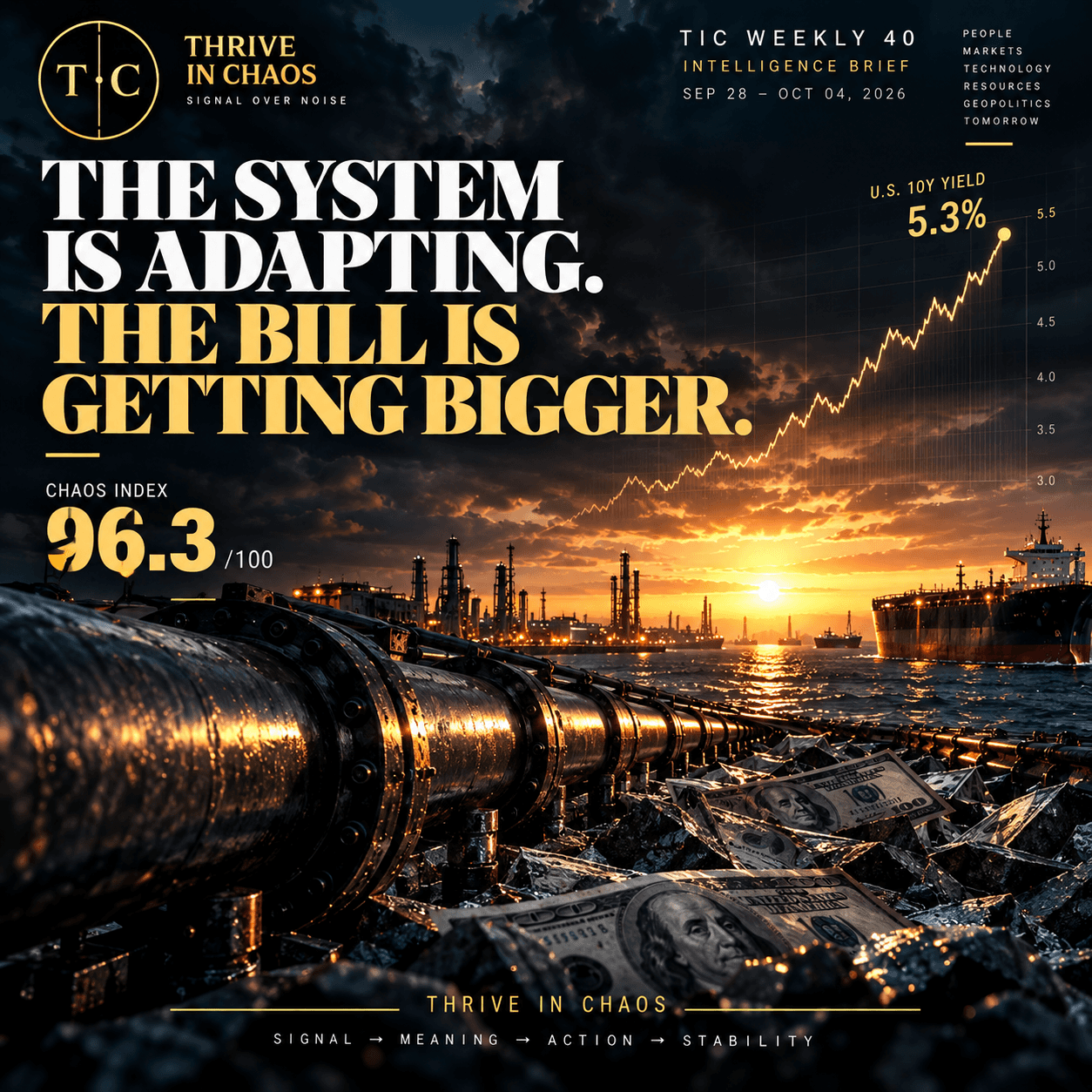
The most important development this week was not another attack, another disruption in the Strait of Hormuz, or another move in oil. It was what happened in the bond market. The U.S. 10-year Treasury yield moved above 5.2% and briefly reached roughly 5.3%. At the same time, Brent remained above $100, the Strait of Hormuz remained constrained, the Red Sea remained strategically contested, and euro-area inflation accelerated again. European gas inventories continued rebuilding, but the improvement in physical buffers has not yet translated into cheaper energy for consumers or easier monetary conditions.
16 min read
THRIVE IN CHAOS — WEEKLY 40 INTELLIGENCE BRIEF
September 28 – October 4, 2026
The Oil Shock Is Becoming a Financing Shock
Chaos Index: 96.3 / 100
Phase: R
System Type: Multipolar Compression — candidate
Adaptation Mode: Defensive — candidate
Signal → Meaning → Action → Stability
1. Executive Summary
The most important development this week was not another attack, another disruption in the Strait of Hormuz, or another move in oil.
It was what happened in the bond market.
The U.S. 10-year Treasury yield moved above 5.2% and briefly reached roughly 5.3%. At the same time, Brent remained above $100, the Strait of Hormuz remained constrained, the Red Sea remained strategically contested, and euro-area inflation accelerated again. European gas inventories continued rebuilding, but the improvement in physical buffers has not yet translated into cheaper energy for consumers or easier monetary conditions.
That combination changes the nature of the problem.
During the first phase of the energy shock, the central question was whether enough oil, gas and shipping capacity would remain available. Governments and companies responded by rerouting cargoes, drawing on alternative pipelines, rebuilding inventories and creating redundancy.
Much of that adaptation is working.
But redundancy is expensive.
Inventories consume working capital. Alternative shipping routes take longer. Insurance rises. Backup infrastructure requires investment. New pipelines, terminals, electricity generation and defence systems require financing. Companies carrying larger inventories need stronger balance sheets.
Now the price of that financing is rising as well.
This creates a second-order constraint:
the system is increasingly able to replace lost capacity, but it is becoming more expensive to finance the replacement.
That is why the movement in long-term interest rates matters more structurally than another few dollars in Brent.
The energy shock is gradually becoming a capital-cost shock.
2. Chaos Index — 96.3
The Week 40 Chaos Index remains at 96.3 / 100.
That does not mean nothing changed.
It means that the changes occurred inside blocks that were already close to their maximum readings. Geopolitical stress, energy disruption, logistics pressure, financial conditions and institutional fragmentation remain simultaneously elevated.
The important signal therefore comes less from the headline number and more from the changing relationship between the blocks.
The previous stored weekly reading already showed that physical buffers were preventing immediate system failure while transferring costs into inflation, financing and institutional risk.
Week 40 strengthens that mechanism.
The system is adapting without becoming materially cheaper or simpler.
That distinction matters because a system can become more resilient operationally while becoming more fragile financially.
3. What Changed This Week
Three developments deserve more attention than the individual headlines surrounding them.
First, long-term U.S. borrowing costs rose sharply. Federal Reserve data put the 10-year Treasury yield at 5.29% on October 1 and 5.24% on October 2, while market reporting showed an intraday move around 5.3%. Federal Reserve H.15 interest-rate data
Second, Europe's physical energy position continued improving while its inflation position deteriorated. EU gas storage reached approximately 72% by October 3, but Eurostat's flash estimate put September euro-area inflation at 3.8%, with energy inflation substantially higher. Gas Infrastructure Europe AGSI+ Eurostat euro-area inflation release
Third, geopolitical fragmentation continued moving from trade restrictions toward control over productive assets. Russia placed Metro AG's Russian assets under temporary administration on September 28, extending the mechanism already seen with other foreign companies.
These are different events, but they point in the same direction.
The world's buffers are becoming more expensive to operate.
4. The Week's Dominant Mechanism
The central chain now looks like this:
Physical disruption → substitution → higher delivered costs → inflation → tighter monetary conditions → higher long-term yields → more expensive adaptation.
This is important because the chain begins to reinforce itself.
A company facing unreliable shipping increases inventories.
Larger inventories require more working capital.
Higher interest rates increase the cost of that working capital.
The company may then raise prices, reduce investment or accept lower margins.
Governments face a similar problem. Strategic inventories, military protection, grid investment, energy infrastructure and industrial policy all require capital at a time when government borrowing is becoming more expensive.
The original physical shock therefore creates a financial aftershock even when the original physical constraint begins to improve.
5. Financial Conditions: The New Constraint
The U.S. Treasury market is increasingly important to the global system because Treasury yields influence the minimum return demanded across much of global capital.
A 10-year Treasury yield around 5.3% changes investment arithmetic.
Projects that looked economically attractive with a risk-free rate around 3–4% may no longer clear their required return. Companies refinancing debt face higher coupons. Infrastructure projects become more expensive. Housing affordability deteriorates. Governments devote more revenue to interest payments.
This matters particularly for the industries the current geopolitical environment requires to expand: energy infrastructure, defence production, semiconductor manufacturing, data centres, power generation, logistics redundancy and strategic inventories.
These are capital-intensive sectors.
The world is asking for more physical resilience at exactly the moment the financial system is making resilience more expensive.
6. Energy: Supply Is Recovering Faster Than Cost
Brent remained above $100 during the week.
That alone does not describe the system accurately.
Some physical supply channels are improving. Saudi Arabia has been rebuilding alternative export capacity, inventories are adjusting, and producers are adapting to disrupted routes.
But physical availability is only one layer of energy cost.
The delivered price also contains freight, insurance, financing, storage, security, rerouting and inventory costs.
That means oil can become physically easier to obtain without returning to its previous economic cost.
This distinction is increasingly important.
Available does not necessarily mean cheap.
7. OPEC+: Stability Rather Than Relief
OPEC+ decided on October 4 to maintain September production requirements for November rather than announce another increase. OPEC official October 4 statement
The decision suggests that producers are not responding to elevated prices with an aggressive attempt to restore a large supply cushion.
More importantly, nominal production quotas should not be confused with usable export capacity.
Physical infrastructure, shipping security and regional disruption determine how much production can actually reach customers.
This means the relevant variable is increasingly not theoretical production capacity but deliverable capacity.
That difference will remain important while regional shipping constraints persist.
8. Hormuz: The Constraint Has Not Disappeared
Iran stated on October 4 that the Strait of Hormuz would not reopen until its conditions were met.
The strategic implication is straightforward.
The system cannot yet assume that the world's most important oil chokepoint is returning to normal operation.
But the more interesting development is what happened around the constraint.
Alternative pipelines became more valuable. Saudi export infrastructure on the Red Sea became more important. Storage became more valuable. Tanker routing changed. Governments increased protection of energy infrastructure.
The system did not stop.
It reorganised.
That is resilience—but resilience purchased through higher complexity and higher cost.
9. Red Sea: The Backup Route Becomes Strategic
The Red Sea and Bab el-Mandeb are increasingly important precisely because other routes are constrained.
Reports this week indicated Saudi preparations for a possible large-scale operation aimed at weakening Houthi control around the Bab el-Mandeb corridor.
Whether such an operation ultimately occurs is less important analytically than the underlying mechanism.
When one corridor becomes unreliable, traffic and strategic importance migrate toward alternatives.
Those alternatives then become more valuable targets.
This produces a recurring pattern:
primary route disrupted → substitute route gains importance → substitute becomes overloaded or contested → another substitute is required.
Redundancy therefore reduces the probability of catastrophic failure while increasing the amount of infrastructure that must be protected.
10. Europe: More Gas, But Not Yet Cheaper Energy
European gas storage provides one of the clearest examples of why physical recovery should not be confused with economic normalization.
By October 3, EU storage was approximately 72.15% full.
Germany remained around 58%, the Netherlands around 60%, Italy close to 88%, and Poland close to full capacity. GIE gas-storage data
This is meaningful improvement.
It reduces the probability of an immediate physical shortage.
But the distribution remains uneven, and storage is not the same thing as inexpensive future supply.
Europe has improved its ability to absorb disruption.
It has not recreated the energy system it had before the current fragmentation cycle.
11. Inflation: The Shock Is Moving Downstream
Eurostat's flash estimate placed September euro-area inflation at 3.8%, compared with 3.2% in August.
Energy inflation was estimated at 18.8%. Eurostat September 2026 flash inflation estimate
This is one of the week's most important pieces of evidence.
Gas inventories are improving while inflation is worsening.
There is no contradiction.
The physical system reacts first. Delivered costs react later. Consumer prices react later still.
The system therefore contains several different clocks.
Markets can begin pricing normalization before infrastructure normalizes.
Infrastructure can recover before delivered costs decline.
Delivered costs can fall before consumers see relief.
Week 40 shows those clocks moving at different speeds.
12. The Normalization Gap
This creates what TIC tracks internally as a normalization gap.
Market expectations have improved modestly.
Physical capacity has improved in parts of the energy system.
But delivered costs remain elevated, while consumer relief is weak or absent.
The public interpretation is simpler:
The supply system is recovering faster than the cost system.
That is why declaring the energy shock “over” would be premature.
The next confirmation must come not from another decline in oil prices, but from freight, insurance, financing and ultimately household and business energy costs.
Until those layers move together, normalization remains incomplete.
13. China: Production Is Recovering
China's official manufacturing PMI returned marginally to expansion in September at 50.1, up from 49.8 in August.
Production reached 51.7 and new orders 50.5. National Bureau of Statistics of China PMI release
At first glance, this is encouraging.
China remains one of the world's largest industrial shock absorbers. Stronger Chinese production can alleviate shortages in manufactured goods, components and industrial equipment.
But the composition matters.
Medium-sized manufacturers remained slightly below the expansion line and smaller companies were weaker still.
The recovery is therefore not broad enough to describe as a generalized industrial acceleration.
14. China's Input-Cost Problem
The same Chinese PMI release contains a less reassuring signal.
The raw-material purchasing-price index reached 60.8, while the factory-gate price index rose to 54.0.
That suggests Chinese producers are themselves absorbing significant upstream price pressure. China NBS PMI commentary
This matters globally.
China has historically helped suppress global goods inflation by combining scale, inexpensive labour, infrastructure and intense domestic competition.
If Chinese producers increasingly face expensive energy, commodities, financing or strategic inputs, part of that inflation-dampening function weakens.
China can continue producing more goods while simultaneously exporting more cost pressure.
15. Russia: Property Rights Become Conditional
Russia's decision to place Metro AG's Russian assets under temporary administration extends a pattern that now deserves treatment as structural rather than exceptional.
The important question is not whether every foreign company operating in Russia will lose control of its assets.
There is no evidence for such a conclusion.
The important development is that control over corporate assets has become another instrument available within geopolitical confrontation.
That changes the meaning of jurisdictional risk.
Companies can no longer assess some markets purely through revenue, costs, taxes and regulatory compliance.
They must also consider whether geopolitical deterioration can alter the practical meaning of ownership.
16. Fragmentation Is Moving Inside the Firm
The first stage of geopolitical fragmentation was mainly external to companies.
Tariffs increased.
Sanctions expanded.
Export controls tightened.
Shipping routes changed.
The next stage increasingly reaches inside corporate structures themselves.
Governments can restrict technology transfers, control local subsidiaries, freeze assets, require localization, impose data rules or change ownership conditions.
The corporate response is predictable: more regional duplication.
Separate supply chains.
Separate data infrastructure.
Separate inventories.
Separate financing structures.
Sometimes separate legal entities.
That increases resilience against geopolitical separation.
It also destroys some of the efficiency created during the previous era of globalization.
17. Ukraine–Russia: Infrastructure Becomes the Battlefield
The conflict continued expanding pressure against logistics and energy infrastructure.
Russia intensified attacks affecting transport and infrastructure around Ukraine, while Ukraine has continued targeting Russian oil-processing capacity.
The strategic logic on both sides increasingly extends beyond immediate battlefield destruction.
Infrastructure attacks affect the opponent's ability to finance, supply and sustain the conflict.
This is especially important because modern economies contain enormous numbers of relatively vulnerable nodes: refineries, substations, pipelines, storage sites, ports, railway junctions and telecommunications facilities.
Protecting all of them simultaneously is extremely expensive.
This produces an asymmetric problem.
The cost of attacking infrastructure can be far lower than the cost of defending every potential target.
18. Cheap Attack, Expensive Defence
That asymmetry extends well beyond Ukraine.
Drones, autonomous navigation, inexpensive electronics and increasingly capable AI lower the technological barrier to attacking infrastructure.
Defence moves in the opposite direction.
A refinery cannot simply install one air-defence system and consider itself protected.
Governments must protect airports, ports, power plants, transmission grids, data centres, fuel storage, water systems, telecommunications and transport infrastructure.
The attacker chooses the target.
The defender must anticipate thousands of possible targets.
This is why technological diffusion can increase system protection costs even when individual defensive technologies improve.
19. AI Is Becoming Strategic Infrastructure
AI security developments this week reinforce the same broader trend.
Political attention in Washington increasingly focuses on protecting model weights and sensitive AI capabilities from unauthorized foreign access.
That represents an important conceptual transition.
Advanced AI models are increasingly treated less like ordinary software and more like strategic infrastructure.
The same security logic already applied to advanced semiconductors is moving upward through the technology stack:
chips → data centres → energy → models → model weights → applications.
Each layer depends on the others.
The result is a growing overlap between AI policy, industrial policy, national security and energy policy.
20. AI Also Changes the Cost of Coercion
The strategic importance of AI is not limited to the value of the models themselves.
AI also reduces the cost of performing complex tasks.
That includes legitimate industrial work, but also cyber operations, autonomous systems, surveillance, targeting and information operations.
This creates an uncomfortable asymmetry.
AI can make infrastructure more efficient.
At the same time, it can make infrastructure easier to attack.
The resulting security expenditure is therefore unlikely to disappear simply because AI improves productivity.
Part of AI's productivity dividend may need to be spent protecting the systems that AI makes more valuable—and potentially more vulnerable.
21. The Fiscal Layer
The same pressure is increasingly visible at the government level.
Governments are being asked simultaneously to finance defence, energy security, infrastructure, industrial policy, aging populations and higher interest payments.
These demands were manageable when sovereign borrowing costs were exceptionally low.
They become more difficult when long-term yields rise toward 5% or higher.
Fiscal capacity therefore becomes another strategic resource.
Countries with deep capital markets, credible institutions and productive tax bases will have greater ability to finance redundancy.
Countries already carrying high debt and weak growth will face harder trade-offs.
The next phase of geopolitical competition may therefore depend not only on who possesses resources or technology, but on who can finance adaptation for longer.
22. Why Markets Can Look Calm
One of the more counterintuitive features of the current environment is that markets do not necessarily behave as if the global system is approaching immediate failure.
That should not be dismissed as irrationality.
Markets can distinguish between catastrophic failure and expensive adaptation.
If Saudi Arabia reroutes oil, Europe rebuilds gas inventories, companies diversify suppliers and governments protect infrastructure, the probability of immediate collapse declines.
Assets can therefore stabilize.
But somebody still pays for the redundancy.
That cost can appear later in corporate margins, taxes, insurance, interest rates and consumer prices.
Market stabilization is not the same thing as system normalization.
23. The Real Scarcity Is Optionality
The deeper pattern emerging from Week 40 is that the most valuable resource is increasingly not any individual commodity.
It is optionality.
A country with several energy suppliers has more optionality.
A company with two genuinely independent supply chains has more optionality.
A household with liquidity and low debt has more optionality.
A government with fiscal capacity has more optionality.
A business with cheap access to capital has more optionality.
Fragmentation becomes dangerous when alternatives disappear faster than actors can create new ones.
Chaos, in this sense, is not simply the number of crises.
It is the rising cost of the next decision because the number of acceptable alternatives is shrinking.
24. What Could Prove This Analysis Wrong
Several developments would weaken the Week 40 thesis.
A sustained fall in Brent accompanied by lower freight and insurance costs would indicate that physical recovery is genuinely moving downstream.
A meaningful decline in long-term U.S. yields would reduce the capital-cost constraint.
A reopening or durable stabilization of Hormuz would materially improve global energy optionality.
European inflation could fall faster than expected as the energy shock works through the system.
China's industrial recovery could broaden from larger manufacturers toward smaller firms without continued input-price pressure.
If several of these occur together, the current normalization gap would begin closing.
We are not there yet.
25. Scenario Lab — Next 7–30 Days
The base case, at 44%, is High-Cost Stabilization. Physical energy supply continues adapting, acute shortages remain contained, but oil, insurance, logistics and financing remain expensive. Chaos stays high without requiring another major shock.
The second scenario, at 30%, is a Financial Conditions Squeeze. Long-term yields become the dominant transmission channel. Refinancing, housing, infrastructure and capital-intensive investment weaken even if energy availability improves.
The third scenario, at 18%, is Multi-Corridor Re-escalation. A material disruption around Hormuz, Bab el-Mandeb, the Black Sea or another critical infrastructure node reverses part of the physical recovery and pushes energy risk higher again.
Only 8% is assigned to Broad Operational Normalization over the next month. That scenario requires several layers to improve together: physical throughput, freight, insurance, energy prices, financing conditions and end-user costs.
A decline in Brent alone would not be enough.
26. Forecast Gate
Week 40 provides strong criterion-relevant evidence for an existing forecast.
W38-F3801 — Candidate HIT
The forecast asked whether Russia would place the assets of at least one additional foreign-owned consumer, retail, food or industrial company under presidential temporary administration by October 20.
Metro AG's Russian assets were placed under temporary administration on September 28.
The underlying condition therefore appears satisfied.
Status: Candidate HIT — Founder resolution required.
The Forecast Ledger also contains several older questions whose deadlines have passed. They remain resolution debt rather than being silently converted into Hits or Misses. That distinction is important because forecast calibration becomes meaningless if criteria are relaxed after outcomes become known.
New W40 Forecast Candidate
Will aggregate EU gas storage reach or exceed 75.0% on any reported gas day on or before October 31, 2026?
Probability: 68%
The starting point is approximately 72.15% on October 3.
The question is intentionally narrow. It does not ask whether Europe will have “enough gas,” whether winter will be mild, or whether energy prices will fall.
It asks about one measurable physical buffer.
That separation matters because the Week 40 thesis specifically argues that physical recovery and economic normalization are no longer moving together.
27. Recommendations
Individuals
The priority is not forecasting the next oil price.
It is preserving room to make decisions.
By October 11, recalculate one month of essential expenses using actual current utility, fuel, food, housing and debt-service costs rather than an older budget.
If that amount has increased, preserve the larger liquidity buffer before making discretionary debt-funded purchases.
The purpose is not to accumulate cash indefinitely. It is to avoid being forced to borrow at the same moment that borrowing becomes more expensive.
The action is highly reversible. The cost is mainly foregone yield or delayed consumption.
Business
Businesses dependent on international inputs should stop treating a backup supplier or route as sufficient evidence of resilience.
A backup is useful only if it is genuinely usable.
By October 12, price one critical flow through both the primary route and an independent alternative. Include freight, insurance, financing, inventory carrying cost and additional transit time.
The important number is not the commodity price.
It is the delivered cost of continuity.
Maintain the alternative until that cost gap narrows consistently rather than assuming that improving benchmark prices mean the supply chain has normalized.
Capital
The operational capital rule remains internal under the current TIC Forecast/Recommendation track-record gate.
The public analytical principle is nevertheless clear: assets that benefit from lower market fear are not necessarily the same assets that benefit from lower financing costs.
A market can become calmer while the real economy continues paying more for capital.
Those two conditions should not be treated as interchangeable.
28. Decision Intelligence — What This Week Actually Means
The global system is demonstrating more resilience than a simple crisis narrative would suggest.
Oil is still moving.
Gas storage is rebuilding.
Factories continue producing.
Alternative shipping routes are being used.
Companies are finding substitute suppliers.
Governments are building new infrastructure.
That is the good news.
The problem is that nearly every adaptation consumes additional capital.
A company can survive expensive oil if financing is cheap.
It can survive expensive financing if energy and logistics are stable.
It becomes considerably more vulnerable when energy, logistics, insurance and financing all become expensive at the same time.
This is where Week 40 changes the picture.
The world is not simply experiencing an energy shock anymore.
It is beginning to experience the financing consequences of adapting to the energy shock.
And the mechanism extends beyond energy.
Defence requires capital.
AI infrastructure requires capital.
Power grids require capital.
Semiconductor fabs require capital.
Strategic inventories require capital.
Supply-chain duplication requires capital.
Infrastructure protection requires capital.
The next constraint may therefore not be whether the world possesses the technology or physical resources required to adapt.
It may increasingly be whether governments, businesses and households can afford to finance that adaptation without sacrificing investment, consumption or fiscal stability elsewhere.
That creates a different kind of fragility.
Not immediate collapse.
Not universal shortage.
Not financial panic.
Something slower and potentially more persistent:
a world that continues functioning, but requires progressively more resources simply to maintain the same level of reliability.
That is the signal to watch after Week 40.
Forecast Direction
Over the next several weeks, the most important question is whether the normalization process moves beyond physical capacity.
If oil falls but long-term yields remain high, the constraint has migrated.
If gas storage rises but household energy inflation remains high, the constraint has migrated.
If shipping resumes but insurance and freight remain structurally expensive, the constraint has migrated.
If companies maintain production but require larger inventories and more working capital, the constraint has migrated.
The system does not need another spectacular crisis for pressure to increase.
It only needs the cost of maintaining resilience to continue rising faster than the resources available to pay for it.
That is the central W40 risk.
WEEK 40 — SIGNAL SUMMARY
Chaos Index: 96.3 / 100
EWMA: 95.04
Phase: R
System Type candidate: Multipolar Compression
Adaptation Mode candidate: DEFENSIVE
Dominant interaction: Finance × Logistics
Secondary interaction: Geopolitics × Energy
Base scenario: High-Cost Stabilization — 44%
Core signal: Physical adaptation is working faster than economic normalization.
Core meaning: The shock is migrating from availability toward delivered cost and financing.
Decision implication: Preserve optionality rather than assuming that improving physical supply means the system has returned to normal.
TIC assessment: Early normalization signal — system confirmation pending.
Signal Over Noise
The important question after Week 40 is no longer simply:
Can the system keep functioning?
Increasingly, the answer is yes.
The more important question is:
How much will it cost to keep it functioning—and who has enough financial, institutional and human capacity to keep paying that cost?
That is where the next stage of the adjustment is likely to be decided.
Join the newsletter
Be the first to read our articles.


