DAILY PULSE | August 22, 2026
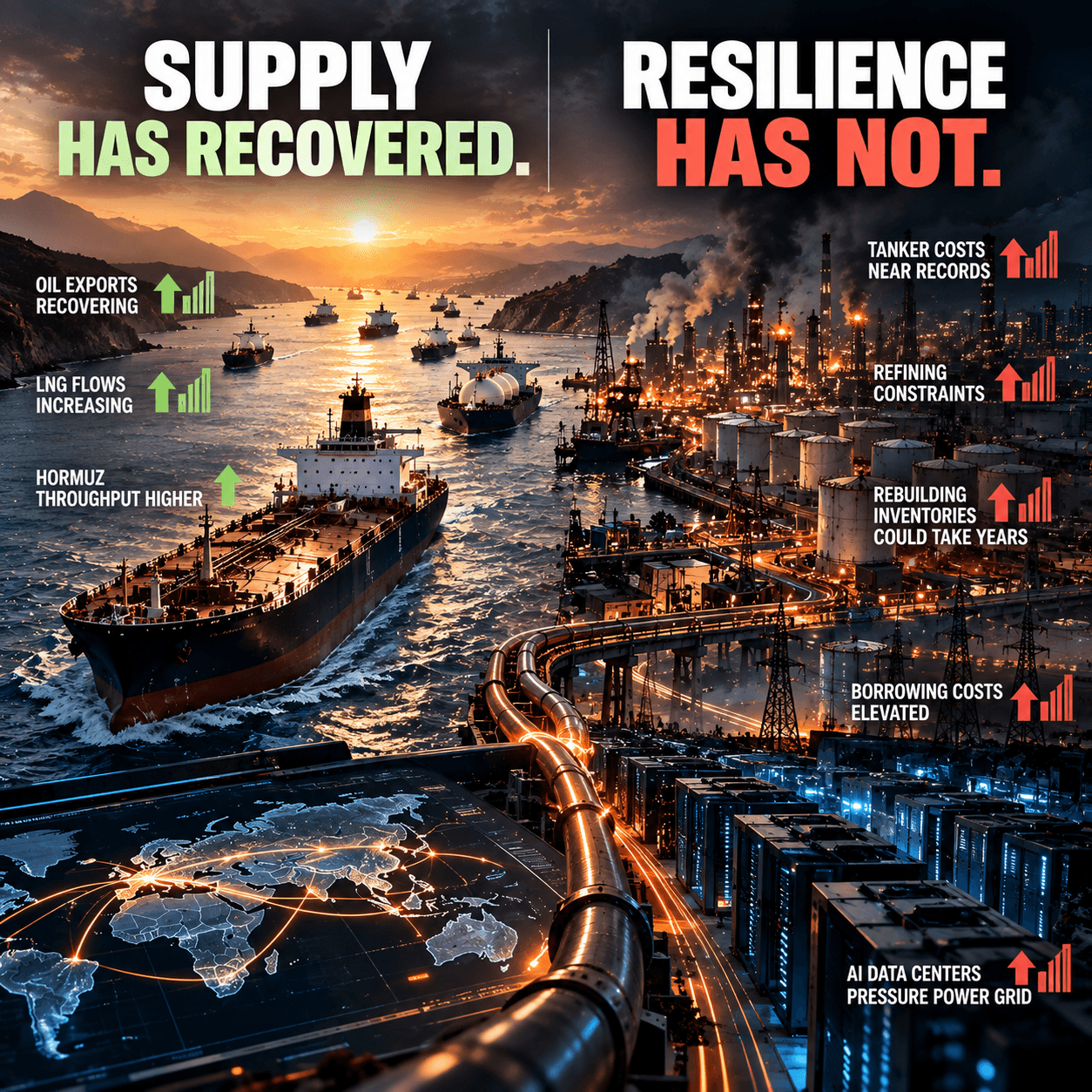
Iran has granted special permission for a number of Iraqi oil tankers to pass through the Strait of Hormuz after repeated requests from Baghdad. At the same time, broader traffic through the strait remains severely impaired. Recent vessel-tracking data showed commodity-ship crossings in single digits on some days, far below normal conditions.
13 min red

THRIVE IN CHAOS — DAILY PULSE
August 22, 2026
Chaos Index: 92.5 / 100 🔴
Phase: R — Systemic Risk
System Type: Multipolar Compression
The Route Is Open. Access Isn’t.
When critical infrastructure becomes permissioned, physical availability stops guaranteeing economic access.
The most important development today is not that another strategic route has closed.
It is that a route can remain open while access to it becomes selective.
Iran has granted special permission for a number of Iraqi oil tankers to pass through the Strait of Hormuz after repeated requests from Baghdad. At the same time, broader traffic through the strait remains severely impaired. Recent vessel-tracking data showed commodity-ship crossings in single digits on some days, far below normal conditions.
This creates a different type of systemic risk.
The conventional model of a chokepoint is binary:
open → trade flows
or
closed → trade stops
The emerging model is more complicated:
the route exists → access is controlled → permission becomes differentiated → economic outcomes diverge
That distinction matters far beyond Hormuz.
It suggests that one of the characteristics of a more fragmented global system may be the emergence of permissioned infrastructure: transport routes, payment systems, technologies, markets and supply networks that remain operational but are no longer equally accessible to every participant.
The physical system survives.
The neutral system does not.
And that changes how resilience must be built.
1. Executive Assessment
The Chaos Index remains at 92.5, firmly inside the RED systemic-risk phase.
Today does not justify another mechanical increase in the index.
That is important.
A high-frequency intelligence system becomes unreliable if every new headline automatically produces a higher score. Several TIC domains are already operating near their practical ceiling. New developments must therefore be assessed primarily by whether they change the mechanism, transmission path or persistence of instability, rather than simply whether they sound serious.
Today’s Hormuz development does exactly that.
It does not materially increase the magnitude of disruption already embedded in the index.
Instead, it reveals how the system is beginning to adapt.
And the adaptation itself contains risk.
Iran’s selective authorization of Iraqi tanker traffic demonstrates that a heavily impaired strategic corridor can begin functioning through negotiated exceptions rather than through restoration of neutral access.
This is not normalization.
It is selective functionality.
The distinction will become increasingly important.
2. The Primary Signal
The primary signal today is:
Access to critical infrastructure is becoming conditional even when the infrastructure itself remains operational.
Iraq did not regain normal access to Hormuz because the underlying security problem disappeared.
It obtained special permission.
Baghdad had repeatedly requested passage, and the issue formed part of discussions surrounding Iranian parliamentary speaker Mohammad Baqer Qalibaf’s visit to Iraq.
That means access became a negotiated political outcome.
This transforms the nature of the dependency.
Before the crisis:
geography determined access.
During the initial disruption:
security determined access.
Under the emerging arrangement:
political permission increasingly determines access.
The physical geography has not changed.
The institutional geography has.
3. What Actually Changed Today
Three developments matter.
First, Iran demonstrated that its restriction of Hormuz is not necessarily an indiscriminate physical closure.
It can differentiate between participants.
Second, Iraq demonstrated that countries exposed to the chokepoint are beginning to respond through a combination of diplomacy and route diversification.
Baghdad is simultaneously examining or expanding export options through Turkey’s Ceyhan port, Syria’s Baniyas port and Jordan’s Aqaba port.
Third, the United States is preparing another major economic-pressure package against Iran, but the actual sanctions architecture has not yet been published. Treasury Secretary Scott Bessent is expected to provide details on Monday.
Together, these signals point toward a system that is neither returning to normal nor collapsing completely.
Instead, it is reorganizing around:
permissions, exemptions, bilateral arrangements, alternative routes and higher transaction costs.
4. Why This Matters More Than the Headline
The headline is about Iraqi tankers.
The mechanism is much larger.
Modern globalization assumed that infrastructure was broadly neutral.
A commercial participant might face tariffs, regulation or price differences, but once inside the system, major infrastructure was generally expected to operate according to relatively predictable rules.
Ports worked.
Shipping lanes worked.
Payment networks worked.
Insurance worked.
Telecommunications worked.
Markets cleared.
That assumption is becoming less reliable.
The emerging question is increasingly not:
Does the infrastructure exist?
It is:
Do you retain the right, authorization and practical ability to use it?
That difference is fundamental.
5. From Chokepoint Risk to Permission Risk
Traditional geopolitical analysis focuses heavily on physical chokepoints.
Hormuz.
Bab el-Mandeb.
Suez.
Malacca.
Panama.
But physical closure is only one form of vulnerability.
A corridor can remain technically open while becoming commercially fragmented.
The new transmission mechanism looks like this:
security control
↓
selective authorization
↓
differentiated access
↓
bilateral negotiation
↓
compliance complexity
↓
alternative-route investment
↓
higher switching costs
↓
reduced optionality
This matters because the system can appear to be recovering while becoming structurally less efficient.
6. The Optionality Problem
For THRIVE IN CHAOS, the critical variable is not simply disruption.
It is optionality.
Chaos increases when the cost of the next decision rises because available alternatives shrink or become more expensive.
Selective access produces exactly that effect.
An Iraqi tanker may now pass.
That appears positive.
But the deeper question is:
What happens if permission is withdrawn?
If access depends on discretionary authorization, continuity cannot be treated as permanent.
The participant must therefore maintain alternatives.
Those alternatives cost money.
Redundant routes.
Additional inventories.
Alternative suppliers.
Extra financing.
Different insurers.
More compliance capacity.
Multiple jurisdictions.
The system remains functional—but maintaining optionality becomes more expensive.
7. Why Iraq Matters
Iraq is especially revealing because it illustrates the vulnerability of countries whose infrastructure was designed for a more predictable regional environment.
Before the Iran war, Iraq produced roughly 4 million barrels of oil per day and relied heavily on Gulf export infrastructure. The disruption of Hormuz therefore created an immediate strategic problem.
Its response is instructive.
Baghdad is not relying on a single solution.
It is simultaneously pursuing:
diplomatic permission through Hormuz;
greater use of Turkey’s Ceyhan route;
potential access through Syria;
potential access through Jordan.
This is resilience through route multiplication.
But route multiplication is not free.
Each alternative requires infrastructure, agreements, security arrangements, financing and time.
Resilience therefore replaces efficiency as the optimization target.
8. The Emerging Infrastructure Regime
The deeper structural shift can be summarized as:
Open Infrastructure → Controlled Infrastructure → Permissioned Infrastructure
In an open system, participation is primarily economic.
In a controlled system, participation is regulated.
In a permissioned system, participation can become discretionary.
This distinction is increasingly relevant to:
shipping;
energy;
payments;
semiconductors;
cloud infrastructure;
AI systems;
critical minerals;
technology licensing;
financial clearing;
data infrastructure.
The same pattern does not need to appear identically in every sector.
What matters is the underlying mechanism:
availability and accessibility are separating.
9. Why Markets Can Misread This
Markets often respond positively when disrupted infrastructure partially resumes operation.
That reaction is understandable.
More ships moving is better than fewer ships moving.
But partial restoration through political exemptions should not automatically be interpreted as normalization.
There are two different recovery paths.
Path A — Normalization
Security improves.
Rules become predictable.
Traffic returns.
Insurance costs decline.
Access becomes neutral again.
Path B — Selective adaptation
Security remains unstable.
Traffic partially returns.
Special permissions expand.
Participants negotiate individually.
Alternative infrastructure develops.
Costs remain structurally elevated.
Today’s evidence is more consistent with Path B.
10. Energy Implications
Hormuz remains one of the most consequential energy corridors in the world.
Before the conflict, the strait handled close to one-fifth of global crude oil and LNG flows. Recent traffic has been dramatically lower, with commodity-ship crossings falling to single digits on some days.
The critical energy question is therefore no longer simply:
Will Hormuz reopen?
A more useful question is:
What percentage of previous flows can return under a selective-access regime, and at what cost?
If exemptions expand, physical supply may recover faster than political stability.
That could reduce immediate scarcity while preserving a geopolitical risk premium.
This is an important distinction for energy markets.
11. The Insurance Layer
Permissioned access creates a second-order problem.
Authorization by a state does not automatically eliminate commercial risk.
A ship may have permission to pass and still face:
security risk;
insurance exclusions;
higher premiums;
crew risk;
financing restrictions;
sanctions exposure;
counterparty uncertainty.
This means political permission does not necessarily restore the full commercial infrastructure surrounding the route.
Shipping is an ecosystem.
A vessel requires more than water beneath its hull.
It requires financing, insurance, legal certainty, port access, crews and counterparties.
The corridor can therefore be physically accessible while remaining economically impaired.
12. The Sanctions Layer
The next major Iran-related input is expected from Washington.
U.S. officials have signalled a substantial expansion of economic pressure, with Treasury Secretary Scott Bessent expected to outline the measures on Monday.
This creates an important analytical discipline.
Announcement is not implementation.
At the time of this Daily Pulse, the full legal instrument, targets, exemptions and enforcement architecture had not yet been published.
Therefore TIC does not score the anticipated package as though it were already operational.
Expectations can influence behaviour.
But Forecast and Index systems must distinguish:
rhetoric
from
policy announcement
from
legal implementation
from
enforcement
from
measurable economic effect.
Collapsing these stages produces false precision.
13. Why the U.S. Sanctions Package Could Matter
If the forthcoming measures substantially expand secondary sanctions, the impact could extend beyond Iran itself.
The important variable would be enforcement against third-country participants.
That could affect:
Chinese buyers;
shipping intermediaries;
financial institutions;
commodity traders;
insurers;
ports;
payment networks.
In that case, the conflict would increasingly move from physical geography into financial geography.
The Strait of Hormuz would remain one control point.
Access to the dollar system, insurance and international settlement could become others.
This would deepen the permissioned-system dynamic.
But until the legal structure is published, this remains a scenario rather than a confirmed scored event.
14. Ukraine: A Separate Signal With the Same Structural Logic
France also agreed today to accelerate air-defence equipment and missile deliveries to Ukraine following discussions between Presidents Emmanuel Macron and Volodymyr Zelenskyy.
On the surface, this is unrelated to Hormuz.
Structurally, however, it reflects the same broader environment.
Systems exposed to persistent instability are shifting from optimization toward resilience.
France and Ukraine had already established a deeper framework for air and missile defence cooperation, including SAMP/T-NG systems, Aster 30 missiles and licensed production arrangements.
The direction is important:
temporary supply → persistent capacity → local production → structural redundancy.
Again, resilience is being institutionalized.
15. The Common Pattern
Hormuz and Ukraine are geographically separate.
The underlying adaptation pattern is similar.
When instability becomes persistent, systems stop waiting for the old environment to return.
They redesign themselves.
Iraq seeks alternative oil routes.
Ukraine seeks local missile-production capacity.
Europe expands defence-industrial capacity.
Companies diversify supply chains.
States create strategic inventories.
Financial institutions strengthen sanctions compliance.
The system becomes more redundant.
But also more expensive.
That is one of the central characteristics of the emerging global economy:
resilience is increasing because efficiency is becoming less reliable.
16. First-Order Effects
The immediate effects are relatively straightforward.
Hormuz traffic remains heavily impaired.
Selected Iraqi tankers receive access.
Iraq gains some export relief.
Alternative export routes become more strategically valuable.
Shipping and insurance risk remain elevated.
Washington prepares additional sanctions.
Ukraine receives commitments for accelerated air-defence support.
None of these individually changes the global system.
Together, they show how actors are adapting to persistent instability.
17. Second-Order Effects
The second-order effects are more consequential.
Companies begin treating political access as a variable rather than a constant.
Governments invest in redundant infrastructure.
Trade routes become less purely economic.
Insurance becomes more politically sensitive.
Compliance costs increase.
Inventory buffers rise.
Working-capital requirements increase.
Strategic relationships acquire commercial value.
The consequence is subtle:
the world can continue functioning while becoming systematically more expensive.
This is one reason GDP or market performance alone may fail to capture declining system quality.
18. Third-Order Effects
The third-order effect is fragmentation of access itself.
If permissioned infrastructure expands across multiple domains, global commerce does not necessarily disappear.
Instead, it separates into overlapping access networks.
Participants may increasingly ask:
Which payment networks can we use?
Which shipping corridors can we access?
Which AI systems are permitted?
Which semiconductor architectures can we buy?
Which currencies can settle the transaction?
Which insurers will cover it?
Which jurisdictions will clear it?
Which cloud infrastructure can host it?
The future system may therefore be less defined by borders than by access rights.
19. Chaos Index — August 22
Final Chaos Index: 92.5 / 100
Phase: RED
The current domain vector remains:
A — 10.0
B — 9.5
C — 9.5
D — 7.0
E — 9.0
F — 8.5
G — 10.0
H — 10.0
I — 9.5
J — 7.5
K — 8.0
Elevated domains: 11 / 11
The important point today is not movement in the headline number.
It is movement inside the system.
The new Hormuz evidence strengthens the interaction between security stress and trade/energy access.
It does not justify repeatedly increasing blocks that are already at or near their practical ceilings.
20. Why the Index Does Not Rise Today
This is an important methodological point.
A Chaos Index should measure the condition of the system.
It should not measure the volume of alarming news.
If Block A is already at 10.0, another event inside the same stress regime cannot mechanically push it to 11.
Instead, we ask whether the new information:
changes another domain;
creates a new transmission channel;
increases persistence;
changes scenario probabilities;
or invalidates an earlier assumption.
Today’s Hormuz development primarily changes our understanding of the transmission mechanism.
The stress is becoming selective rather than simply universal.
That is analytically important even though CI remains 92.5.
21. What Is Signal and What Is Noise
SIGNAL
Selective permission for Iraqi tankers.
Persistently depressed Hormuz traffic.
Iraq developing alternative export routes.
Forthcoming U.S. sanctions architecture.
Accelerated European air-defence adaptation.
NOISE
Every hostile political statement.
Every repetition of previously known military threats.
Every market move without evidence of structural transmission.
Every sanctions headline before the actual legal mechanism exists.
Every temporary movement in shipping traffic treated as proof of normalization.
The objective is not to react faster.
It is to distinguish system change from information volume.
22. Scenario Matrix — 7 to 30 Days
Scenario 1 — Managed Selective Access
Probability: 45%
Iran expands exemptions or negotiated permissions for selected countries and cargoes.
Hormuz remains impaired but increasingly functional.
Oil flows recover partially.
Insurance and compliance costs remain elevated.
Iraq and other exposed states continue building alternatives.
System effect: pressure stabilizes at a high level rather than disappearing.
This is currently the base case.
Scenario 2 — Renewed Escalation
Probability: 30%
Sanctions escalation, enforcement actions or military incidents trigger renewed confrontation.
Selective permissions narrow.
Shipping traffic falls again.
Energy risk rises.
Secondary sanctions broaden the economic transmission channel.
System effect: CI could move above the current 92.5 level if the escalation generates genuinely new cross-domain stress rather than simply repeating existing conditions.
Scenario 3 — Negotiated Decompression
Probability: 20%
Economic pressure creates enough incentive for limited diplomatic arrangements.
Shipping access broadens.
Traffic begins recovering.
Security risk declines incrementally.
System effect: the index could begin moving lower, but only after observable normalization rather than political statements alone.
Scenario 4 — Rapid Normalization
Probability: 5%
A broader political agreement restores substantially neutral access through Hormuz and materially reduces confrontation.
System effect: significant downward reassessment across security, energy and trade blocks.
This remains the least likely near-term scenario.
23. Forecast Gate
New Forecasts Opened Today: 0
No new formal forecast is opened.
Why?
Because today’s evidence modifies an existing mechanism more than it creates an independent forecastable event.
Creating a new forecast every time the mechanism gains another data point would inflate the Forecast Engine and reduce its usefulness.
Instead, today’s information updates the existing outlook:
Selective access and higher-cost adaptation are likely to preserve system function while reducing neutrality and increasing transaction-specific dependency.
Horizon
7–30 days
Confidence
Medium-High
What would strengthen this assessment?
Additional country-specific exemptions.
Persistent bilateral negotiations over corridor access.
Continued investment in alternative export infrastructure.
Shipping flows recovering without restoration of neutral access.
What would weaken it?
Broad restoration of unrestricted commercial transit.
Sustained decline in security incidents.
Falling insurance premiums.
A durable political settlement.
24. Watch Next
The most important next signal is not another speech.
It is the actual U.S. sanctions instrument.
Watch:
the legal scope;
named entities;
secondary-sanctions provisions;
treatment of Chinese counterparties;
shipping restrictions;
financial enforcement;
exemptions;
implementation dates.
Second, watch Hormuz traffic.
Not one day.
The trend.
The distinction between:
more ships
and
more neutral access
will matter.
Third, watch Iraq.
If Baghdad continues investing in Ceyhan, Baniyas and Aqaba despite improved Hormuz access, that would confirm that policymakers themselves do not regard the current permission as sufficient long-term resilience.
Fourth, watch insurance.
A decline in security risk should eventually appear in commercial pricing.
If traffic rises but insurance remains structurally expensive, normalization is incomplete.
25. Recommendations
Individuals
The lesson from Hormuz is not that individuals should react directly to tanker movements.
The relevant lesson is dependency.
Identify one important recurring dependency in your own system that is available today but could become permission-dependent.
This could involve:
payments;
banking;
digital services;
cross-border transfers;
cloud storage;
travel access;
energy;
communications.
Do not build ten backups.
Build one independent alternative for the dependency whose loss would most reduce your optionality.
Time horizon: next 30 days.
The objective is not maximum redundancy.
It is avoiding a single permission point.
Business
Map one critical operational chain:
supplier → transport → payment → insurance → jurisdiction → customer
Then identify where continuity depends on discretionary permission rather than physical availability.
The most dangerous dependency is not always the supplier.
It may be:
the payment rail;
shipping insurance;
export authorization;
port access;
software license;
cloud provider;
banking intermediary.
For the most critical permission point, calculate:
replacement cost;
switching time;
working-capital requirement;
inventory requirement;
legal constraints.
Time horizon: 30–90 days.
Do not diversify everything.
Diversify the dependency with the highest combination of impact × switching time × permission risk.
Capital
Separate infrastructure exposure into two categories.
Category 1: physically constrained assets
Capacity is the primary bottleneck.
Category 2: permission-constrained assets
Capacity exists, but access depends on politics, regulation, sanctions or security.
The second category requires a different risk premium.
Stress-test exposures for:
delayed authorization;
higher insurance;
sanctions compliance;
forced rerouting;
working-capital expansion;
jurisdictional fragmentation.
Time horizon: immediate portfolio review; 6–24 month structural horizon.
The key investment question is increasingly not only:
What asset is scarce?
It is:
Who retains reliable access to it?
26. The Decision Intelligence Test
Today’s decision-intelligence question is:
Where in your system are you confusing availability with access?
That distinction is becoming strategically important.
A route can exist.
A bank can exist.
A supplier can exist.
A technology can exist.
A market can exist.
But your ability to use it may depend on:
permission;
jurisdiction;
political alignment;
compliance;
insurance;
identity;
contractual status.
A resilient system therefore does not merely ask:
“Is the resource available?”
It asks:
“Under what conditions do I retain access?”
That is a higher-quality decision question.
27. One Decision for Today
Choose one critical dependency.
Write down three things:
1. What do I depend on?
2. Who can restrict my access to it?
3. What independent alternative exists outside that same control point?
If question three has no answer, you have identified a concentration of optionality risk.
Do not solve the entire system today.
Solve that dependency first.
28. Final Assessment
The most important signal on August 22 is not that Hormuz is reopening.
It is not.
Nor is the most important signal that Iran has completely closed it.
That description is increasingly incomplete.
Something more structurally interesting is happening.
The corridor is becoming permissioned.
Selected participants can gain access through political negotiation while broader traffic remains impaired. Iraq is simultaneously seeking alternative export routes. Washington is preparing another layer of economic pressure. Europe is accelerating defence adaptation elsewhere.
These developments point toward a global system that is learning to function under persistent instability.
That sounds positive.
But there is a cost.
The new system requires:
more redundancy;
more inventory;
more diplomacy;
more compliance;
more capital;
more infrastructure;
more alternative routes.
In other words:
the system becomes more resilient by becoming less efficient.
And as neutral access weakens, the value of optionality rises.
This is why the Chaos Index can remain at 92.5 even when parts of the system appear to adapt successfully.
Adaptation does not necessarily mean that chaos is falling.
Sometimes adaptation means the system has accepted that instability is becoming persistent.
The route is open.
Access isn’t.
And increasingly, that distinction is where the real risk lives.
THRIVE IN CHAOS
Decision Intelligence for an Uncertain World
Analysis → Forecast → Recommendations
Signal → Meaning → Action → Stability
Signal Over Noise
THRIVE IN CHAOS is an AI-assisted Decision Intelligence System with human editorial oversight. The Chaos Index is an analytical framework, not a financial forecast or investment recommendation
Join the newsletter
Be the first to read our articles.