

TIC Weekly 34 Intelligence Brief |
Geopolitical, energy and trade stress were already close to their effective ceilings. The additional deterioration came through other parts of the system: financial conditions, physical buffers and institutional constraints.
16 min red
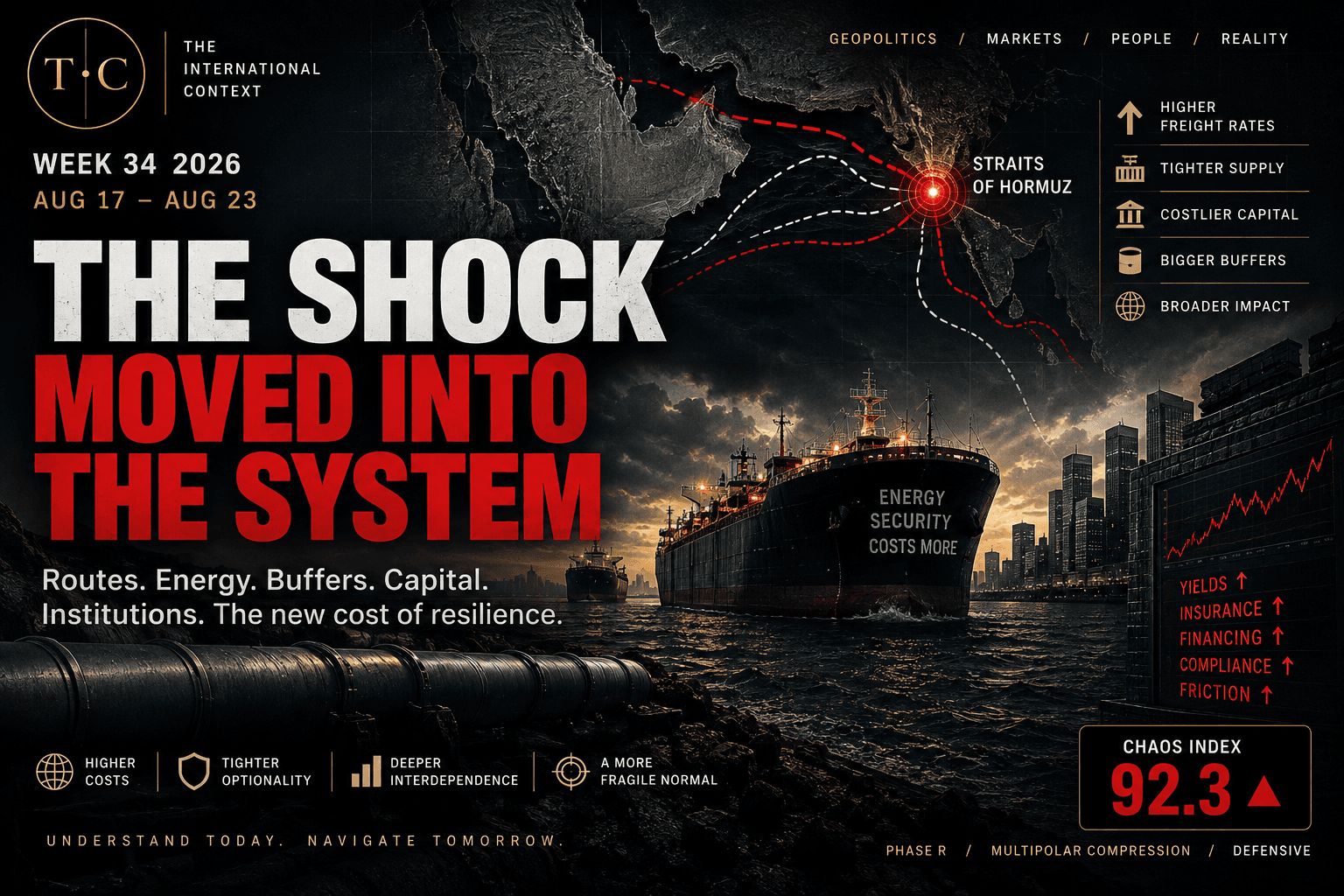
Chaos Index 92.3: The Shock Moved Into the System
THRIVE IN CHAOS — WEEKLY INTELLIGENCE BRIEF
Week 34 of 2026 | August 17–23, 2026
Chaos Index: 92.3 🔴
Previous Week: 91.0
Weekly Change: +1.3
Phase: R
System Type: Multipolar Compression
Adaptation Mode: DEFENSIVE
Confidence: High
Core Signal: The shock is no longer concentrated at the event layer. It is moving into the cost of keeping the system functioning.
Executive Summary
Week 34 did not produce a single event large enough to explain the rise in the THRIVE IN CHAOS Index from 91.0 to 92.3.
That is precisely why this week matters.
The dominant development was transmission.
Geopolitical, energy and trade stress were already close to their effective ceilings. The additional deterioration came through other parts of the system: financial conditions, physical buffers and institutional constraints.
The mechanism increasingly looks like this:
Restricted access → substitution → higher delivered cost → buffer consumption → higher financing cost → institutional intervention → temporary functional stability.
The final step is important.
Intervention can keep a system functioning without returning it to its previous state.
Ships can still move while shipping becomes more expensive.
Energy can still reach consumers while inventories and alternative routes are consumed.
Financial markets can remain liquid while long-term capital remains expensive.
Companies can continue operating while sanctions, compliance requirements and payment restrictions force them to maintain duplicate infrastructure.
The result is not immediate systemic breakdown.
It is something more subtle:
the cost of preserving optionality is rising.
That is the central signal of Week 34.
1. What Changed This Week
The Chaos Index increased from 91.0 to 92.3, a weekly change of +1.3 points.
But the distribution of that increase is more informative than the headline number.
The increase came from three blocks:
C — Financial Stress: +0.55
E — Climate / Natural Systems: +0.35
I — Institutional / Regulatory: +0.40
Combined contribution:
+1.30
The other eight blocks contributed no additional increase.
This does not mean they improved.
Several are already at or near their upper bounds.
Geopolitics / Conflict remains at 10.0.
Energy / Resources remains at 10.0.
Trade / Logistics remains at 10.0.
These blocks cannot contribute much additional numerical acceleration because much of their available range has already been consumed.
This creates an important analytical distinction.
A system can continue deteriorating even when its most visible risk indicators stop rising.
Stress simply migrates.
That appears to be happening now.
2. The Week 34 System Map
The complete Week 34 block structure is:
Block | Domain | Score |
|---|---|---|
A | Geopolitics / Conflict | 10.0 |
B | Economy | 9.5 |
C | Financial Stress | 9.0 |
D | Technology / AI | 7.0 |
E | Climate / Natural Systems | 9.5 |
F | Strategic Industry / Supply Chains | 8.5 |
G | Energy / Resources | 10.0 |
H | Trade / Logistics | 10.0 |
I | Institutional / Regulatory | 9.5 |
J | Social / Demographic | 7.5 |
K | Information / Cyber | 8.0 |
11 of 11 blocks remain elevated.
This matters more than the absolute level of any single block.
At lower levels of instability, a system can compensate for weakness in one domain through strength elsewhere.
At 11/11 elevated blocks, that compensating capacity becomes more expensive.
Energy problems interact with logistics.
Logistics interacts with inflation.
Inflation interacts with financing.
Financing interacts with investment.
Institutional restrictions interact with payments, insurance and supply chains.
The problem is therefore increasingly one of coupling, not isolated risk.
3. The Central Mechanism: From Event Risk to System Cost
The most important analytical change is the location of the stress.
Earlier stages of the current cycle were dominated by events:
wars, sanctions, attacks, chokepoints, tariffs, political decisions.
Week 34 shows the next stage.
The events are becoming embedded in operating structures.
Consider the sequence:
Geopolitical restriction
↓
Physical route disruption
↓
Alternative sourcing
↓
Higher transport and insurance costs
↓
Inventory consumption
↓
Higher working-capital requirements
↓
Higher financing costs
↓
Margin pressure
↓
Lower investment flexibility
↓
More demand for redundancy
The original shock may eventually disappear from the headlines.
Its economic architecture can remain.
That distinction separates temporary volatility from structural fragmentation.
4. Hormuz: Permission Is Not Normalization
The Strait of Hormuz remains one of the clearest examples.
Traffic through the strait has fallen dramatically relative to normal conditions. Recent vessel tracking showed only a handful of commodity vessels moving through periods in which pre-war traffic would have been vastly higher.
The key distinction is between access and normal commercial access.
Selective or permissioned passage can prevent complete physical interruption.
But it does not restore the previous commercial environment.
A shipper must still consider:
insurance,
security,
authorization,
counterparty exposure,
route availability,
cargo concentration,
political risk,
and the possibility that permission disappears.
Therefore:
some ships moving ≠ normalization.
This is why the Strait remains a structural signal even when individual vessels successfully transit.
5. Energy Is Adapting — at a Price
Energy systems are demonstrating substantial adaptive capacity.
That is the constructive side of the current environment.
Alternative sourcing exists.
Inventories exist.
Ship-to-ship transfers exist.
Alternative ports exist.
Some pipeline capacity exists.
Governments can intervene.
Companies can reroute cargoes.
But adaptation is not free.
Chinese state-linked shippers, for example, have increasingly used transfers outside the Gulf and alternative loading arrangements to reduce exposure to major chokepoints.
This demonstrates resilience.
It simultaneously demonstrates the cost of resilience.
Longer routes reduce vessel utilization.
Transfers introduce additional handling.
Alternative ports require infrastructure.
Insurance changes.
Inventory requirements increase.
Freight premiums rise.
The system is therefore adapting through redundancy rather than restoration.
That is a very different economic regime.
6. The Refining Problem
Crude oil prices alone increasingly provide an incomplete picture of energy stress.
The more important constraint can occur downstream.
Refining capacity has been affected across several regions, while inventories of key refined products remain constrained.
This creates a potentially counterintuitive situation:
crude prices can decline while consumers continue paying elevated prices for diesel, jet fuel or other refined products.
The mechanism is straightforward.
Crude oil is only an input.
Consumers require refined fuels.
If refining capacity, logistics or product inventories are constrained, falling crude does not automatically produce proportional downstream relief.
This is an example of stress moving deeper into the system.
The original commodity shock becomes an infrastructure and processing problem.
7. China: Adaptation Meets Weak Domestic Demand
China illustrates another dimension of the same mechanism.
Official July data showed industrial production still expanding, with industrial value added rising 4.5% year over year.
But consumer demand remained much weaker.
July retail sales increased only 0.6% year over year, while January–July retail sales increased 1.2%.
Manufacturing PMI for July stood at 49.2, below the 50 expansion threshold.
The combination matters.
China retains considerable industrial capacity.
But domestic demand is not absorbing that capacity at the same rate.
This creates pressure to maintain production through exports, price competition and external market penetration.
For the global system, the implication is important:
China can simultaneously act as an important source of supply resilience and as a source of competitive pressure on manufacturers elsewhere.
That is not contradictory.
It is one mechanism producing two different consequences.
8. Financial Stress Is Becoming More Important
The financial block rose to 9.0.
This was the largest single contributor to the Week 34 increase.
The important signal is not simply market volatility.
It is the persistence of expensive long-term capital.
The Federal Reserve's H.15 series showed the U.S. 30-year Treasury yield reaching 5.31% on August 17.
This matters because long-duration sovereign yields influence much more than government borrowing.
They affect:
mortgages,
corporate debt,
infrastructure financing,
commercial real estate,
private equity assumptions,
discount rates,
capital expenditure,
and asset valuations.
A world with structurally higher geopolitical and physical redundancy also requires more capital.
If that capital is simultaneously more expensive, adaptation itself becomes harder.
9. Market Functioning Is Not the Same as Cheap Capital
This distinction deserves emphasis.
Governments and central institutions possess substantial tools for preventing disorderly market dysfunction.
Liquidity can be provided.
Issuance can be adjusted.
Collateral frameworks can change.
Facilities can be created.
Market plumbing can be supported.
But those mechanisms do not necessarily eliminate the underlying risk premium.
Therefore two things can be true simultaneously:
financial markets remain functional;
and
capital remains structurally expensive.
This is one reason a simple binary framework — crisis or no crisis — is increasingly inadequate.
The more useful question is:
At what cost is stability being maintained?
10. The Dominant Interaction: Financial × Institutional
The dominant Week 34 interaction is:
C × I — Financial Stress × Institutional / Regulatory Stress
The mechanism is:
access and financial separation → higher compliance and funding costs → intervention improves liquidity → underlying term premium remains.
Estimated transmission lag:
0–4 weeks.
This interaction matters because financial fragmentation is increasingly reinforced by institutional fragmentation.
Sanctions affect banking.
Banking restrictions affect payments.
Payment restrictions affect trade.
Trade restrictions affect working capital.
Compliance requirements affect transaction costs.
Higher transaction costs affect margins.
Margins affect investment.
The distinction between “geopolitical” and “financial” risk therefore becomes less useful as the two systems become more tightly coupled.
11. The Secondary Interaction: Geopolitics × Energy
The second major interaction is:
A × G — Geopolitics / Conflict × Energy / Resources
Mechanism:
permissioned maritime access → persistent scarcity → substitution and buffer draw → higher delivered energy and refined-product costs.
Estimated transmission lag:
0–8 weeks.
This is why a reduction in direct military escalation would not automatically return energy conditions to normal.
Physical systems require time.
Inventories must rebuild.
Ships must reposition.
Contracts must normalize.
Insurance must reprice.
Refineries must recover.
Alternative routes must unwind.
The political event can change faster than the infrastructure response.
12. Trade and Logistics: Redundancy Becomes Infrastructure
Trade / Logistics remains at 10.0.
The crucial development is that alternative routes are no longer merely emergency measures.
They are beginning to become part of permanent strategic planning.
Iraq's consideration of a new crude pipeline through Syria is an instructive example.
Such infrastructure could eventually reduce dependence on Hormuz.
But projects of this scale require years and billions of dollars.
This illustrates the structural transition.
A chokepoint crisis produces demand for redundancy.
Redundancy produces capital expenditure.
Capital expenditure produces new infrastructure.
New infrastructure changes future trade geography.
Today's disruption therefore becomes tomorrow's physical network.
13. Institutional Fragmentation Is Becoming Operational
Institutional / Regulatory stress rose to 9.5.
Sanctions are often analysed as political instruments.
For businesses, however, their significance is operational.
Every new sanctions regime or transaction restriction potentially requires:
new screening,
new legal review,
new banking relationships,
new payment channels,
new suppliers,
new corporate structures,
new documentation,
new insurance arrangements.
The accumulated result is an institutional tax on cross-border activity.
This does not necessarily stop trade.
It makes trade more complicated.
And complexity has a price.
14. Multipolar Compression
The selected System Type for Week 34 is:
MULTIPOLAR COMPRESSION
This does not mean the world has simply become multipolar.
The important word is compression.
The number of politically acceptable routes, counterparties, technologies, financial channels and jurisdictions available for any particular decision is narrowing.
A company may technically have ten suppliers.
But geopolitical restrictions may reduce the usable set to six.
Financial restrictions may reduce it to four.
Shipping constraints may reduce it to three.
Compliance requirements may reduce it to two.
The nominal option set remains large.
The effective option set shrinks.
This is Multipolar Compression.
15. Why This Is Not Cascading Breakdown
The Chaos Index is extremely high.
But THRIVE IN CHAOS does not classify the current system as Cascading Breakdown.
There are important reasons.
Alternative suppliers still exist.
Energy substitution is functioning.
Inventories remain available.
Financial markets remain operational.
Governments retain policy capacity.
Companies are adapting.
Alternative routes are being developed.
Institutional mechanisms continue functioning.
This matters analytically.
High instability is not equivalent to collapse.
The current regime is better described as:
a functioning system operating at a progressively higher cost of resilience.
That distinction should determine decisions.
16. Why the Adaptation Mode Remains DEFENSIVE
The Week 34 Adaptation Mode is:
DEFENSIVE
This does not mean all risk-taking should stop.
It means preservation of optionality currently has higher strategic value than aggressive optimization.
The objective is therefore not maximum efficiency.
It is:
maintaining liquidity,
avoiding irreversible commitments,
identifying hidden dependencies,
preserving alternative routes,
maintaining financing flexibility,
and preventing one disruption from eliminating multiple options simultaneously.
This is a different decision environment from a stable expansion regime.
17. Saturation Is Hiding Some Acceleration
One unusual feature of Week 34 is the relationship between the extremely high Chaos Index and the relatively modest Coupling Fast score of 0.33.
At first glance this might appear contradictory.
It is not.
Several blocks are already near their maximum values.
A block at 10.0 cannot rise another two points.
Therefore the system can remain under extreme pressure without showing large week-to-week numerical acceleration.
This creates a saturation effect.
At very high index levels, absolute level becomes increasingly important relative to rate of change.
The absence of further acceleration should therefore not automatically be interpreted as stabilization.
18. First-Order Effects
The immediate consequences of the current regime are increasingly visible.
Shipping
Higher freight premiums.
More route uncertainty.
Lower vessel utilization.
Higher insurance costs.
Energy
Higher delivered fuel costs.
Greater dependence on inventories.
More expensive substitution.
Refining bottlenecks.
Finance
Higher long-duration funding costs.
More expensive refinancing.
Higher discount rates.
Business
Higher working-capital requirements.
More compliance expenditure.
More inventory.
More redundancy.
The first-order effect is therefore straightforward:
operating costs rise.
19. Second-Order Effects
The second-order effects are more important.
Higher operating costs reduce margins.
Lower margins reduce investment flexibility.
Higher financing costs eliminate marginal projects.
Companies hold more inventory instead of optimizing for just-in-time delivery.
Governments subsidize strategically important systems.
Businesses duplicate suppliers.
Banks increase compliance spending.
Capital moves toward infrastructure perceived as essential.
Efficiency declines.
The system remains operational.
But more resources are devoted to maintaining the system rather than expanding it.
20. Third-Order Effects
The third-order consequences can change the structure of the global economy.
Repeated disruptions make redundancy permanent.
Permanent redundancy creates duplicated infrastructure.
Duplicated infrastructure changes capital allocation.
Capital allocation changes geography.
Supply chains become shorter or politically aligned.
Energy infrastructure diversifies.
Payment systems fragment.
Regulatory blocs deepen.
Strategic industries receive greater state support.
The result is not necessarily deglobalization in the simple sense.
Global exchange continues.
But the network becomes:
more expensive, more redundant, more political and less interchangeable.
That is a structural shift.
21. 7–30 Day Scenario Matrix
BASE CASE — 55%
High-Cost Adaptation Persists
Hormuz remains partially constrained or permissioned.
Energy substitution continues.
Markets remain functional.
Long-end financing remains expensive.
Sanctions and transaction restrictions persist.
No single disruption triggers systemic failure.
But the cost of maintaining redundancy remains elevated.
Expected CI range: 90–94.
This is currently the highest-probability path.
STRESS CASE — 25%
Transmission Broadens
Maritime disruption persists or expands.
Refined-product constraints worsen.
Insurance and freight premiums rise further.
Long-end yields remain near or above recent highs.
Institutional restrictions widen.
Business confidence and investment weaken.
The key characteristic would be movement from expensive adaptation toward cross-domain reinforcement.
Expected CI range: 94–97.
ESCALATION CASE — 12%
Multiple Buffers Fail Simultaneously
A major maritime incident, significant regional military escalation or another systemic disruption reduces available substitution capacity.
Energy, shipping, insurance and financial stress rise together.
Policy interventions become more aggressive.
Liquidity remains available, but confidence deteriorates.
This would represent movement toward Cascading Breakdown.
Expected CI range: 97–100.
CONSTRUCTIVE CASE — 8%
Real Normalization Begins
Commercial access through major Gulf routes normalizes on a sustained basis.
Shipping volumes recover.
Insurance premiums decline.
Energy inventories begin rebuilding.
Long-end financial conditions ease without extraordinary intervention.
Institutional escalation slows.
The critical requirement is simultaneous improvement across several transmission channels.
One positive headline would not be sufficient.
Expected CI range: 85–90.
22. Forecast Gate
New Forecast Decision
No new Week 34 forecast is opened.
This is deliberate.
The strongest forecast candidates this week overlap existing causal families involving:
Hormuz,
energy,
Iran sanctions,
and long-end financing.
Creating another forecast would increase the number of ledger entries without materially increasing informational independence.
Forecast discipline requires resisting the temptation to predict simply because new information exists.
Forecast Gate Result
NEW FORECAST: NO
Reason: insufficient causal independence from existing open forecast families.
Forecast Resolution — W31-F3111
Question: Would the U.S. 30-year Treasury yield close at or above 5.30% during the defined August 3–14 resolution window?
Resolution: MISS
Outcome: 0
Observed maximum: 5.25%
Threshold: 5.30%
The completed Federal Reserve H.15 series did not reach the required threshold during the forecast window.
An important post-resolution point follows.
The 30-year yield subsequently reached 5.31% on August 17.
The underlying directional thesis therefore remained relevant, but the forecast was still wrong under its own rules.
That distinction must be preserved.
A forecast is not graded on whether it was “almost right.”
It is graded against the pre-defined condition and resolution window.
Forecast discipline requires accepting the miss.
23. What Not to Do
The current environment encourages several predictable decision errors.
Do not interpret quieter headlines as normalization.
Stress can move from events into costs.
Do not assume diversification exists because suppliers have different names.
They may share the same port, insurer, bank, payment rail or jurisdiction.
Do not optimize exclusively for the lowest current cost.
The cheapest structure may contain the highest hidden concentration.
Do not treat policy intervention as proof that underlying risk disappeared.
Liquidity support can stabilize functioning while structural costs remain high.
Do not respond to uncertainty by attempting to predict every event.
The objective is not omniscience.
It is maintaining enough optionality that being wrong does not become catastrophic.
24. Recommendations
Individuals
Action
By August 31, identify one important household or financial dependency exposed simultaneously to energy and financing conditions.
Examples might include:
transport,
housing,
debt servicing,
energy expenditure,
or a major planned purchase.
Define:
Trigger: What observable condition would make the dependency materially worse?
Fallback: What reversible alternative could be activated?
Why It Matters
The objective is not to forecast the next crisis.
It is to prevent one external change from forcing an immediate irreversible decision.
Time Horizon
Immediate — 1 week
Optionality Uplift
MODERATE
Business
Action
By September 4, identify the three largest hidden common dependencies in your operating system.
Examine:
suppliers,
shipping routes,
ports,
insurers,
banks,
payment providers,
cloud infrastructure,
critical software,
and jurisdictions.
For each dependency, define a viable 30-day alternative.
Why It Matters
Nominal diversification is increasingly unreliable.
Two suppliers can represent one actual dependency.
Two banks can represent one regulatory dependency.
Two logistics providers can represent one port dependency.
The correct unit of analysis is therefore not the vendor.
It is the underlying infrastructure.
Time Horizon
1–2 weeks
Optionality Uplift
REAL
Capital
Action
By August 31, divide relevant exposures into two categories:
A. Intervention-dependent resilience
and
B. Cash-flow-supported resilience
Stress-test the first category against:
a U.S. 30-year Treasury yield around 5.3%,
continued abnormal Gulf access,
and no immediate return to pre-crisis financing conditions.
Why It Matters
An asset can appear resilient because the underlying business is strong.
Or because policy intervention is preventing instability from becoming visible.
Those are not equivalent forms of resilience.
Time Horizon
Immediate / 1–4 weeks
Optionality Uplift
REAL
This framework is for decision analysis and exposure mapping, not personalized investment advice.
25. Opportunity Axis
High instability does not eliminate opportunity.
It changes who is forced to spend.
The critical question is:
Who now has to buy optionality?
Three Week 34 blocks provide clear answers.
G — Energy / Resources
Buyers of Optionality
Importers.
Refiners.
Logistics-intensive businesses.
Energy-dependent industrial firms.
What They Need
Alternative supply.
Storage.
Flexible logistics.
Insurance.
Route redundancy.
Potential Demand Receivers
Alternative producers.
Storage infrastructure.
Logistics providers.
Risk-transfer capacity.
C — Financial
Buyers of Optionality
Borrowers.
Refinancers.
Capital-intensive businesses.
Companies approaching maturity walls.
What They Need
Longer maturity.
Liquidity.
Multiple financing channels.
Contingency funding.
Transmission
Higher geopolitical and institutional uncertainty raises the value of financing flexibility.
I — Institutional
Buyers of Optionality
Cross-border companies.
Banks.
Importers.
Exporters.
International service providers.
What They Need
Compliance redundancy.
Alternative payment channels.
Jurisdictional flexibility.
Screening infrastructure.
Cross-border legal capacity.
The opportunity is therefore not to “profit from chaos.”
It is to identify where instability forces new expenditure on adaptation.
26. The Structural Lesson
The dominant economic philosophy of the previous era was optimization.
Reduce inventory.
Concentrate suppliers.
Use the cheapest capital.
Maximize asset utilization.
Centralize infrastructure.
Minimize redundancy.
In a stable environment, this is rational.
In a fragmented environment, the same architecture can become fragile.
The emerging system therefore pays for something different:
spare capacity,
alternative routes,
duplicate suppliers,
inventories,
liquidity,
local infrastructure,
energy autonomy,
and institutional redundancy.
This represents a fundamental shift:
efficiency is no longer the only measure of competitiveness.
Increasingly:
resilience itself becomes productive capacity.
27. The Decision Intelligence Test
A useful decision under current conditions should survive five questions.
1. What happens if the base case is wrong?
If failure becomes catastrophic, the decision contains too little optionality.
2. Is the decision reversible?
Reversible decisions can be made faster.
Irreversible decisions require a higher evidence threshold.
3. Are apparently independent options actually dependent on the same system?
Supplier diversity is meaningless if all suppliers use the same chokepoint.
4. Does the decision remain viable if capital stays expensive?
Strategies built entirely on rapid refinancing are increasingly fragile.
5. What is the cost of waiting?
Optionality also has a price.
Waiting is rational only when the information gained is worth more than the options lost.
The objective is not to eliminate uncertainty.
It is to maintain decision quality inside uncertainty.
28. One Decision for Today
Do one thing before Week 35.
Choose one important dependency.
Map it one layer deeper than usual.
Do not stop at:
“My supplier.”
Ask:
Which port?
Which shipping route?
Which insurer?
Which bank?
Which payment system?
Which jurisdiction?
Which energy source?
Which critical upstream supplier?
Then ask one final question:
If that underlying dependency became unavailable for 30 days, what would I do?
If there is no answer, you have identified a concentration risk.
If there is an answer but it cannot be activated quickly, you have identified an execution risk.
If there is an answer that can be activated reversibly, you have created optionality.
That is the practical meaning of resilience.
Final Assessment
Week 34 reinforces a structural change already visible across the system.
The world is not simply experiencing more crises.
The deeper shift is that crises are beginning to alter the operating architecture between crises.
Routes are duplicated.
Inventories are rebuilt.
Capital becomes more expensive.
Compliance systems expand.
Energy infrastructure diversifies.
Supply chains become political.
Governments intervene more frequently.
Companies accept lower efficiency in exchange for greater survivability.
This is why the Chaos Index can remain above 90 without producing immediate collapse.
The system is adapting.
But it is adapting by paying more for almost every layer of optionality.
That is the meaning of Multipolar Compression.
The strategic danger is therefore not only a catastrophic event.
It is the cumulative narrowing of the decision space:
fewer cheap routes,
fewer interchangeable suppliers,
fewer neutral financial channels,
fewer low-cost financing options,
and fewer decisions that can be reversed without loss.
The strategic objective is correspondingly different.
Not maximum prediction.
Not maximum efficiency.
Not permanent defensiveness.
The objective is to preserve enough optionality that the next shock does not make the decision for you.
The shock moved into the system.
Now the cost of resilience is becoming part of the normal operating environment.
WEEK 34 PULSE
August 17–23, 2026
Chaos Index: 92.3 🔴
Weekly Change: +1.3
Phase: R
System Type: Multipolar Compression
Adaptation Mode: DEFENSIVE
Elevated Blocks: 11 / 11
Primary Signal
Stress is moving from events into the cost structure of the system.
7–30 Day Direction
Elevated / Persistent
Base Case
55% — High-cost adaptation continues without systemic breakdown.
Stress Case
25% — Financial, energy and institutional transmission broadens.
Escalation Case
12% — Multiple buffers fail simultaneously.
Constructive Case
8% — Sustained normalization appears across several transmission channels.
Watch Next
Commercial traffic through the Strait of Hormuz.
Refined-product inventories and refining capacity.
Freight and insurance premiums.
U.S. long-duration sovereign yields.
New sanctions and transaction restrictions.
Chinese domestic demand and industrial/export pressure.
Evidence that alternative routes are becoming permanent infrastructure.
Decision Signal
Preserve reversible options before redundancy becomes more expensive.
Sources & Verification
Week 34 analysis uses the THRIVE IN CHAOS signal and scoring system together with primary-source verification and current reporting.
Primary verification includes Federal Reserve H.15 data for U.S. Treasury yields and China's National Bureau of Statistics releases covering July retail sales, industrial production and manufacturing conditions.
Federal Reserve H.15 recorded the U.S. 30-year constant-maturity Treasury yield at 5.31% on August 17, after a maximum of 5.25% during the W31-F3111 resolution window.
China's National Bureau of Statistics reported July retail sales growth of 0.6% year over year, January–July retail growth of 1.2%, and July industrial value-added growth of 4.5%. China's July manufacturing PMI was 49.2.
Current maritime reporting documents sharply reduced Strait of Hormuz traffic and continued use of alternative loading, transfer and routing arrangements as firms and governments attempt to reduce chokepoint exposure.
Reporting also indicates that the energy shock is increasingly concentrated downstream in refining and refined-product availability, illustrating why falling crude prices alone do not necessarily represent normalization.
Longer-term infrastructure responses are beginning to emerge, including plans for alternative oil-export infrastructure designed explicitly to reduce dependence on Hormuz. Such projects, however, require years rather than weeks, reinforcing the distinction between immediate adaptation and structural redundancy.
THRIVE IN CHAOS
Signal → Meaning → Action → Stability
Method: Analysis → Forecast → Recommendations
THRIVE IN CHAOS is a Decision Intelligence system designed to help individuals, businesses and capital preserve decision quality under uncertainty.
This material provides analytical scenarios, exposure mapping and decision frameworks. It is not personalized financial, investment, legal or other regulated advice.
Signal Over Noise.
Join the newsletter
Be the first to read our articles.


