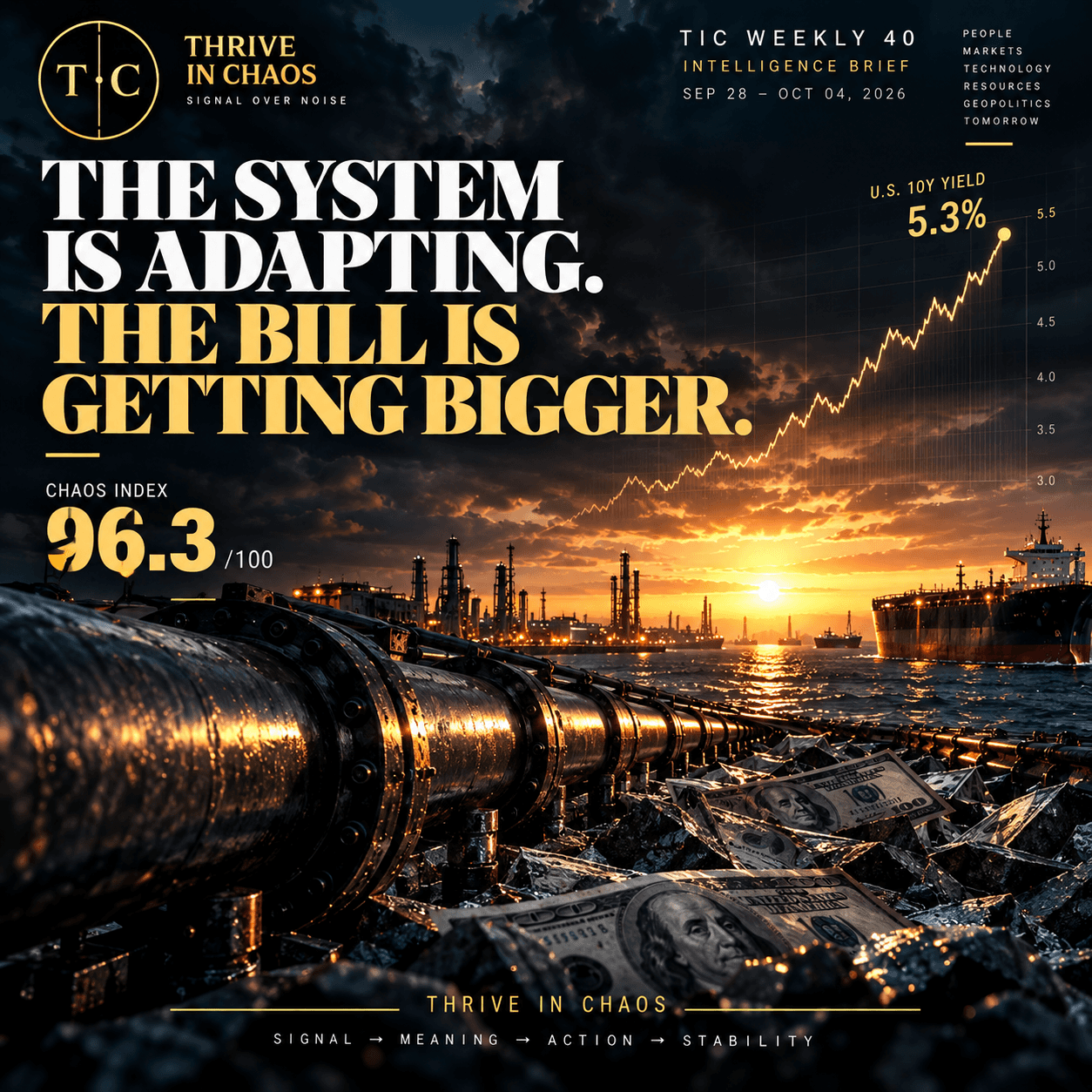
DAILY PULSE | August 20, 2026- Chaos Index 92: Stability Is Now Something the System Has to Buy
The system is being stabilized faster than it is being repaired. Energy buffers and financial intervention are suppressing visible damage — but the underlying cost of maintaining stability is rising.
13 min red

Chaos Index 92: Stability Is Now Something the System Has to Buy
THRIVE IN CHAOS — DAILY PULSE
August 20, 2026
Chaos Index: 92 / 100 🔴
Raw CI: 91.95
Phase: R
System Type: Multipolar Compression
Stress concentration: 11 of 11 systems elevated
The Chaos Index did not materially rise today.
That is not the important signal.
The important signal is how much work the system now has to do to prevent existing stress from becoming visible disruption.
Energy markets are adapting.
Inventories are being used.
Refinery and product flows are changing.
Governments are supporting financial-market liquidity.
Alternative supply channels continue absorbing part of the physical disruption.
All of these mechanisms reduce immediate damage.
But none of them is free.
The global system is increasingly maintaining stability by spending:
inventory,
liquidity,
capital,
redundancy,
government balance-sheet capacity,
alternative logistics,
insurance capacity,
and political coordination.
That changes the analytical question.
The question is no longer simply:
“Is the system stable?”
It is:
“How much does the system now have to spend to remain stable?”
Today's core mechanism is:
SHOCK
→ BUFFER USE
→ INSTITUTIONAL INTERVENTION
→ VISIBLE STABILITY
→ UNDERLYING COST REMAINS
→ HIGHER-COST STABILITY
The system is not collapsing.
It is adapting.
But adaptation itself is becoming more expensive.
Executive Summary
The Chaos Index remains at an extreme:
92 / 100 🔴
The raw reading is 91.95.
No block changes relative to August 19.
The current vector remains:
A — 10.0
B — 9.5
C — 9.0
D — 7.0
E — 9.0
F — 8.5
G — 10.0
H — 10.0
I — 9.5
J — 7.5
K — 8.0
All eleven systems remain elevated.
Five are operating at or around binding extreme-stress floors in the secondary diagnostic framework.
Today's lack of index movement should therefore not be interpreted as normalization.
The system is already close to saturation across several domains.
Instead, the important developments are occurring inside the mechanisms represented by those blocks.
Three signals matter most today.
First, the energy shock is moving downstream.
Commercial Hormuz disruption continues, but the analytical focus is shifting from crude availability alone toward refined-product inventories, diesel, freight and operating costs.
Second, Treasury liquidity-support operations have provided real relief to the long end of the U.S. government bond market.
But market-function relief is not the same as structural normalization.
Third, additional U.S. economic measures against Iran remain prospective rather than implemented during today's analytical window.
That distinction prevents us from mechanically increasing institutional-fragmentation scores before the actual policy instrument and enforcement mechanism are known.
The 7–30 day base case is therefore:
HIGHER-COST STABILITY THROUGH ACTIVE ABSORPTION.
The system remains capable of adaptation.
But more stability has to be produced rather than assumed.
1. What Changed in the Index
Almost nothing changed numerically today.
That is analytically useful.
The Chaos Index remains:
91.95 raw
and therefore:
92 / 100 publicly.
Relative to the Week 33 anchor, two accumulated changes remain:
C — Financial Stress:
8.5 → 9.0
Weighted CI contribution:
+0.55
I — Institutional / Access Stress:
9.0 → 9.5
Weighted CI contribution:
+0.40
Combined difference:
+0.95.
Anchor:
91.0
Current:
91.95.
Reconciliation:
PASS.
No additional block move is justified on August 20.
This is exactly what a disciplined index should sometimes do.
A daily analytical system should not create movement simply because new headlines exist.
New evidence must change the operating state.
2. Why No Change Does Not Mean No Development
At lower levels of stress, a stable index can indicate genuine stabilization.
At 92, the interpretation is different.
Three blocks already stand at 10.0.
Several others are near their upper range.
That creates saturation.
Once a block is already describing extreme conditions, another event from the same causal family may deepen the problem without producing a meaningful numerical increment.
The energy system illustrates this today.
There is new evidence.
But G is already 10.
The correct response is therefore not:
10 → 10.5.
There is no 10.5.
The correct response is:
understand what is changing inside the extreme state.
3. The Energy Shock Is Moving Downstream
The Gulf disruption began primarily as a problem of physical access.
Can crude move through Hormuz?
Can tankers obtain insurance?
Can operators accept the security risk?
Those questions remain important.
But a prolonged energy shock rarely stays at the point where it begins.
It migrates.
The next transmission layer includes:
refinery availability;
distillate inventories;
diesel prices;
aviation fuel;
freight costs;
industrial energy inputs;
and ultimately household operating costs.
Today's energy signal therefore becomes more important because the disruption is moving further into the economic system.
4. Crude Oil Is Only the First Layer
Energy security is often reduced to crude prices.
That is convenient.
It is also incomplete.
A barrel of crude is not useful to most final consumers until it has been:
transported,
refined,
distributed,
insured,
financed,
and delivered.
Each stage contains its own capacity constraints.
This means adequate crude availability does not guarantee adequate product availability.
A market can therefore experience:
moderate crude stress
and
significant refined-product stress
at the same time.
5. Why Distillates Matter
Distillates occupy a particularly important position in the economy.
They power:
freight;
construction;
agriculture;
industrial machinery;
commercial transport;
and large parts of the logistics system.
This makes diesel-like fuels economically different from many consumer commodities.
When distillate availability tightens, the cost does not remain in one sector.
It enters the movement of goods.
That creates a broad transmission mechanism:
ENERGY CONSTRAINT
→ DIESEL / FREIGHT COST
→ LOGISTICS COST
→ BUSINESS MARGINS
→ FINAL PRICES.
The energy shock can therefore become more economically important even without an explosive crude-price move.
6. The Missing Price Spike Can Mislead
One of the recurring analytical risks of this crisis is assuming that the absence of a dramatic oil spike means the shock has been absorbed.
That conclusion is too simple.
A muted crude-price reaction can result from:
inventory drawdowns;
weaker demand;
refinery adjustments;
government action;
alternative supply;
or expectations of future normalization.
Those mechanisms can delay the visible price signal.
They do not prove that the physical constraint disappeared.
The cost may simply be appearing elsewhere.
7. Stress Migrates Through Systems
This is a broader principle.
Complex systems rarely transmit stress in a straight line.
A shipping disruption may first appear in freight.
Then inventory.
Then working capital.
Then pricing.
Then consumer demand.
Then credit.
The original shock has not disappeared.
It has changed form.
THRIVE IN CHAOS therefore distinguishes between:
shock location
and
shock transmission.
Today's energy evidence is primarily about transmission.
8. Hormuz Has Still Not Normalized
Commercial traffic through Hormuz remains substantially impaired relative to normal conditions.
This matters because several days of persistent disruption have a different economic effect from a short interruption.
Duration consumes buffers.
The first days use:
available inventories;
existing contracts;
route flexibility;
and spare operational capacity.
Later days increasingly require:
replacement supply;
new logistics arrangements;
additional working capital;
political intervention;
and demand adjustment.
The same physical constraint therefore becomes more expensive over time.
9. Duration Can Matter More Than Severity
Consider two disruptions.
The first is extremely severe but lasts three days.
The second is slightly less severe but lasts six weeks.
The second can produce greater systemic damage.
Why?
Because modern systems are designed around finite buffers.
Inventory has a duration.
Credit lines have limits.
Alternative routes have capacity.
Insurance has risk thresholds.
Management attention is finite.
Political tolerance is finite.
The longer the disruption persists, the more the surrounding system becomes part of the problem.
10. The Buffer Mechanism Is Still Operating
On August 17, the central signal was buffer depletion.
That mechanism remains active today.
Inventories continue protecting current consumption.
Alternative energy flows protect supply.
Financial institutions protect market functioning.
Government action protects liquidity.
Each buffer converts:
immediate disruption
into
future adjustment.
This is valuable.
But it changes the timing rather than automatically eliminating the cost.
11. Stability Is a Stock as Well as a Condition
We usually talk about stability as if it were simply present or absent.
A more useful approach is to treat resilience as a stock.
A system possesses a certain amount of:
inventory;
liquidity;
fiscal space;
redundancy;
political tolerance;
infrastructure capacity;
and time.
These assets allow it to absorb shocks.
When they are used, resilience declines unless they can be replenished.
This means stability today can be financed by reduced stability tomorrow.
12. The Treasury Intervention Illustrates the Same Mechanism
The financial system is showing the same pattern.
Long-duration U.S. Treasury yields recently came under significant pressure.
Treasury liquidity-support buybacks have been expanded.
The immediate effect has been constructive.
Market functioning improves.
Liquidity increases.
Some of the visible pressure on yields declines.
That matters.
But the nature of the improvement must be identified correctly.
13. Market-Function Relief vs Fundamental Normalization
There are at least three reasons bond yields can decline.
First:
inflation and fiscal risk genuinely improve.
That is fundamental normalization.
Second:
the economy deteriorates sharply.
That can reduce yields for negative reasons.
Third:
market authorities improve liquidity or absorb temporary dislocation.
That is market-function relief.
Today's signal is primarily closer to the third category.
The distinction is crucial.
Liquidity support can make a stressed system easier to operate.
It does not necessarily make the system fundamentally less stressed.
14. Plumbing Matters
Calling liquidity operations “market plumbing” can sound dismissive.
It should not.
Plumbing is essential.
Markets cannot function if liquidity disappears.
A government bond market with poor liquidity can transmit stress rapidly into:
mortgages;
corporate debt;
derivatives;
bank balance sheets;
and global risk pricing.
Improving that plumbing is therefore meaningful.
But a well-functioning pipe can still carry expensive water.
Better execution does not eliminate the underlying price of capital.
15. What Treasury Support Cannot Solve by Itself
Liquidity operations do not automatically solve:
large structural fiscal deficits;
high sovereign borrowing requirements;
persistent inflation uncertainty;
large defence expenditures;
energy-security investment;
AI infrastructure capital demand;
or geopolitical risk.
Those pressures operate at a different layer.
This leads to a useful distinction:
LIQUIDITY PROBLEM
versus
SOLVENCY / SUPPLY / TERM-PREMIUM PROBLEM.
One tool cannot solve every layer.
16. The System Is Becoming More Intervention-Dependent
This is the deeper signal.
The system still works.
But increasingly, it works because someone intervenes.
Inventories are released.
Trade routes are rearranged.
Refiners change output.
Treasury operations improve liquidity.
Governments subsidize strategic industries.
Regulators modify rules.
Central banks provide facilities.
None of these actions is necessarily undesirable.
The important analytical point is that intervention itself becomes part of the baseline architecture.
17. Intervention Can Become Structural
Emergency mechanisms often begin as temporary responses.
But repeated use can change expectations.
Market participants begin assuming authorities will intervene.
Companies build strategies around government support.
Strategic reserves become operational supply.
Industrial policy becomes permanent.
Temporary redundancy becomes mandatory.
At that point, the system has not returned to its previous equilibrium.
It has created a new one.
18. The New Equilibrium Is More Expensive
The emerging equilibrium may be stable.
But it is unlikely to be as cheap.
Consider what modern resilience increasingly requires:
more inventory;
more defence;
more energy redundancy;
more supply-chain diversification;
more compliance;
more liquidity;
more insurance;
more domestic infrastructure;
more cyber security;
more strategic industrial capacity.
Every one of these requires resources.
This creates a structural resilience premium.
19. From Low-Cost Stability to Purchased Stability
The previous global model benefited from an unusually important condition:
a large part of stability was embedded in the system.
Trade routes were predictable.
Technology ecosystems integrated.
Capital relatively mobile.
Energy could often be optimized globally.
Security costs were partially externalized.
Inventory could be minimized.
Under those conditions, companies could treat stability as a background assumption.
That assumption is weakening.
Stability increasingly has to be purchased explicitly.
20. What Is the Price of Stability?
There is no single price.
For a household it can be:
larger savings;
backup energy;
higher insurance;
or paying more for a reliable supplier.
For a business:
inventory;
multiple suppliers;
higher working capital;
cybersecurity;
additional jurisdictional compliance;
or spare operational capacity.
For a state:
defence;
strategic reserves;
industrial subsidies;
domestic infrastructure;
and fiscal capacity.
For capital markets:
liquidity facilities;
larger risk premiums;
and higher required returns.
The forms differ.
The function is the same.
They purchase optionality.
21. The Efficiency–Resilience Trade-Off Is Becoming Real
For years, “resilience” was often used as a strategic slogan.
The current environment makes it measurable.
Every additional layer of resilience has a cost.
Two suppliers cost more than one.
Extra inventory costs more than just-in-time.
Backup energy costs more than dependence on the cheapest grid supply.
Multiple banking relationships cost more than a single optimized financial stack.
This does not mean resilience always wins.
It means the trade-off can no longer be ignored.
22. Over-Resilience Is Also a Risk
There is an opposite error.
Responding to every uncertainty by maximizing redundancy is economically destructive.
A company can become so defensive that it destroys competitiveness.
A household can hold so much liquidity that long-term wealth creation suffers.
A state can subsidize so much domestic capacity that productivity collapses.
The objective is therefore not maximum resilience.
It is:
RESILIENCE WHERE FAILURE WOULD DESTROY OPTIONALITY.
This is a more precise decision rule.
23. The Correct Unit Is Critical Dependency
The best place to apply resilience capital is a dependency with four characteristics:
high consequence if lost;
low substitutability;
long switching time;
and high probability that access can become constrained.
Those dependencies deserve buffers.
Low-impact, easily replaceable dependencies generally do not.
This creates a practical allocation framework:
Do not ask:
“Where can I add redundancy?”
Ask:
“Where would the absence of redundancy materially shrink my Decision Space?”
24. Economic Isolation Remains Prospective Today
Another development concerns planned U.S. economic pressure on Iran.
Additional measures have been signalled.
But during today's analytical window, the exact instrument, affected entities and enforcement mechanism were not yet sufficiently defined as implemented measures.
That distinction matters.
Intent is not execution.
An announced policy can influence expectations.
But the Chaos Index should not treat:
“the government intends to act”
as identical to:
“the restriction is now changing economic behaviour.”
That is why I remains:
9.5
rather than rising automatically to 10.
25. Why Announcement Discipline Matters
This rule may appear conservative.
It is intentionally so.
Modern information environments contain enormous quantities of:
threats;
policy proposals;
draft legislation;
military warnings;
sanctions discussions;
and political positioning.
If every announcement is scored as completed action, systemic indices become measures of rhetoric rather than reality.
Decision Intelligence requires a gap between:
ANNOUNCED
and
OPERATING.
We should move the system score when behaviour changes.
26. Today's Dominant Mechanism
The most useful combined mechanism today is:
PHYSICAL CONSTRAINT
→ BUFFER CONSUMPTION
→ DOWNSTREAM COST TRANSMISSION
→ INSTITUTIONAL INTERVENTION
→ PARTIAL VISIBLE RELIEF
→ HIGHER-COST STABILITY.
Notice what is missing:
collapse.
The system is still functioning.
That is important.
But equally important is what has changed.
Normal functioning increasingly requires active resource expenditure.
27. Why This Is Not a Collapse Thesis
At a Chaos Index near 92, there is a temptation to assume that TIC is forecasting imminent systemic breakdown.
That would be analytically incorrect.
High systemic stress can produce several outcomes.
One is collapse.
Another is successful adaptation.
A third is persistent degradation.
The current evidence points primarily toward:
adaptation under rising cost.
This is why the base case remains different from the stress scenario.
28. Base Scenario — Higher-Cost Stability
Indicative probability:
50%
Base direction:
HIGHER-COST STABILITY THROUGH ACTIVE ABSORPTION.
Under this scenario:
Hormuz remains commercially impaired but does not deteriorate into complete sustained closure;
refined-product stress remains elevated;
inventories and changing flows continue absorbing part of the energy shock;
oil remains elevated but manageable;
Treasury liquidity measures maintain better market functioning;
long-term borrowing costs remain structurally high relative to the previous decade;
new restrictions on Iran increase selectively rather than triggering immediate comprehensive financial separation;
and firms continue adapting through redundancy and working capital.
The system functions.
But its operating cost rises.
29. Constructive Scenario — Partial Normalization
Indicative probability:
25%
Under the constructive scenario:
Gulf tensions moderate;
commercial Hormuz throughput improves;
insurance availability recovers;
energy inventories stop deteriorating;
refined-product pressure eases;
long-duration yields fall for fundamental rather than merely liquidity reasons;
and announced U.S. measures remain targeted rather than expanding into wider secondary restrictions.
The critical condition is rebuilding buffers.
Real normalization requires more than lower spot prices.
It requires renewed capacity to absorb the next shock.
30. Stress Scenario — Fragmentation Cascade
Indicative probability:
25%
The stress scenario emerges if several pressures reinforce each other.
Potential pathway:
Hormuz disruption persists or worsens;
distillate and refined-product inventories tighten further;
Brent moves materially above the current range;
freight and insurance rise;
additional economic restrictions expand;
long-duration yields return above recent extremes;
and weak demand reduces firms' ability to pass higher costs to customers.
This creates:
HIGHER COSTS
+
WEAKER DEMAND
+
EXPENSIVE CAPITAL.
That combination is substantially more difficult for the corporate system than any one factor alone.
31. What Would Change the Base Case?
We would become more constructive if:
commercial Hormuz throughput normalizes materially;
refined-product inventories stabilize;
freight and insurance costs decline;
long-term Treasury yields fall without recessionary deterioration;
and buffers begin rebuilding.
We would become more defensive if:
distillate shortages intensify;
secondary economic restrictions widen;
long-duration yields return above 5.3% and remain there;
corporate credit begins repricing sharply;
or physical energy constraints spread into new infrastructure.
The key variable is not one headline.
It is whether the system is rebuilding resilience faster than it is consuming it.
32. Forecast Gate
Today's Forecast Gate produces:
NEW FORECASTS: 0.
This is deliberate.
The major candidate questions fall into causal families that are already heavily represented.
Hormuz and oil-price transmission are already covered.
Energy-to-monetary-policy transmission is already covered.
Long-duration U.S. rates are already represented.
Creating another forecast around these variables would add apparent sample size without adding sufficient causal independence.
The additional U.S. economic measures against Iran are not yet defined well enough to create a clean treatment condition.
The policy instrument must exist before we forecast its measurable consequences.
33. Why Zero Is an Analytical Output
Forecast systems are vulnerable to production incentives.
If the publication process expects predictions every day, analysts begin manufacturing them.
That creates:
correlated questions;
weak resolution criteria;
repeated causal families;
and false statistical confidence.
A disciplined Forecast Gate must therefore be capable of returning:
Today is such a day.
The system map changed.
The forecast sample does not need to.
34. Forecast Resolution Discipline
An older long-duration Treasury forecast remains a methodological reminder.
A forecast with a defined closing window must be resolved only using observations inside that window.
Later data cannot be used because it makes the forecast look easier after the event.
This is especially important during volatile periods.
A threshold may be reached one day after expiration.
That can be interesting analytically.
It cannot change the original forecast outcome.
Calibration requires rules that survive hindsight.
35. Recommendation — Individuals
Time horizon:
by August 27.
Choose one recurring expense materially exposed to:
fuel,
transport,
shipping,
imported energy,
or another variable likely to respond to the current energy environment.
Then define three levels.
NORMAL LEVEL
No action required.
CAUTION LEVEL
Reduce discretionary use or begin substitution.
ACTION LEVEL
Change provider, postpone expenditure, switch transport mode or activate the prepared alternative.
The exact price threshold will differ by household.
The important point is to set it before the price move occurs.
This converts:
reaction
into
predefined decision logic.
The goal is not forecasting fuel prices.
It is preserving decision quality if they move.
36. Recommendation — Business
Time horizon:
by August 24.
Re-run one 30-day operating plan under the following combined assumptions:
Brent approximately $95;
continued Hormuz impairment;
higher diesel or freight costs;
no immediate return to cheap long-term financing.
Measure the effect on:
gross margin;
working capital;
inventory requirement;
delivery times;
cash conversion;
and customer pricing.
Then identify the first variable that breaks the operating plan.
That is the actual vulnerability.
It may not be energy itself.
It may be working capital.
It may be pricing power.
It may be inventory.
It may be customer demand.
The purpose of the stress test is to find the constraint before reality does.
37. Recommendation — Capital
Time horizon:
by August 24.
Separate portfolio exposures into two categories.
CATEGORY 1
Assets that benefit materially from lower long-term yields even if underlying fiscal, inflation and energy risks remain.
CATEGORY 2
Assets that require genuine fundamental normalization for the investment thesis to work.
This distinction matters because liquidity support can improve Category 1 temporarily without improving Category 2.
Then repeat the stress test with:
U.S. 30-year yield >5.3%;
Brent ≈$95;
persistent Gulf access risk;
and weak consumer demand.
The purpose is not to predict that exact state.
It is to determine which exposures depend on several favourable assumptions simultaneously.
This is a risk diagnostic, not a recommendation to buy or sell securities.
38. What Not to Do
Do not treat a stable Chaos Index as evidence of normalization.
Do not treat Treasury support as proof that long-duration financial risk disappeared.
Do not treat inventories as permanent supply.
Do not treat moderate crude prices as evidence that refined-product stress is absent.
Do not treat announced sanctions or restrictions as implemented facts.
Do not increase a block simply because the same extreme event produces another headline.
Do not assume every form of redundancy is worth its cost.
Do not assume every stabilization measure is evidence of structural repair.
And do not confuse system functionality with system health.
39. First-Order Effects
Persistent Gulf Energy Constraint
First-order effects:
reduced route reliability;
higher insurance and security costs;
continued inventory draw;
energy-price volatility.
Refined-Product Tightness
First-order effects:
diesel pressure;
higher freight costs;
industrial operating-cost pressure;
greater refinery sensitivity.
Treasury Liquidity Support
First-order effects:
better long-end market functioning;
reduced liquidity premium;
partial yield relief;
lower immediate financial stress.
Prospective Iran Restrictions
First-order effect today:
expectation change.
Not yet:
fully observable implementation impact.
40. Second-Order Effects
Energy stress can increase:
working-capital requirements;
transport prices;
inventory demand;
corporate margin pressure;
and consumer prices.
Financial intervention can increase:
market confidence;
duration demand;
and willingness to maintain leverage.
But it can also reduce the urgency to adjust underlying structural problems.
Prospective restrictions can cause firms to:
pre-emptively de-risk;
reduce exposure;
delay transactions;
and increase compliance checks
before formal enforcement begins.
Expectations themselves therefore become operational.
41. Third-Order Effects
Over longer periods, repeated intervention can reshape the economy.
Companies internalize greater redundancy.
Governments maintain larger strategic reserves.
Capital markets expect more institutional support.
Energy systems build more spare capacity.
Trade flows become more regional.
Financial relationships become more politically conditioned.
The result can be:
less efficient,
more resilient,
more capital-intensive,
and more expensive.
This is not necessarily a temporary crisis architecture.
It may be the emerging operating model.
42. Higher-Cost Stability as a Regime Candidate
We should not yet call higher-cost stability a confirmed new regime.
That would require more evidence.
But it is becoming a useful regime candidate.
Its characteristics would be:
persistent geopolitical friction;
continued market functioning;
frequent institutional intervention;
more redundancy;
greater capital intensity;
higher baseline fiscal demands;
and structurally higher cost of maintaining continuity.
The important distinction is that this regime does not require continuous crisis.
It requires continuous preparation for crisis.
43. Why This Matters for Productivity
There is an economic trade-off.
Resources spent on redundancy are not simultaneously available for productive expansion.
A second warehouse can improve resilience.
It can also reduce capital efficiency.
A backup energy system protects continuity.
It may generate little return during normal periods.
Extra inventory reduces disruption risk.
It increases working capital.
If resilience spending becomes structurally larger, measured productivity may face pressure even when the investment is strategically rational.
This is one reason the next economic environment may feel more expensive even without persistent headline inflation.
44. Why This Matters for Small Businesses
Large corporations can often purchase resilience.
They can diversify suppliers.
Hold more inventory.
Build compliance teams.
Access multiple banks.
Hedge energy.
Negotiate logistics.
Smaller firms have fewer resources.
Higher-cost stability can therefore create a scale advantage.
The world may become more difficult not because small firms are less innovative, but because the fixed cost of resilience rises.
That is a second-order concentration risk worth monitoring.
45. Why This Matters for Households
Households experience the same structural problem on a smaller scale.
Redundancy costs money.
A larger emergency fund ties up capital.
Owning rather than renting certain assets can cost more upfront.
Alternative transport can be less efficient.
Home energy resilience requires investment.
Multiple banking channels require management.
Not every household should maximize all of these.
The correct question is:
Which failure would most reduce my ability to make the next decision?
That is where resilience has the highest value.
46. Human Development Layer
Material buffers matter.
But they are only one form of resilience.
Capabilities are buffers too.
A person with multiple useful skills has greater labour optionality.
A business with strong institutional knowledge adapts faster.
A household that understands its own cash flow can react earlier.
A community with functioning relationships can solve problems that money alone cannot immediately solve.
This is where the Human Development layer becomes operational.
Knowledge reduces dependence on external interpretation.
Practical capability reduces switching cost.
Institutional memory prevents repeated errors.
These are forms of resilience that can increase rather than decrease through use.
47. The Decision Intelligence Test
When you see apparent stabilization, ask seven questions.
1. What changed?
Did the underlying constraint improve?
Or only the visible symptom?
2. What absorbed the shock?
Inventory?
Liquidity?
Government spending?
Margin?
Insurance?
Alternative supply?
3. Is that buffer finite?
How much remains?
4. Can it be replenished?
And how quickly?
5. What does the intervention cost?
Money?
Efficiency?
Political capacity?
Future flexibility?
6. Who is paying?
Households?
Companies?
Government?
Investors?
7. What happens if the same shock occurs again before the buffer is rebuilt?
That final question is the resilience test.
48. One Decision for Today
Ask:
WHAT PART OF MY CURRENT STABILITY AM I PAYING MORE TO MAINTAIN THAN I WAS ONE YEAR AGO?
Then determine why.
Is the cost temporary?
Or has the operating environment changed?
Next ask:
Does paying that extra cost preserve meaningful optionality?
If yes, it may be rational resilience spending.
If no, it may simply be inertia.
This distinction matters because an unstable environment can justify more resilience.
It does not justify unlimited cost.
49. The Strategic Principle
The most important strategic principle today is:
DO NOT MEASURE STABILITY ONLY BY THE ABSENCE OF FAILURE.
A system can avoid failure by consuming resources rapidly.
A company can avoid insolvency by drawing credit.
A household can maintain consumption by spending savings.
A government can stabilize prices through subsidies.
A market can remain orderly through official liquidity support.
Each can appear stable.
The balance sheet tells you whether that stability is sustainable.
50. Final Assessment
The Chaos Index remains:
92 / 100 🔴.
The headline number barely moves.
The system underneath it continues to evolve.
On August 17, the central mechanism was buffer depletion.
On August 18, physical instability began transmitting into the long-term cost of capital.
On August 19, institutions became increasingly active in defending market functioning and economic access.
On August 20, the pattern becomes clearer:
the system is being stabilized faster than it is being repaired.
Energy markets demonstrate it.
Inventories, refinery flexibility and altered product flows are preventing a physical disruption from turning immediately into a full-scale energy shortage.
Financial markets demonstrate it.
Treasury liquidity operations reduce visible long-end pressure without necessarily eliminating the structural fiscal, inflation and geopolitical forces behind it.
Policy demonstrates it.
New economic restrictions are being prepared, but disciplined analysis requires distinguishing intended action from implemented action.
Across all three systems, the same principle appears:
ADAPTATION CAN REDUCE IMMEDIATE DAMAGE WITHOUT RESTORING THE PREVIOUS OPERATING ENVIRONMENT.
That distinction defines today's assessment.
The global system remains remarkably capable of adaptation.
This should not be underestimated.
Complex economies contain enormous reserves of:
capital,
knowledge,
inventory,
institutional capacity,
technology,
substitution,
and political response.
That is why extreme stress does not automatically produce collapse.
But those capabilities are not free.
Every adaptation has a cost.
Every reserve has a limit.
Every intervention changes incentives.
Every new layer of redundancy consumes resources.
This produces a possible emerging equilibrium:
HIGHER-COST STABILITY.
The world continues functioning.
Energy continues flowing.
Markets remain open.
Companies keep operating.
Governments prevent disorder.
But the cost of achieving those outcomes increases.
More inventory.
More security.
More insurance.
More fiscal support.
More liquidity.
More redundancy.
More capital.
More political management.
The strategic question therefore changes.
It is no longer enough to ask:
“Will the system survive?”
The better question is:
“What must be continuously spent for the system to survive in its current form?”
And then:
“Is that cost sustainable?”
For individuals, the response is selective redundancy.
For business, it is stress-testing the dependencies whose failure would destroy operating optionality.
For capital, it is separating temporary policy relief from genuine improvement in the underlying economics.
The objective is not pessimism.
It is precision.
The system is not collapsing.
It is adapting.
But stability is now something the system increasingly has to buy.
DAILY PULSE — AUGUST 20, 2026
CHAOS INDEX
92 / 100 🔴
RAW CI
91.95
PHASE
R
SYSTEM TYPE
Multipolar Compression
STRESS CONCENTRATION
11 / 11 blocks elevated
CURRENT BLOCK VECTOR
A — 10.0
B — 9.5
C — 9.0
D — 7.0
E — 9.0
F — 8.5
G — 10.0
H — 10.0
I — 9.5
J — 7.5
K — 8.0
PRIMARY MECHANISM
Shock
→ Buffer Use
→ Institutional Intervention
→ Visible Stability
→ Underlying Cost Remains
→ Higher-Cost Stability
7–30 DAY DIRECTION
Higher-Cost Stability Through Active Absorption
CONFIDENCE
Medium–High
FORECAST GATE
New forecasts: 0
WATCH NEXT
• commercial Hormuz throughput
• Gulf war-risk insurance
• Brent crude
• diesel and refined-product prices
• U.S. distillate inventories
• refinery throughput
• freight rates
• Chinese energy flows and inventory use
• U.S. 30-year Treasury yield
• U.S. 10-year Treasury yield
• Treasury-market liquidity
• corporate credit spreads
• refinancing conditions
• implementation details of new U.S. Iran measures
• secondary-sanctions risk
• corporate working-capital pressure
• evidence of buffer rebuilding rather than continued depletion
THRIVE IN CHAOS
Decision Intelligence for an Uncertain World
Analysis → Forecast → Recommendations
Signal → Meaning → Action → Stability
Signal Over Noise
thriveinchaos.ai
AI intelligence system with human editorial oversight.
Forecasts represent probability-based analytical assessments, not certainties.
This material supports independent judgment and does not constitute financial, legal or investment advice.
Join the newsletter
Be the first to read our articles.