

TIC WEEKLY 37 INTELLIGENCE BRIEF
That interpretation would miss the most important development of the week. Much of the deterioration occurred inside parts of the system that were already at or near the maximum score. Geopolitical stress, energy, logistics, monetary conditions and institutional fragmentation have little numerical room left to deteriorate inside the current 0–10 block structure.
18 min read
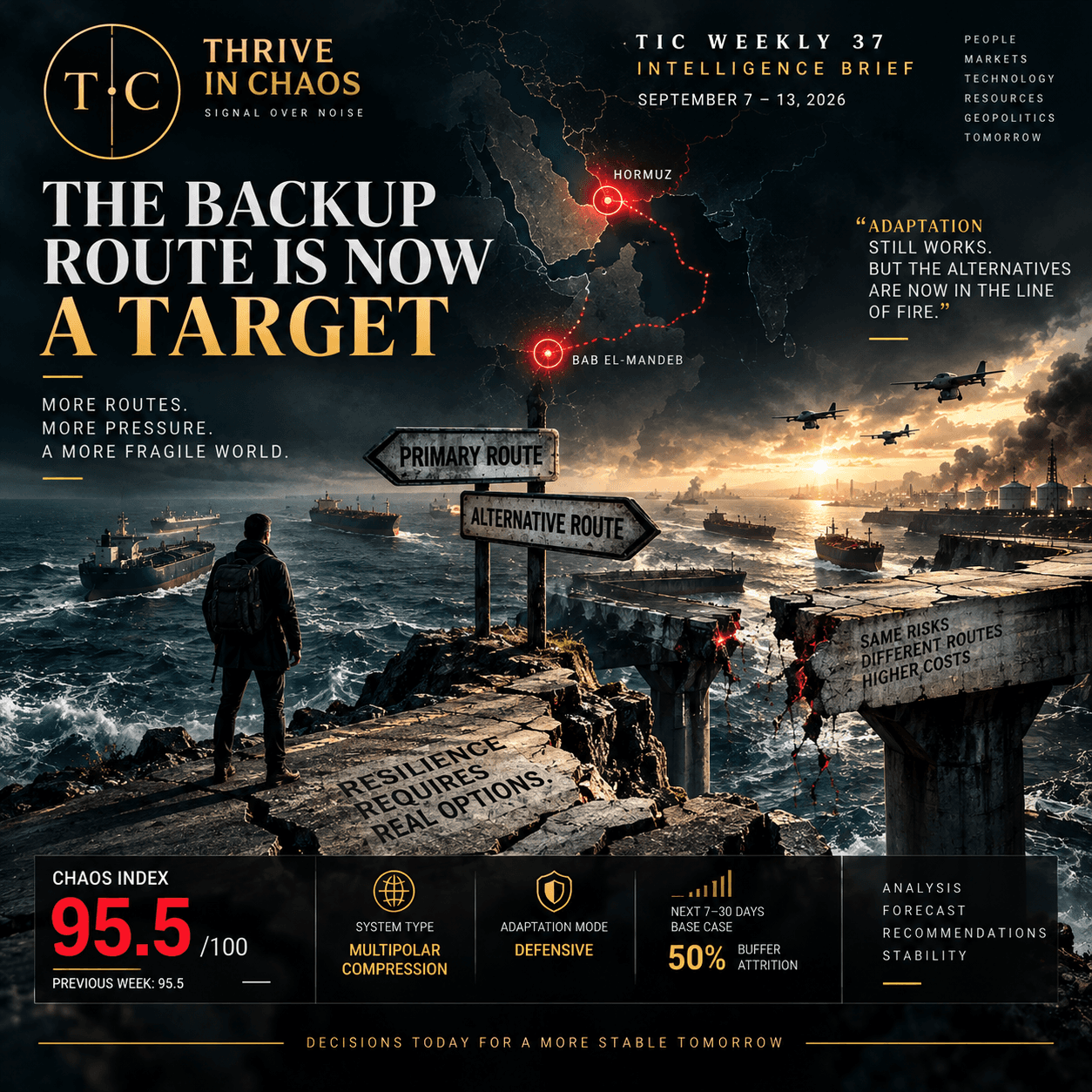
TIC WEEKLY 37 INTELLIGENCE BRIEF
The Backup Route Is Now a Target
September 7–13, 2026
THRIVE IN CHAOS — Weekly Decision Intelligence
Chaos Index: 95.5 / 100 🔴
Previous week: 95.5
Phase: R
System Type: Multipolar Compression
Adaptation Mode: DEFENSIVE
This Week’s Core Signal
For months, the global system has absorbed disruption by finding alternatives. When one shipping route became unreliable, cargo moved elsewhere. When one energy channel was constrained, inventories, pipelines and alternative suppliers carried more of the load. When one technology or jurisdiction became inaccessible, companies searched for substitutes.
Week 37 reveals the weakness inside that adaptation model.
The alternatives are increasingly exposed to the same shocks as the systems they were supposed to replace.
That does not mean the global system is collapsing. It means resilience is becoming more expensive, more complicated and harder to verify.
The important question is no longer whether a backup exists.
It is whether the backup is genuinely independent.
01 — Executive Summary: The Number Stayed the Same. The System Did Not.
The Chaos Index remains at 95.5, exactly where it stood in Week 36. On the surface, this suggests that global stress stopped increasing.
That interpretation would miss the most important development of the week.
Much of the deterioration occurred inside parts of the system that were already at or near the maximum score. Geopolitical stress, energy, logistics, monetary conditions and institutional fragmentation have little numerical room left to deteriorate inside the current 0–10 block structure.
But underneath those scores, the architecture changed.
The clearest example is Saudi Arabia's East-West Pipeline. The pipeline exists partly to reduce dependence on the Strait of Hormuz by carrying crude across Saudi Arabia toward the Red Sea. After a drone attack, that alternative route itself became impaired.
At the same time, pressure around Bab el-Mandeb increased, including the reported seizure of Perim Island. This matters because Red Sea capacity is one of the alternatives that becomes more valuable when Gulf shipping is disrupted.
The pattern is broader than either event.
The global economy still has buffers. It has inventories, alternate routes, spare capacity, financial reserves and policy tools.
What is changing is the independence of those buffers.
That is the central W37 signal.
02 — What Actually Changed This Week?
Week 36 was primarily about re-coupling.
Energy pressure was feeding inflation. Inflation was feeding expectations of tighter monetary policy. Higher rates were raising the cost of financing the very infrastructure needed to adapt to geopolitical and technological fragmentation.
That mechanism remains active.
Week 37 adds another layer.
The system has spent several years responding to disruption by building alternatives. But alternatives become strategically valuable precisely because the original system is vulnerable. Once they become strategically valuable, they also become attractive targets.
The sequence is straightforward:
Primary infrastructure becomes unreliable → alternative infrastructure absorbs demand → the alternative becomes strategically important → pressure migrates toward the alternative.
This changes the meaning of redundancy.
Two routes do not necessarily provide twice the resilience.
If both depend on the same conflict zone, insurer, electricity grid, jurisdiction, port, technology or security architecture, they may represent only one effective option disguised as two.
03 — Chaos Index: 95.5 / 100
The Week 37 raw Chaos Index is 95.45, displayed publicly as 95.5.
The weekly change is therefore:
95.5 → 95.5
The EWMA, however, continues moving upward because it incorporates the persistence of elevated stress:
92.29 → 93.40
The block structure remains:
Block | Score | Weight |
|---|---|---|
A | 10.0 | 13% |
B | 9.5 | 11% |
C | 10.0 | 11% |
D | 7.5 | 6% |
E | 10.0 | 7% |
F | 9.5 | 10% |
G | 10.0 | 13% |
H | 10.0 | 12% |
I | 10.0 | 8% |
J | 7.5 | 4% |
K | 8.0 | 5% |
All eleven blocks remain elevated.
Eight are at 9.5 or above.
This is not a system being driven by one exceptional crisis. Stress is distributed across almost the entire architecture.
04 — Ceiling Watch: Why 95.5 Is Becoming Harder to Read
This is now the second consecutive reproducible weekly reading above 95.
That creates a measurement problem.
The Index was designed to show changes in systemic stress, but six blocks are already at the maximum score of 10.0 and another two stand at 9.5. A major deterioration inside one of those blocks can therefore occur without changing the headline number.
We should not solve this by arbitrarily raising other scores. Doing so would destroy comparability with previous weeks.
Instead, the interpretation needs to change.
Near the ceiling, the Chaos Index increasingly needs four dimensions:
Level — how high is systemic stress?
Breadth — how much of the system is affected?
Interaction — are stresses reinforcing one another?
Buffer condition — how much capacity remains to absorb the next shock?
The Index remains useful.
But at 95+, another decimal point contains less information than it did at 70 or 80.
That limitation should be visible rather than hidden.
05 — The Structural Signal: Redundancy Is Becoming Part of the Attack Surface
Most modern resilience systems are based on redundancy.
Businesses use multiple suppliers.
Countries diversify energy sources.
Cloud systems operate across several locations.
Shipping companies maintain alternative routes.
Banks maintain multiple funding channels.
Governments build strategic reserves.
This works when the alternatives fail independently.
The danger appears when the alternatives share hidden dependencies.
Imagine a company with two suppliers. They appear diversified because they operate in different countries.
But both rely on the same Chinese component.
Or two logistics routes use different ports but both cross the same maritime chokepoint.
Or two data centres operate in different cities but depend on the same regional grid.
Or two banks belong to different groups but remain subject to the same sanctions regime.
The number of alternatives looks unchanged.
Effective optionality is much smaller.
That is what W37 increasingly reveals at the global level.
06 — Hormuz: The System Has Not Returned to Normal
The Strait of Hormuz remains one of the most important physical nodes in the global economy.
But describing it simply as “open” or “closed” is increasingly inadequate.
Commercial normalization requires several conditions simultaneously:
physical passage must be possible;
security risk must be acceptable;
insurance must be obtainable;
political permission must be predictable;
shipowners must be willing to transit;
and counterparties must accept the resulting risk.
Traffic remained impaired during Week 37 while negotiations continued over the future navigation regime.
That means physical availability and commercial availability remain different things.
A tanker theoretically capable of crossing Hormuz is not equivalent to a tanker that can cross at a predictable price, with normal insurance and without unusual political exposure.
This distinction explains why economic disruption can persist even when maps show that a route remains physically open.
07 — Saudi Arabia: The Bypass Became a Dependency
The Saudi East-West Pipeline is a textbook example of strategic redundancy.
It moves crude from eastern Saudi Arabia toward Yanbu on the Red Sea, allowing part of Saudi export capacity to bypass Hormuz.
During a Hormuz disruption, its strategic value rises sharply.
That is precisely why its impairment matters.
After drone attacks, the pipeline was shut, with reported repair estimates ranging from several days to several weeks.
The important point is not the exact repair duration, which remains uncertain.
It is the change in system architecture.
Previously:
Hormuz disruption → East-West Pipeline absorbs part of the pressure.
Now:
Hormuz disruption + East-West Pipeline impairment → storage and other routes absorb more pressure.
The system still functions.
But another layer of optionality has been consumed.
08 — Inventories Can Delay a Crisis Without Solving It
Saudi storage around Yanbu provides an important buffer.
That prevents pipeline damage from translating immediately into an equivalent reduction in exports.
This is why inventories matter.
But inventories frequently create analytical confusion because they can make an impaired system look normal for a period of time.
The sequence is:
Infrastructure damaged → inventory compensates → visible output remains relatively stable → inventory declines → sensitivity to repair time increases.
The system therefore has two clocks.
The first measures the immediate operational shock.
The second measures buffer depletion.
The second clock often matters more.
A country with 30 days of inventory and a country with 90 days of inventory can experience the same infrastructure outage but face completely different strategic decisions.
09 — Bab el-Mandeb: Pressure Migrates Toward the Alternative
The reported seizure of Perim Island near Bab el-Mandeb does not mean the strait has automatically become unusable.
That distinction matters.
But the development changes the security environment around another strategically important maritime corridor.
When Hormuz becomes less reliable, Red Sea routes and Saudi west-coast infrastructure become more valuable.
Their value therefore rises at exactly the moment their exposure also increases.
This creates a dangerous feedback loop:
disruption raises the value of the alternative → higher strategic value attracts pressure → alternative becomes less reliable → remaining alternatives carry more load.
That is how isolated infrastructure disruptions can evolve into network problems without any single event becoming catastrophic.
10 — Oil Above $100: Price Is Only Part of the Energy Shock
Brent crossed $100 during Week 37 and briefly moved materially higher before retreating toward roughly $104–105 by Friday.
The retreat is important counter-evidence.
Markets are still adapting.
Inventories exist.
Supply is still moving.
Substitution is occurring.
We therefore should not treat every new infrastructure attack as evidence of an inevitable uncontrolled oil-price spiral.
But crude oil itself is only one component of the economic shock.
The delivered cost includes:
shipping,
insurance,
refining,
financing,
inventory,
route length,
security,
and operational uncertainty.
A barrel that costs $104 at the benchmark but requires expensive transport, insurance and working capital can impose considerably more economic stress than the headline oil price suggests.
11 — Tanker Rates Reveal What the Oil Price Hides
One of the clearest examples is shipping.
Record or near-record tanker rates during the disruption mean that falling crude prices do not automatically translate into proportional relief for consumers or industry.
This creates an important distinction:
commodity cost ≠ delivered cost.
The same applies elsewhere.
Cheap natural gas at one hub does not guarantee cheap gas where pipeline capacity is constrained.
Cheap electricity generation does not guarantee cheap electricity where grid capacity is scarce.
Cheap semiconductor fabrication does not guarantee available chips if packaging or export licensing becomes the bottleneck.
The economic system increasingly needs to be analysed through delivered availability, not merely benchmark prices.
12 — The Energy Shock Has Entered Monetary Policy
The ECB's September 10 decision marks one of the most important confirmations of the TIC framework this week.
The ECB raised its three key interest rates by 25 basis points and explicitly connected the Middle East conflict with continuing inflation pressure.
This matters because the transmission mechanism has now moved from forecast to observed policy:
Conflict
→ energy disruption
→ higher prices
→ inflation persistence
→ monetary tightening.
This is where geopolitical instability begins influencing economic growth through a second channel.
The first channel is the direct cost of energy.
The second is the cost of money.
And the second can persist after the first begins easing.
13 — Long-Term Interest Rates Create a Resilience Tax
U.S. Treasury yields reinforce the same mechanism.
On September 10, Federal Reserve H.15 data placed the 10-year Treasury yield around 4.95% and the 30-year around 5.37%.
These numbers matter because the global economy simultaneously needs enormous investment.
Power grids need expansion.
AI infrastructure requires electricity and data centres.
Defence spending is increasing.
Supply chains are being duplicated.
Energy infrastructure needs protection.
Ports and logistics systems need redundancy.
Climate resilience requires capital.
All of these projects become harder to finance when long-term rates remain elevated.
The result is a structural contradiction:
the world needs more investment because instability is rising, while instability itself is helping make that investment more expensive.
That is one of the strongest mechanisms sustaining the current high Chaos Index.
14 — The Fed: Inflation Risk Is Replacing the Easing Narrative
The probability attached to the September FOMC decision changed materially during W37.
The TIC Forecast Ledger moved the probability of a September rate increase from 61% to 85%.
This does not mean the rate increase is certain.
It means the balance of evidence shifted substantially.
The broader significance is more important than one meeting.
For much of the previous cycle, financial markets expected weaker growth eventually to produce easier monetary conditions.
The Middle East energy shock complicates that path.
If energy increases inflation while growth slows, central banks face a worse trade-off:
tightening hurts growth;
easing risks validating inflation.
The result can be a prolonged period in which neither households nor businesses receive the monetary relief normally associated with weaker economic conditions.
15 — Europe Faces the Harder Version of That Problem
Europe is particularly exposed because several constraints overlap.
Energy dependence remains significant.
Industrial growth is weak.
Fiscal flexibility differs sharply between countries.
Defence spending needs are increasing.
Infrastructure requires investment.
Demographics remain difficult.
And now energy-driven inflation can require tighter monetary policy.
Germany illustrates the problem.
Weak industrial production and pressure on automotive manufacturing point toward a fragile industrial base at exactly the moment financing conditions remain restrictive.
The policy contradiction becomes:
Europe needs investment to improve resilience, but the inflation generated partly by insufficient resilience makes financing that investment more expensive.
This is not an immediate collapse mechanism.
It is a long-term stagnation mechanism.
16 — European Gas Storage: 67.8% Does Not Mean Europe Has One Buffer
EU gas storage stood around 67.8% on September 10.
That headline appears reasonably comfortable.
The national distribution tells a more complicated story.
Germany was around 55.4%.
The Netherlands around 51.5%.
Italy around 84.2%.
Poland around 97.3%.
These differences matter because European storage is not one giant interchangeable tank.
Gas needs infrastructure to move.
Interconnectors have limits.
Withdrawal capacity differs.
Contracts differ.
National demand profiles differ.
A better way to understand European resilience is therefore:
storage × location × interconnection × withdrawal capacity × access to replacement supply.
The aggregate remains useful.
It simply cannot answer the resilience question by itself.
17 — AI Is Quietly Becoming Part of the Same Infrastructure Competition
AI was not the dominant geopolitical story of Week 37.
Structurally, however, it remains deeply connected to the system.
The next generation of AI infrastructure requires enormous quantities of:
electricity,
grid connections,
transformers,
cooling,
memory,
advanced semiconductors,
construction capacity,
and capital.
South Korea's projected power requirements for AI infrastructure are another indication that compute is becoming a physical infrastructure industry rather than merely a software industry.
That creates competition for resources.
The same grids needed for AI are needed for industrial electrification.
The same capital is needed for defence and resilience.
The same advanced manufacturing equipment supports several strategic industries.
The same skilled engineers are scarce across multiple sectors.
AI therefore does not sit outside the fragmentation story.
It increases the value of the physical infrastructure already under pressure.
18 — Strategic Technology Is Becoming Geographic
Taiwan's semiconductor position illustrates another dimension.
Advanced semiconductor capacity increasingly represents not simply industrial efficiency but geopolitical leverage.
Countries want domestic or allied capacity because access during a crisis cannot be assumed.
But duplication is expensive.
A world with several partially redundant semiconductor ecosystems will almost certainly cost more than a globally optimized single supply chain.
The same logic applies to:
batteries,
rare-earth processing,
pharmaceuticals,
defence manufacturing,
cloud infrastructure,
and energy equipment.
Resilience therefore has an economic price.
The more fragmented the geopolitical system becomes, the larger that price becomes.
19 — Dominant Interaction: Geopolitics × Logistics
The strongest W37 interaction is between geopolitical/security stress and logistics.
The mechanism is increasingly clear:
A primary corridor becomes unsafe.
Traffic moves toward alternatives.
The alternatives become more valuable.
Their strategic importance rises.
Pressure then migrates toward them.
Capacity becomes concentrated in fewer remaining routes.
Insurance and freight costs rise.
Inventories absorb the temporary difference.
The system becomes increasingly sensitive to another disruption.
The expected transmission lag is short:
immediate to roughly four weeks.
This is why the Saudi pipeline and Bab el-Mandeb developments matter more together than separately.
Neither event needs to stop global trade.
Their significance lies in the reduction of independent alternatives.
20 — Secondary Interaction: Energy × Finance
The second major interaction remains energy and monetary conditions.
Higher energy costs influence inflation.
Persistent inflation affects central-bank behaviour.
Higher policy expectations move longer-term yields.
Higher yields raise financing costs.
Higher financing costs slow investment.
Slower investment delays the infrastructure required to reduce future vulnerability.
That creates a feedback loop:
shock → inflation → tighter finance → slower adaptation → continued vulnerability to shock.
The ECB's decision this week makes this mechanism particularly important because one stage of the loop is now directly observable rather than theoretical.
21 — First-Order Effects
The immediate effects of W37 are already visible.
Energy remains expensive.
Transport and insurance costs remain elevated.
Some alternative infrastructure has become less reliable.
Inventory drawdowns become more important.
Interest rates remain restrictive.
Governments and companies need to spend more on security and redundancy.
These effects are relatively easy to observe.
They will dominate headlines.
But they are not necessarily the most important consequences.
22 — Second-Order Effects: Hidden Correlation Becomes Visible
The second-order problem is that organizations begin discovering that their redundancy was weaker than assumed.
A manufacturer may have two suppliers but discover both depend on the same component producer.
A logistics company may have two routes but discover both require passage through the same security environment.
A business may have two banks but discover both depend on the same cross-border payment infrastructure.
A technology company may have multiple cloud providers but discover that all depend on the same semiconductor supply chain.
This creates expensive redesign.
Companies must move from:
multiple alternatives
to:
independent alternatives.
That requires more inventory, more suppliers, more contracts and often more capital.
Efficiency declines.
Resilience rises.
The transition between the two is expensive.
23 — Third-Order Effects: Resilience Favors Scale
The third-order consequence may be corporate concentration.
This sounds counterintuitive.
Fragmentation appears to create opportunities for more regional suppliers.
In some industries it will.
But genuine resilience is expensive.
A large multinational can maintain:
multiple suppliers,
regional warehouses,
several banks,
alternative payment channels,
security teams,
regulatory teams,
insurance programs,
and redundant infrastructure.
A small company often cannot.
As instability persists, the fixed cost of remaining operational increases.
That creates a structural advantage for organizations with:
strong balance sheets,
access to capital,
political reach,
and scale.
The global system may therefore become simultaneously more geographically fragmented and more economically concentrated.
24 — Scenario Lab: September–October 2026
Scenario 1 — Buffer Attrition
Probability: 50%
Expected CI: 94–97
This remains the base case.
The system continues functioning.
Oil moves.
Ships move.
Governments intervene.
Inventories compensate.
Alternative routes remain usable.
But each adjustment consumes something:
inventory,
money,
spare capacity,
political flexibility,
or infrastructure life.
The visible system remains operational while its margin for error declines.
This is the scenario most consistent with the current evidence.
Scenario 2 — Multi-Corridor Re-Coupling
Probability: 28%
Expected CI: 97–100
A second significant disruption affects one or more of the routes currently absorbing Gulf pressure.
The important condition is not simply another attack.
It is the simultaneous impairment of nominal substitutes.
Examples could include prolonged Saudi pipeline disruption combined with materially worse Red Sea access, or another major energy/logistics infrastructure failure.
The result would be nonlinear because the remaining system would have fewer places to move the displaced load.
Scenario 3 — Policy-Stabilized Containment
Probability: 15%
Expected CI: 91–94
Energy supply adapts.
Inventories remain sufficient.
Shipping operators establish workable routes.
Central banks convince markets that inflation will remain contained.
The physical system remains more expensive than before the crisis, but uncertainty declines.
This would be stabilization rather than normalization.
Scenario 4 — Coordinated De-escalation
Probability: 7%
Expected CI: 87–91
This requires several improvements simultaneously:
more predictable Gulf passage,
lower attack frequency,
normalizing insurance,
declining freight costs,
lower energy prices,
and reduced monetary pressure.
A decline in oil alone would not qualify.
True normalization requires improvement across several layers at once.
25 — Forecast Gate
The Forecast Ledger entered W37 with 31 open positions.
All were touched during the weekly run.
Twelve probabilities changed.
Nineteen were explicitly held because W37 provided insufficient criterion-specific evidence to justify changing them.
One new forecast was added under the v5.3 Forecast Seed requirement.
New Forecast — W37-F3701
Question: Will Saudi Aramco or Saudi Arabia's Ministry of Energy officially confirm commercial restart of the East-West crude pipeline toward Yanbu by September 27?
Entry probability: 48%
The initial shallow estimate was 55%.
After deeper analysis it was reduced to 48%.
Why?
Storage makes a relatively rapid restart operationally valuable, but uncertainty around the physical damage and continued attack environment creates a meaningful long-tail repair risk.
This is deliberately close to 50%.
The evidence does not justify artificial confidence.
Major probability changes
The probability of a September Fed hike increased:
61% → 85%
The probability of Germany entering October with storage at or below the specified threshold increased:
68% → 94%
The probability of a major port or terminal suspension increased:
68% → 78%
The probability of USD/JPY reaching at least 163 by year-end declined:
72% → 52%
Other forecasts moved more modestly.
Forecasts requiring founder resolution
Two forecasts now appear to satisfy their criteria based on the ECB's September 10 decision:
W31-F3116
TIC-W31-F05
Four older positions with August 31 deadlines also require formal resolution.
They remain separated from the current forecast probabilities so that calibration is not contaminated by retrospective rewriting.
A further methodological caution applies: previously calculated Brier averages are not used here because the discovered scoring defect excluded MISS outcomes from part of the historical calculation.
That calibration series must be repaired before it becomes a decision-quality metric.
26 — Recommendations: What to Do With This Information
Individuals — Protect Short-Term Optionality
The relevant risk for most households is not predicting whether Brent reaches $110 or $120.
It is being forced into a bad decision because several costs rise at the same time.
By September 20, recalculate the next 30 days of essential expenditure assuming a 15% increase in fuel, transport and imported-goods costs.
If that scenario creates a cash shortfall greater than roughly 10% of immediately available liquidity, increase the accessible buffer before taking new discretionary commitments.
The cost is modest: cash earns less than some investments.
The benefit is optionality.
When uncertainty is high, avoiding forced borrowing or forced selling can matter more than maximizing short-term yield.
Business — Audit the Backup Behind the Backup
By September 18, identify the three inputs, routes or services whose interruption would most materially affect operations.
For each, map:
Primary route → backup route → shared dependency.
The shared dependency is the important part.
Look for:
port,
pipeline,
maritime chokepoint,
electricity grid,
insurer,
bank,
jurisdiction,
cloud provider,
component producer,
or security umbrella.
If primary and fallback depend on the same material failure node, the company does not have true redundancy.
The immediate objective is not necessarily to replace everything.
It is to identify one critical false backup and create a genuinely independent alternative.
That provides more resilience than adding several additional suppliers connected to the same hidden dependency.
Capital — Internal Decision Layer
The capital rule remains internal under the current TIC methodology.
The relevant stress configuration is nevertheless clear:
Brent > $105 + U.S. 30-year yield ≥5.35% + impairment of one major logistics fallback.
The analytical question is whether an exposure requires two or more of those variables to normalize simultaneously in order for its valuation thesis to work.
Assets dependent on multiple simultaneous normalization assumptions have less genuine optionality than they appear to have.
27 — What Not to Do
The most important mistake this week would be to interpret the unchanged Chaos Index as evidence that conditions have stabilized.
They have not.
The second mistake would be to treat every infrastructure attack as evidence of imminent systemic collapse.
The evidence does not support that either.
Markets continue functioning. Inventories exist. Alternative routes operate. Governments are intervening. VIX remains subdued.
The third mistake would be to count backups without testing their independence.
Three suppliers connected to the same component manufacturer are not three independent suppliers.
Two routes passing through the same security environment are not two independent routes.
Several investments dependent on the same interest-rate assumption are not true diversification.
And finally, do not assume that lower commodity prices automatically mean normalization.
A temporary decline in Brent can coexist with record freight costs, expensive insurance and high financing rates.
Price relief is not necessarily system relief.
28 — Decision Intelligence Layer: Measure Optionality, Not Just Risk
The purpose of Decision Intelligence is not to predict every attack, interest-rate decision or market move.
That is impossible.
The objective is to preserve decision quality when prediction becomes unreliable.
Week 37 provides a particularly useful framework.
For every important dependency, ask five questions.
What is the primary option?
Identify what currently allows the system, company, portfolio or household to function.
What is the fallback?
Determine what happens if the primary option fails.
What hidden node connects them?
Look beneath the visible alternatives.
The common node may be geography, finance, technology, infrastructure, regulation or security.
How much capacity remains after that node fails?
A fallback capable of replacing 20% of normal throughput is not equivalent to one capable of replacing 100%.
How reversible is the next decision?
When buffers are being consumed, reversible decisions become more valuable.
This leads to the central decision rule for W37:
Do not measure resilience by the number of backups. Measure it by the number of independently survivable options.
That distinction is increasingly important for individuals, companies, governments and capital allocators alike.
Final Assessment
Week 37 does not show a world entering immediate systemic collapse.
It shows something more subtle and potentially more persistent.
The global system has become remarkably capable of adaptation.
Ships reroute.
Energy is substituted.
Inventories are released.
Companies find new suppliers.
Governments intervene.
Financial markets absorb shocks.
That adaptive capacity is one reason the world can experience extraordinary geopolitical stress without immediately producing a global economic breakdown.
But adaptation changes the system.
Every substitute route attracts additional load.
Every strategic reserve that is used becomes smaller.
Every alternative supplier becomes more valuable.
Every bypass becomes strategic infrastructure.
Every additional layer of redundancy requires capital.
And once alternatives become important enough, they themselves become targets of coercion, disruption or competition.
This is why Multipolar Compression remains the most appropriate system description.
The world still has choices.
But the number of choices that are simultaneously affordable, politically available, physically secure and operationally independent is shrinking.
That is the distinction between complexity and chaos.
Complexity means there are many variables.
Chaos begins when those variables reduce your ability to choose.
Week 37 Pulse
Chaos Index: 95.5 🔴
Direction: Numerically flat, structurally deteriorating
Phase: R
System Type: Multipolar Compression
Adaptation Mode: DEFENSIVE
Dominant interaction: Geopolitics × Logistics
Secondary interaction: Energy × Finance
Base scenario: Buffer Attrition — 50%
Watch Next
The next week should be judged less by whether another dramatic event occurs and more by whether the existing buffers continue to work.
Watch the commercial restart of Saudi Arabia's East-West Pipeline.
Watch actual Hormuz throughput rather than political statements alone.
Watch Bab el-Mandeb and Red Sea insurance conditions.
Watch tanker rates alongside Brent.
Watch European gas storage at the national level.
Watch the September Federal Reserve decision and the long end of the Treasury curve.
And above all, watch whether new disruptions continue migrating from primary infrastructure toward the systems built to replace it.
If they do, the next stage of instability will not simply be more disruption.
It will be the gradual erosion of the world's ability to route around disruption.
THRIVE IN CHAOS
Signal → Meaning → Action → Stability
Join the newsletter
Be the first to read our articles.


