

TIC Weekly 31 Intelligence Brief
Military confrontation, energy prices, maritime routes, inflation expectations, monetary policy and technology investment are increasingly connected through the same limited set of buffers. A pause in one pressure point may reduce immediate risk without restoring the system’s capacity to absorb the next disruption.
12 min red
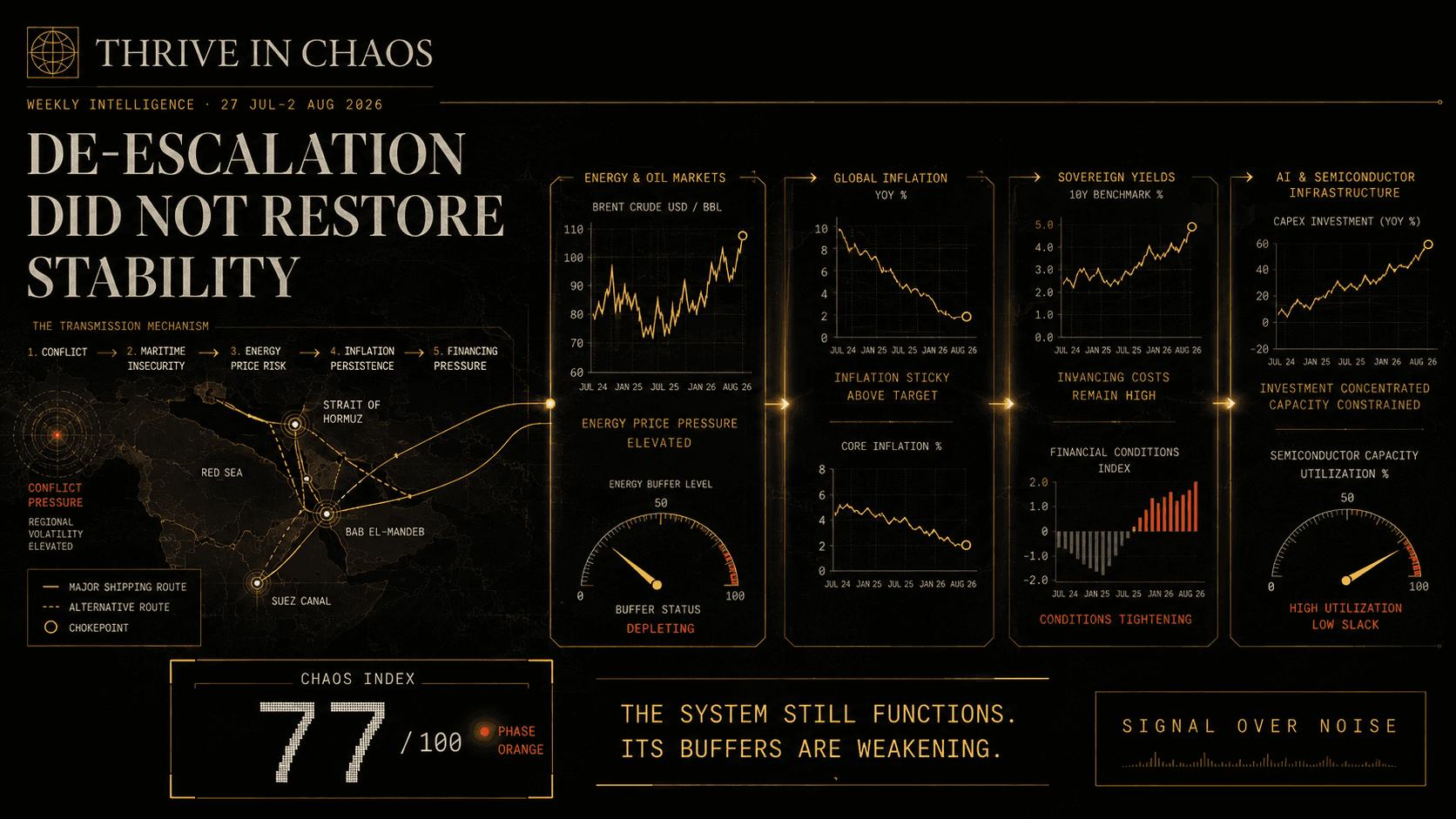
WEEK 31 — DE-ESCALATION WITHOUT RESTORED STABILITY
Weekly Intelligence Brief · 27 July–2 August 2026
THE CHAOS INDEX
77 / 100 🟠
System Type: Inflationary Disorder
Primary Direction: Managed Instability
Analytical Confidence: Medium–High
Executive Summary
Week 31 did not produce one dominant global shock. It revealed something structurally more important: temporary de-escalation is becoming less capable of restoring durable stability.
Military confrontation, energy prices, maritime routes, inflation expectations, monetary policy and technology investment are increasingly connected through the same limited set of buffers.
A pause in one pressure point may reduce immediate risk without restoring the system’s capacity to absorb the next disruption.
This is why the Chaos Index remains elevated at 77 out of 100.
The global system continues to function. Trade continues. Financial markets remain liquid. Governments retain policy tools. Companies continue investing.
But the cost of maintaining that functionality is rising.
The defining condition is therefore not systemic collapse. It is managed instability with declining shock absorption.
The priority is not to predict every disruption. It is to preserve sufficient liquidity, redundancy and decision flexibility to respond when conditions change.
What Happened
Five developments defined the week.
1. De-escalation failed to become durable
A temporary reduction in confrontation between the United States and Iran did not create a lasting stabilisation mechanism.
The problem was not simply that tensions returned. Political signalling did not fully constrain the military, proxy and maritime actors capable of restarting escalation.
A local action can still reactivate the broader conflict system and affect oil markets, shipping, insurance and inflation expectations.
The stabilisation window is becoming shorter.
2. Maritime risk spread across connected chokepoints
Risk in the Strait of Hormuz, Bab el-Mandeb, the Red Sea and the Suez corridor can no longer be analysed separately.
Avoiding one route does not eliminate the risk. It transfers pressure elsewhere.
Rerouting vessels increases transit time, fuel consumption, insurance costs, vessel demand, inventory requirements and working-capital needs.
The result is displacement rather than resolution.
3. Energy returned as a constraint on inflation and monetary policy
Oil prices ended July at elevated levels while European gas buffers remained incomplete.
Energy is operating through several channels simultaneously:
household costs;
industrial margins;
transportation costs;
inflation expectations;
government subsidies;
central-bank decisions.
The principal risk is not one temporary energy spike. It is that elevated prices persist long enough to delay monetary easing and reduce financial flexibility.
4. AI growth became more concentrated
Artificial-intelligence investment continues to support semiconductor demand, data-centre construction, cloud infrastructure and electricity consumption.
However, this growth engine is increasingly dependent on:
a limited number of technology companies;
concentrated semiconductor supply chains;
large capital-expenditure programmes;
access to financing;
sufficient power and grid capacity.
Strong aggregate investment can therefore coexist with rising company-level and market-level fragility.
5. Air-defence scarcity became a strategic bottleneck
The war in Ukraine continued to expose an unfavourable exchange between relatively low-cost offensive systems and expensive defensive interceptors.
Repeated attacks force defenders to use scarce munitions faster than allied production can replenish them.
This creates a non-compensatory risk: strength in other areas cannot fully offset a shortage in the specific defensive layer required to protect critical infrastructure.
Why It Matters
The five developments are connected by one structural pattern:
Buffers are being consumed faster than they are rebuilt.
Energy inventories are incomplete.
Shipping redundancy is limited.
Air-defence inventories are constrained.
Fiscal space is being used to absorb energy and security costs.
Monetary-policy flexibility is reduced by inflation risk.
Technology growth increasingly depends on concentrated capital expenditure and infrastructure.
The world is not becoming incapable of responding.
It is becoming more expensive to respond.
Each additional disruption requires more capital, more inventory, more political coordination and more time.
This reduces optionality.
Pattern of the Week
Stabilisation Is Becoming More Expensive
In a resilient system, a temporary ceasefire, lower volatility or declining energy price allows buffers to recover.
In the current environment, pressure often moves from one domain to another before recovery is complete.
Conflict moves into shipping.
Shipping moves into energy and inventory costs.
Energy moves into inflation.
Inflation moves into monetary policy.
Higher financing costs then affect technology investment, government budgets and household demand.
Stabilisation remains possible, but it requires increasing expenditure of limited buffers.
Chaos Interpretation
A Chaos Index reading of 77 indicates elevated systemic pressure without immediate cascading breakdown.
The system is characterised by:
multiple active stress channels;
incomplete policy control;
shrinking stabilisation windows;
declining buffer quality;
greater dependence on a limited number of critical systems.
The global system remains functional.
Its resilience is weakening.
Apparently stable conditions should therefore not automatically be interpreted as structural improvement.
Stability may instead reflect the temporary use of inventories, fiscal support, military reserves or financial liquidity.
Outlook
Base Scenario — Managed Instability
Probability: 55%
Conflict remains below the threshold of full regional war, but recurring incidents sustain elevated energy, maritime and insurance costs.
Inflation declines slowly.
Central banks retain restrictive policies for longer.
Markets remain operational but volatile.
Stress Scenario — Distributed Escalation
Probability: 30%
A series of attacks or operational interruptions affects ports, terminals or maritime corridors.
Oil moves materially higher.
European energy security deteriorates.
Inflation expectations rise and monetary easing is delayed.
Severe Scenario — Cross-System Disruption
Probability: 15%
A major military escalation causes sustained disruption to energy exports or critical shipping routes.
The shock spreads through inflation, sovereign financing, industrial production and financial markets.
This remains the least likely scenario, but its consequences would be disproportionate.
Watch Next
Monitor:
whether Brent crude closes above $100 on several trading days;
the pace of European gas-storage replenishment;
operational suspensions at major ports or energy terminals;
war-risk insurance premiums;
central-bank references to Middle East energy prices;
revisions to major technology capital-expenditure plans;
semiconductor localisation in China;
air-defence interceptor deliveries and production rates.
The direction of these indicators matters more than individual headlines.
Recommendations
Individuals
Review fixed monthly exposure within 14 days.
Identify expenses most sensitive to energy, borrowing costs and currency changes.
Maintain a liquid reserve where feasible.
Liquidity is not merely idle capital. It preserves the ability to respond without forced decisions.
Limit continuous conflict monitoring.
Scheduled information reviews improve decision quality more than constant exposure to rapidly changing headlines.
Business
Map exposure to connected maritime chokepoints within 30 days.
Include rerouting, insurance, supplier and working-capital effects.
Stress-test margins at Brent prices of $90, $110 and $130.
Identify where energy prices become operationally material.
Measure AI-cycle concentration.
Review dependence on individual customers, semiconductor suppliers, cloud providers, power infrastructure and financing conditions.
Capital
Measure portfolio dependence on the largest technology companies.
Headline index diversification may conceal concentration in earnings and capital expenditure.
Test duration exposure against a higher-for-longer rate environment.
Energy inflation can delay monetary easing and pressure long-duration assets.
Separate European exposure by energy intensity and pricing power.
Broad geographic allocation is insufficient when company-level energy sensitivity differs substantially.
Final Assessment
Week 31 confirmed that the global system is not moving cleanly from crisis to stabilisation.
Risk is circulating between conflict, energy, shipping, inflation, finance and technology.
The main strategic error would be to interpret temporary calm as restored resilience.
The system remains functional because governments, companies and households continue spending buffers to preserve that functionality.
The central question is therefore no longer whether disruption will occur.
It is whether sufficient room to manoeuvre will remain when it does.
THRIVE IN CHAOS
Decision Intelligence for an Uncertain World
Analysis → Forecast → Recommendations
Signal → Meaning → Action → Stability
Signal Over Noise
thriveinchaos.ai
AI intelligence system with human editorial oversight. This publication is intended for analytical and educational purposes and does not constitute financial, investment, legal or professional advice.
NEWSLETTER
Subject Line
Week 31: Stability Is Becoming More Expensive
Preview Text
Chaos Index 77. Temporary de-escalation reduced immediate pressure but did not rebuild system resilience.
Newsletter Title
DE-ESCALATION WITHOUT RESTORED STABILITY
Newsletter Body
THRIVE IN CHAOS · WEEK 31
27 July–2 August 2026
THE CHAOS INDEX — 77 / 100 🟠
System Type: Inflationary Disorder
Direction: Managed Instability
Week 31 did not produce one dominant global shock.
It revealed that temporary de-escalation is becoming less capable of restoring durable stability.
Conflict, energy prices, maritime routes, inflation, monetary policy and AI investment are increasingly connected through the same limited set of buffers.
A pause in one pressure point may reduce immediate risk without restoring the system’s ability to absorb the next disruption.
The central pattern
Buffers are being consumed faster than they are rebuilt.
European energy inventories remain incomplete.
Shipping alternatives consume time, fuel, fleet capacity and working capital.
Air-defence systems depend on scarce interceptors.
Fiscal support reduces future policy space.
AI growth depends increasingly on concentrated capital expenditure and infrastructure.
The global system remains functional.
But the cost of preserving that functionality is rising.
Base scenario — 55%
Managed instability continues.
Conflict remains contained below the threshold of full regional war, but recurring incidents sustain elevated energy, insurance and transport costs.
Inflation declines slowly and central banks retain restrictive policy for longer.
Stress scenario — 30%
A series of attacks or operational interruptions affects ports, terminals or maritime routes.
Oil moves materially above current levels.
Inflation expectations rise and monetary easing is delayed.
Severe scenario — 15%
A major escalation disrupts energy exports or critical shipping routes for a sustained period.
The shock spreads into inflation, sovereign financing, industrial production and financial markets.
What to watch
Brent crude above $100;
EU gas-storage refill;
port or terminal suspensions;
war-risk insurance premiums;
central-bank language on energy inflation;
technology capital-expenditure revisions;
air-defence replenishment rates.
What to do
Individuals: review fixed expenses and protect liquidity.
Business: map connected chokepoint exposure and stress-test margins at $90, $110 and $130 oil.
Capital: measure hidden technology concentration and test duration exposure against delayed rate cuts.
Temporary calm should not be confused with restored resilience.
The strategic objective is not to predict every event.
It is to retain enough room to manoeuvre when conditions change.
Read the full Week 31 intelligence brief:
thriveinchaos.ai
THRIVE IN CHAOS
Decision Intelligence for an Uncertain World
Analysis → Forecast → Recommendations
Signal → Meaning → Action → Stability
Signal Over Noise
AI intelligence system with human editorial oversight.
PATREON FREE
Title
Week 31: De-escalation Without Restored Stability
Subtitle
Chaos Index 77 — temporary calm did not rebuild system resilience.
Body
THE CHAOS INDEX — 77 / 100 🟠
Weekly reading · 27 July–2 August 2026
The central signal of Week 31 was not one new crisis.
It was the shortening duration of stabilisation.
Temporary de-escalation reduced immediate pressure, but conflict, oil, shipping, inflation and financial conditions remained connected.
The global system continues to function.
However, it is relying increasingly on the expenditure of limited buffers:
energy inventories;
financial liquidity;
shipping capacity;
fiscal support;
military stockpiles;
corporate balance sheets.
The main pattern is therefore:
Buffers are being consumed faster than they are rebuilt.
Base scenario — 55%
Managed instability continues. Oil and shipping costs remain elevated, but major routes continue operating.
Stress scenario — 30%
A port, terminal or maritime corridor experiences a material interruption. Oil rises and monetary easing is delayed.
Severe scenario — 15%
A sustained regional escalation spreads into energy, inflation, sovereign financing and industrial production.
Three practical actions
Individuals: review fixed monthly exposure and protect liquidity.
Business: map combined exposure to Hormuz, the Red Sea and Suez.
Capital: identify hidden concentration in AI and technology-related holdings.
The strategic error would be to interpret temporary calm as restored resilience.
The correct response is not fear or complete withdrawal.
It is preserving the ability to change direction without disproportionate loss.
The extended reports include:
full cross-system mechanism;
six measurable forecasts;
leading indicators;
trigger conditions;
detailed recommendations for Individuals, Business and Capital.
THRIVE IN CHAOS
Signal Over Noise
thriveinchaos.ai
#ThriveInChaos #ChaosIndex #DecisionIntelligence #WeeklyBrief
AI intelligence system with human editorial oversight.
PATREON PRO
Title
Week 31 PRO: The Rising Cost of Stabilisation
Subtitle
Chaos Index 77 — conflict, energy, inflation and technology investment are reinforcing the same structural constraints.
Body
THE CHAOS INDEX — 77 / 100 🟠
System Type: Inflationary Disorder
Primary Interaction: Conflict × Energy
Secondary Interaction: Technology Investment × Financial Conditions
Week 31 confirmed a structural change in the global risk environment:
De-escalation is becoming less effective at restoring system capacity.
The world continues to avoid comprehensive breakdown because governments, companies and households repeatedly deploy buffers.
Those buffers include energy inventories, liquidity, fiscal support, spare shipping capacity, military stockpiles, corporate balance sheets and household savings.
The principal risk is not the failure of every buffer simultaneously.
It is the gradual reduction in their quality and availability.
The dominant transmission mechanism
Military escalation
→ maritime insecurity
→ energy-price risk
→ inflation persistence
→ delayed monetary easing
→ higher financing costs
→ weaker fiscal and investment flexibility
The most important variable is duration.
A brief oil-price increase can be absorbed.
Persistent elevated prices alter inflation expectations, central-bank policy and capital allocation.
Why temporary calm is misleading
A temporary ceasefire or decline in volatility can reduce immediate stress.
It does not automatically restore:
depleted inventories;
military stockpiles;
fiscal space;
supply-chain redundancy;
political trust;
financing capacity.
Operational continuity can therefore remain visible while structural resilience weakens.
Scenario architecture
Managed Instability — 55%
No sustained closure of a major chokepoint.
Oil remains elevated but manageable.
Central banks delay easing.
AI capital expenditure remains strong but concentrated.
Decision posture: maintain productive exposure while strengthening liquidity and redundancy.
Distributed Escalation — 30%
Repeated attacks affect maritime or energy infrastructure.
At least one port or terminal suspends operations temporarily.
Brent trades above $100 for several sessions.
Decision posture: activate prepared contingencies, alternative routes and exposure limits.
Cross-System Disruption — 15%
Sustained disruption affects major energy exports or several connected maritime corridors.
Inflation and financial volatility rise together.
Decision posture: prioritise essential continuity and liquidity over optimisation.
Forecast Ledger
F01 — Brent above $100
Probability: 41%
YES if front-month Brent officially closes above $100 on at least three trading days before 31 August 2026.
F02 — EU gas storage below 70%
Probability: 64%
YES if the published EU aggregate remains below 70% on 31 August 2026.
F03 — VIX above 25
Probability: 28%
YES on an official daily close above 25 before 14 August 2026.
F04 — Major port or terminal suspension
Probability: 47%
YES if a confirmed attack causes at least 12 hours of operational suspension before 30 September 2026.
F05 — Central bank delays easing because of Middle East energy prices
Probability: 68%
YES if the Fed, ECB, Bank of England or Bank of Japan explicitly links Middle East energy prices to delayed easing before 31 October 2026.
F06 — Chinese commercial production using domestic immersion DUV equipment
Probability: 39%
YES only after company disclosure and independent technical confirmation before 31 January 2027.
Trigger conditions
Increase defensive positioning if any two occur:
Brent closes above $100 for three sessions;
a major port or terminal suspends operations;
war-risk insurance premiums rise sharply;
EU gas storage falls materially behind trajectory;
a major central bank delays easing because of energy prices.
Review AI-cycle exposure if:
leading companies reduce capital-expenditure guidance;
semiconductor demand forecasts are revised down;
data-centre projects are delayed by power or financing constraints;
Chinese substitution materially changes expected market share.
Recommendations
Individuals
Build a household optionality map within 14 days.
Identify fixed essential costs, variable debt, energy exposure, currency exposure and unstable income sources.
Maintain a reserve proportionate to income stability and fixed obligations.
Use scheduled information reviews rather than continuous crisis monitoring.
Business
Map direct and indirect exposure to Hormuz, Bab el-Mandeb, the Red Sea and Suez.
Stress-test margins at Brent prices of $90, $110 and $130.
Introduce trigger-based inventory rules rather than permanently maximising stock.
Audit dependence on individual AI customers, semiconductor suppliers, cloud providers, power sources and financing channels.
Stage large capital expenditure into reversible phases where possible.
Capital
Calculate direct and indirect exposure to the largest AI and technology companies.
Stress-test portfolios against delayed rate cuts, higher long-term yields and weaker growth.
Segment European holdings by energy intensity, pricing power, secured supply and refinancing needs.
Separate the structural AI thesis from valuation and concentration risk.
Preserve deployable liquidity to avoid forced asset sales during dislocation.
Final strategic judgement
Week 31 did not mark a transition into systemic breakdown.
It showed that the system is becoming more dependent on continuous intervention.
That dependence matters because intervention consumes the resources required for future intervention.
The defining advantage will not be perfect prediction.
It will be the ability to continue making high-quality decisions after conditions change.
THRIVE IN CHAOS
Decision Intelligence for an Uncertain World
Analysis → Forecast → Recommendations
Signal → Meaning → Action → Stability
Signal Over Noise
thriveinchaos.ai
AI intelligence system with human editorial oversight. This report is provided for analytical and educational purposes and does not constitute financial, investment, legal, tax or professional advice.
Join the newsletter
Be the first to read our articles.


