

THE WORLD ISN’T RUNNING OUT OF RULES | IT’S RUNNING OUT OF CAPACITY TO APPLY THEM
The reason given for the deferral is the important part, and it was not a change of policy. National competent authorities had not been designated. Harmonised technical standards were not finalised. The compliance tools required to assess conformity did not exist yet. The rules were not withdrawn because anyone stopped wanting them. They were postponed because the machinery to apply them was not ready.
16 min red
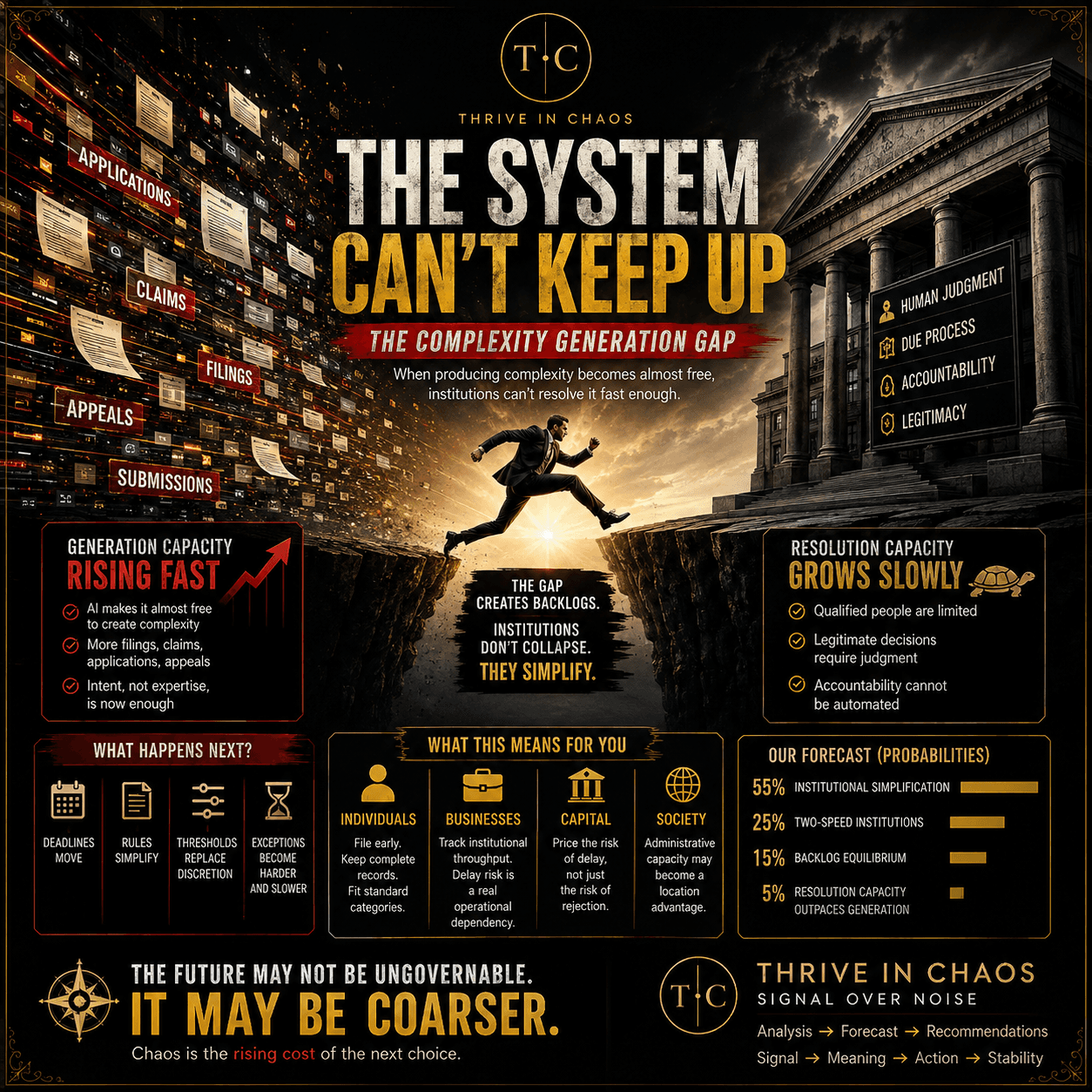
THE COMPLEXITY GENERATION GAP
What happens when producing complexity becomes almost free
Article 2 of 8 · Series I of III · Published 19 August 2026 · Analysis → Forecast → Recommendations
How this series measures things. Every article applies the same three questions to its subject. Concentration: how many genuinely independent alternatives exist, once shared upstream origins are traced rather than counted. Criticality: what stops if this fails, and how quickly. Substitution time: how long until an alternative actually functions. Article 1 applied this to physical and financial dependency. This article applies it to something less obvious: the capacity of institutions to process what the world produces.
1. The Signal
On 27 July 2026, an amendment to the European Union's Artificial Intelligence Act entered into force. Its central effect was to move a deadline.
The Act's obligations for standalone high-risk AI systems — those used in employment, creditworthiness assessment, education, insurance underwriting and access to essential services — had been scheduled to apply from 2 August 2026. They now apply from 2 December 2027. Obligations for high-risk systems embedded in regulated products moved from August 2027 to August 2028. The requirement for member states to establish national regulatory sandboxes moved by a year.
The transparency duties under Article 50 took effect on schedule on 2 August, ten days ago. Watermarking obligations for AI system providers moved to December 2026. The prohibitions in force since February 2025 remain in force, and a new prohibition on AI-generated non-consensual intimate imagery was added.
The reason given for the deferral is the important part, and it was not a change of policy. National competent authorities had not been designated. Harmonised technical standards were not finalised. The compliance tools required to assess conformity did not exist yet. The rules were not withdrawn because anyone stopped wanting them. They were postponed because the machinery to apply them was not ready.
Set that beside a second observation from an entirely different domain.
WIPO records 3.7 million patent applications filed worldwide in 2024, a record, up 4.9 percent on the previous year and the fifth consecutive annual increase. That was the fastest growth since 2018. Filings have nearly doubled since 2010. Computer technology is the largest single field at 13.2 percent of published applications, and it has grown at an average of 10.3 percent a year over the past decade.
Patent offices are the clearest available measurement of a general phenomenon, because they are one of the few institutions that publishes its own inbound volume. Every one of those 3.7 million applications requires examination by someone qualified to judge novelty, and the number of such people does not grow at 4.9 percent a year.
Two observations, two continents, two unrelated fields of law.
In both cases the volume of things requiring institutional judgement is rising faster than the capacity to render it.
Article 1 argued that the world is becoming less forgiving because the system has less slack. This article examines the specific mechanism by which slack disappears from institutions, which is different from how it disappears from supply chains, and considerably less discussed.
2. The Mechanism
Every functioning institution operates on a ratio that nobody calculates.
On one side, the rate at which the world produces things requiring a decision: applications, claims, filings, disputes, transactions, requests, appeals, submissions, registrations, inspections.
On the other, the rate at which the institution can resolve them to a standard that holds.
Call it the ratio of generation capacity to resolution capacity. While it sits below one, the institution is in equilibrium and nobody thinks about it. Above one, a backlog forms. The backlog is not the problem. The backlog is the symptom that the ratio crossed one, and what happens next is the subject of this series.
Why nobody notices until it is late
The ratio has an unpleasant measurement property: it is invisible until well after it crosses one.
Backlog is a stock, not a flow. An institution running at a ratio of 1.02 accumulates a queue slowly enough that each individual month looks normal, and the accumulated total only becomes visible when it is large. By the time the backlog is discussed, the ratio has usually been above one for years, and the remedy required is proportional to the accumulated stock rather than to the current imbalance.
This is why institutional overload arrives as a surprise to institutions that were watching. They were watching the monthly flow, which looked survivable, rather than the ratio, which is what determines whether the flow is survivable indefinitely.
Why the two sides moved apart
For most of modern history the two costs were coupled. Producing a formal claim required a professional, which meant time and money. Resolving it required a professional, which meant time and money. Both sides were rate-limited by the same scarce input, so both grew at roughly the same pace, and the ratio stayed roughly stable through several centuries of institutional expansion.
Software began to decouple them. Artificial intelligence is breaking the coupling.
The generation side is approaching a cost floor of near zero. Drafting a claim, a filing, an appeal, an application or a submission is becoming a task that requires intent rather than expertise. One person can now produce what previously required a department.
The resolution side has not moved in the same way, and the reason is not that institutions are slow to adopt technology. Some are quick. The reason is structural.
The irreducible step
Generation can be automated end to end. A document can be produced entirely by machine and nothing about it requires a human to have been involved, because the document carries no consequence until somebody acts on it.
Resolution cannot be automated end to end wherever consequence attaches, and consequence is what institutions exist to deliver. A decision that denies a benefit, grants a licence, awards damages, refuses an application or authorises a treatment must be attributable, contestable and legitimate. Each of those properties requires something that does not scale with compute.
— Attribution: someone must be answerable for the decision. A model output with no accountable party is not a decision, it is a suggestion.
— Contestability: the affected party must be able to challenge it, which requires the reasoning to be reconstructible after the fact rather than merely produced.
— Legitimacy: the outcome must be accepted by people who did not want it, which is a social property and not a technical one.
This is why the asymmetry is not a temporary lag. It is a structural feature of what institutions are for. An institution that could resolve at machine speed with no accountable human would have stopped being an institution and become an algorithm, and the debate about whether that is acceptable is precisely what deferred the AI Act.
Applying the instrument
The three questions from Article 1 transfer directly, and the answers are uncomfortable.
Measure | Applied to institutional capacity | Typical answer |
Concentration | How many independent bodies can render this judgement? | Frequently one. There is no second patent office, no alternative court of jurisdiction, no competing regulator. |
Criticality | What stops if it cannot keep up? | Not collapse. Delay first, then a change in what gets decided at all. |
Substitution time | How long to build additional capacity? | Years. Examiners, judges and inspectors are trained, not hired. |
Institutional capacity is the most concentrated dependency in the modern system and the one with the longest substitution time. It is also the one nobody holds inventory against, because it never occurred to anyone that it might run short.
The two sections that follow examine what is actually driving the ratio, and what institutions do when it crosses one.
3. Subtheme One — This Is Not an AI Story
The most common version of this argument treats artificial intelligence as the cause. That version is wrong, and being wrong about it leads to the wrong response.
The curve was already rising. AI is an accelerant applied to something that had been climbing for three decades.
The evidence predates the technology
Global patent filings nearly doubled between 2010 and 2024. The fifth consecutive annual rise was recorded for 2024, meaning the streak began in 2020. Computer technology has grown at over ten percent a year for a decade — a trend that starts long before any generative system was available to a filer.
Whatever is driving institutional load, it did not start in 2023.
Four independent sources feeding the same channel
Regulatory accumulation. New rules are added far more often than old ones are removed, and each rule creates a class of cases that must be assessed, licensed, inspected or contested. The AI Act itself is an instance: a single regulation that generates conformity assessments, notified body designations, sandbox applications, registrations and incident reports, none of which existed as categories three years ago.
The energy transition. Every grid connection, every storage installation, every transmission corridor and every mineral processing facility is a permitting case, an environmental assessment and frequently a legal challenge. Article 1 described the connection queue as an engineering constraint. It is simultaneously an administrative one, and the administrative half is often the longer half.
Trade fragmentation. When access becomes conditional, conditions must be checked. Export controls, sanctions screening, origin verification and dual-use classification each convert what used to be a commercial decision into a compliance determination requiring a qualified judgement. Fragmentation does not reduce the volume of trade nearly as much as it multiplies the number of decisions per unit of it.
Demography. Ageing populations generate rising volumes of pension assessments, healthcare authorisations, disability determinations and care entitlements, at the same time as the working-age cohort from which assessors are drawn contracts. This is the only one of the four where the generation side and the resolution side move in opposite directions by arithmetic necessity.
Why the distinction changes the response
If AI is the cause, the response is to regulate AI, and the problem resolves when the technology matures.
If AI is an accelerant on a curve driven by four independent forces, regulating it changes the slope and not the direction. The other four continue regardless, and three of them are the direct consequence of policies most people support.
That is the harder version of the argument, and it is the one the evidence supports. The complexity is not being generated by an external technology imposed on institutions. Much of it is being generated by the institutions themselves, doing what they were asked to do.
4. Subtheme Two — What Institutions Actually Do About It
The intuitive prediction is that an overloaded institution slows down, forms a queue, and eventually seizes. Backlog, then paralysis, then failure.
That prediction is wrong, and the AI Act deferral is a clean demonstration of why.
The case, in sequence
The Act entered into force on 1 August 2024 with a staggered timetable. By late 2025 implementation was visibly behind: national competent authorities were undesignated, harmonised standards unfinished, conformity assessment infrastructure not yet in place.
On 19 November 2025 the Commission proposed amendments. Trilogue negotiations on 28 April 2026 ended without agreement. A provisional political agreement followed on 6 and 7 May, was confirmed by member state representatives on 13 May, and entered into force on 27 July, six days before the original deadline.
The outcome was a sixteen-month deferral for one category, a twelve-month deferral for another, a one-year deferral for national sandboxes, and a set of measures the institutions themselves described as simplification.
Nothing seized. Nothing collapsed. A deadline moved, scope was trimmed, and the parts that could be delivered were delivered on schedule.
The general form
An institution facing a ratio above one has four moves available, and it uses them in a predictable order.
It defers. The cheapest response is to move the date, which converts an impossible obligation into a difficult one without conceding anything of principle.
It simplifies. Categories replace cases. A rule that would have required individual assessment is rewritten to apply on a threshold, because a threshold can be checked and an assessment cannot be scaled.
It raises the bar for entry. Fees rise, standing narrows, filing requirements tighten. The queue is shortened at the front rather than processed faster at the back.
It stops deciding some things altogether. Discretion is withdrawn, exceptions are eliminated, and what was once a judgement becomes a form.
The order is not arbitrary. Deferral costs the least politically and concedes nothing, so it comes first. Simplification concedes something real and is therefore resisted until deferral has been exhausted. Raising the bar at the front of the queue is unpopular and visible, so it follows. Withdrawing a decision entirely is the last move, because it is the only one that cannot be presented as a temporary adjustment.
Watching which move an institution reaches for tells you how far along the sequence it already is, and the sequence is a better indicator of load than any statistic it publishes about itself.
The consequence, stated precisely
The complexity generation gap does not produce institutional paralysis. It produces a simpler world. An institution that cannot match the variety of what it faces will reduce the variety it recognises, and it will do so because that is the only move available to it.
This is a formal result rather than a rhetorical one. A control system must possess at least as much variety as the system it regulates. When it cannot acquire more, it must reduce the variety it is required to handle. There is no third option, and the reduction happens whether or not anyone intends it.
The effects are not evenly distributed. A threshold rule is efficient for the standard case and blunt for the unusual one. Someone whose circumstances fit the category is served faster than before. Someone whose circumstances do not fit any category discovers that the category is now the whole of the law.
The AI Act did all four things in a single instrument: it deferred, it simplified, it maintained the entry requirements it could enforce, and it left several implementation questions to a later date. That is not a failure of the legislation. It is what capable institutions do under load, and recognising it as normal is the first step to forecasting it.
Article 3 examines this response in detail, because it is the most consequential and least discussed feature of the coming decade.
5. What Most Analysis Gets Wrong
That artificial intelligence will resolve as much as it generates
It will help substantially, and it will not close the gap, because the two sides are not symmetric. A machine can produce a filing with no human involved. A machine cannot produce a binding decision with no accountable human, wherever the decision carries consequence. The generation side has no floor. The resolution side has one, and the floor is legal and social rather than technical.
That bureaucratic collapse is coming
The evidence points the other way. Institutions under load do not seize; they economise. The visible outcome is not a system that stops working but one that recognises fewer distinctions and offers less discretion. Predicting collapse is more dramatic and less accurate, and it leads people to prepare for the wrong event.
That deferral means the rules were abandoned
The AI Act deferral was a reprieve rather than a repeal. The obligations remain, with new dates, and several were reinforced in the same instrument. Reading a moved deadline as a retreat produces exactly the wrong preparation: an organisation that stopped work in August 2026 will face the same obligations in December 2027 with sixteen months less progress and the same shortage of qualified assessors, now competing with everyone else who also stopped.
That this is primarily a public-sector problem
The same ratio governs any organisation that must render judgements at volume. Insurers assessing claims. Banks assessing creditworthiness. Platforms assessing content. Employers assessing applications. Each faces rising inbound volume that can be machine-generated, against a resolution process that carries liability and therefore cannot be fully automated. The private sector reaches the same four moves by the same logic, and generally reaches them faster.
6. Base, Stress and Extreme
Four paths, with our probability assessment and the condition that would falsify each. Probabilities sum to one hundred.
Path | P | What it looks like | What would falsify it |
Institutional simplification | 55% | Categories replace cases, thresholds replace assessment, discretion narrows. Faster for the standard case, worse for the unusual one | Discretionary and individually assessed decision-making expands in volume across several major administrative systems |
Two-speed institutions | 25% | Machine triage for standard cases, human capacity concentrated on exceptions. Works where interoperable data infrastructure exists and not elsewhere | Automated adjudication is broadly prohibited rather than bounded, in the jurisdictions with the infrastructure to attempt it |
Backlog equilibrium | 15% | Queues become permanent and delay becomes the rationing mechanism. Nothing is formally denied; things simply take longer than the decision is worth | Processing times fall across several high-volume systems while inbound volume continues rising |
Resolution outrun | 5% | Resolution capacity rises faster than complexity is generated and institutions process more with less delay | This is the falsifier for the series as a whole rather than a scenario needing one |
The base and second cases are not opposites. The most likely single outcome is simplification in most places and two-speed operation in a minority with the data infrastructure to support it, which is why the divergence in the ten-year forecast matters more than the aggregate.
7. Forecast — One Year, to mid-2027
Generation volume continues rising while resolution capacity does not
Probability 0.75 · Confidence: High
The measurable proxies keep climbing. Patent filings, regulatory submissions, compliance determinations and formal claims all continue to rise, and no comparable expansion occurs in examiner, assessor, inspector or judicial capacity, because those roles are trained over years rather than recruited over months.
The visible symptom in this window is not failure. It is lengthening processing times in systems that were already at capacity, and a rising share of decisions taken by threshold rather than by assessment.
Second-order effect. Organisations that can absorb delay gain an advantage over those that cannot, independently of the merits of their case. Where a decision takes eighteen months, the party able to wait eighteen months wins arguments it would have lost on substance.
What would weaken it. A measurable expansion of qualified assessment capacity in at least two major jurisdictions, or a fall in inbound volume that is not explained by a fee increase or a narrowing of standing.
8. Forecast — Three Years, to 2029
Deferral and simplification become the standard institutional response
Probability 0.70 · Confidence: Medium-High
The AI Act deferral is early rather than exceptional. We expect further instances across major regulatory programmes: deadlines moved, scope narrowed, individual assessment replaced by categorical rules, and the change presented as simplification rather than as capacity failure.
The presentation matters analytically. A deferral described as simplification is difficult to distinguish from genuine deregulation, and the two have opposite implications. Deregulation reduces obligation. Capacity-driven simplification preserves the obligation and reduces the fineness with which it is applied.
Second-order effect. Compliance planning becomes harder rather than easier. A stable rule that is difficult is more manageable than a moving rule that is simple, because the moving date destroys the value of preparation and rewards the organisations that did least.
What would weaken it. Major regulatory programmes meeting their original timetables, particularly where the original timetable required new assessment infrastructure to exist first.
9. Forecast — Five Years, to 2031
Automated adjudication arrives in high-volume standard cases, bounded by contestability
Probability 0.55 · Confidence: Medium
By the early 2030s we expect machine decision-making to be formally authorised for high-volume standard cases in several jurisdictions, with human capacity redirected toward exceptions and appeals. The likely first domains are those with structured data and low ambiguity: routine tax assessment, standard benefit renewal, licence renewal, customs classification.
The binding constraint will not be technical capability, which already exists. It will be contestability — whether the reasoning can be reconstructed well enough to survive a challenge. Systems that can explain a decision after the fact will be authorised. Systems that can only produce one will not, regardless of accuracy.
Second-order effect. The exception queue becomes the new bottleneck, and it will be staffed by the people the standard queue no longer needs, who may not be qualified for the harder cases. Automating the easy half of a workload does not halve it; it concentrates the difficulty.
What would weaken it. A binding prohibition on automated decision-making without individual human review in the jurisdictions with the infrastructure to deploy it, or a high-profile failure severe enough to reverse authorisations already granted.
10. Forecast — Ten Years, to 2036
Institutional capacity becomes a location factor
Probability 0.45 for a pronounced version · Confidence: Medium-Low
Over a decade, the divergence between institutions that can process at volume and those that cannot may become material enough to influence where activity locates. Not through any dramatic event, but through the accumulation of ordinary delays: how long a permit takes, how long a dispute takes, how long a licence takes, how predictable each of those is.
The differentiator will be interoperable data infrastructure rather than institutional quality in the conventional sense. A well-regarded institution without machine-readable records may process more slowly than a less-regarded one that has them, which will be an uncomfortable finding for the conventional rankings.
We hold this at lower confidence deliberately. Ten-year institutional forecasts are the easiest kind to write and the hardest to resolve, and this one also depends on the shape of measurement that does not exist yet.
What would weaken it. Convergence rather than divergence: administrative processing times narrowing between jurisdictions, or the emergence of portable cross-border assessment that makes local institutional capacity less binding.
11. Signals to Watch
— Filing and application volumes where institutions publish them: patents, trademarks, regulatory submissions, formal claims
— Deadline changes in major regulatory programmes, and the reason given for each. Capacity failure and policy change look identical in a press release and have opposite implications
— Individual assessment replaced by threshold or categorical rules in benefits, permitting, licensing and tax
— Fee increases and narrowing of standing, which shorten the queue at the front rather than the back
— Formal authorisation of automated decision-making, and specifically whether the authorisation requires reconstructible reasoning
— Recruitment and training pipelines for examiners, assessors, inspectors and judges, which are the actual resolution capacity
— Processing time as a published statistic. Where it stops being published, treat that as a signal in itself
12. Recommendations — Individuals
The practical consequence of a simplifying institution is that fitting the category becomes more valuable than having a good case, and being unusual becomes more expensive than it used to be.
Immediate — 30 days
List every pending or foreseeable interaction with an institution over the next two years: a permit, a visa or residence renewal, a benefit, a licence, a registration, a tax position, a claim. Against each, record the current processing time and the date you would need the decision. The gap between those two numbers is your exposure, and it is usually larger than expected because the remembered processing time is the one from several years ago.
Build — 12 months
File early and completely. Under a lengthening queue, submission date determines outcome more than merit does, and an incomplete filing usually returns to the back rather than being corrected in place.
Keep your own documentation in a form you can reproduce. As institutions economise, the burden of proof shifts toward the applicant, and the party who can produce the record quickly is the party whose case gets assessed rather than deferred.
Position — 3 years
Where a life decision depends on an institutional outcome, prefer arrangements that fit a standard category over ones requiring individual assessment, unless the non-standard route offers something substantial enough to justify the delay. This is uncomfortable advice and it is what the mechanism implies. The unusual case is not being refused. It is being made slower, and slower is a cost that compounds.
Avoid. Treating a deferred deadline as a cancelled one. When an obligation moves, the requirement generally survives, and the people who stopped preparing arrive at the new date competing for the same scarce assessment capacity as everyone else who stopped.
Why this works. You cannot increase an institution's capacity. You can control which queue you are in, when you entered it, and whether your case can be decided without a further request for information. All three are within reach and all three are usually neglected.
13. Recommendations — Business
Most organisations track regulatory obligations and do not track regulatory throughput. The obligation tells you what is required. The throughput tells you whether anyone can process it, and the second determines the timeline.
Immediate — 60 days
Build a register of every institutional dependency in the business: permits, licences, certifications, conformity assessments, customs classifications, court and tribunal matters, regulatory approvals. For each, record the issuing body, the current processing time, the trend in that time, and what happens operationally if it doubles.
Then apply the concentration question honestly. For most of these there is exactly one body that can issue the decision, no alternative and no appeal that does not go through the same institution. That is a single point of failure with a substitution time measured in years, sitting outside the risk register entirely.
Build — 12 months
Move regulatory work earlier in project timelines than the formal deadline requires, and treat the deferral of a deadline as additional preparation time rather than as relief. The organisations that will handle the December 2027 high-risk obligations comfortably are the ones that continued working through the deferral.
Reduce the number of judgement calls your submissions require. A filing that fits a standard category clears faster than a better filing that requires assessment, and the difference widens as the queue lengthens. Where a project can be structured to fit an existing category without material loss, that structuring is worth real money in time.
Position — 3 years
Assume that the standard case is automated and the exception is queued. Design products, contracts and processes so that the ordinary path is machine-assessable and only genuinely unusual matters require human judgement. An organisation whose every transaction is an exception will find its cost of doing business rising for reasons that have nothing to do with its market.
Build the capacity to demonstrate compliance rather than merely to achieve it. As assessment capacity tightens, the burden shifts toward the applicant, and evidence that can be produced on request is worth more than evidence that exists somewhere.
Avoid. Optimising a business model around a regulatory interpretation that requires individual assessment to be sustained. Categorical simplification removes exactly those positions first, and it removes them without any decision being taken about your case specifically.
Why this works. Institutional throughput is a dependency with concentration of one and a substitution time of years. Article 1's rule applies unchanged: you cannot remove the dependency, and you can convert it into a form that preserves alternatives and buys time.
14. Recommendations — Capital
Regulatory risk is conventionally modelled as the risk that rules change. The larger and less modelled risk is that rules stay the same and cannot be administered.
Immediate — this quarter
For assets whose value depends on a pending institutional decision — a permit, a licence, an approval, a grid connection, a conformity assessment — establish the issuing body's current processing time and its trend, not the statutory timeline. The statutory timeline describes intent. The processing time describes capacity, and only one of them determines when the asset produces cash.
Build — 12 months
Separate two exposures that are usually combined. The risk that an approval is refused is a merits risk and is generally priced. The risk that an approval arrives two years late is a capacity risk and is generally not, despite being both more likely and, for a leveraged asset, frequently more damaging.
Then look at portfolio-level correlation. Holdings across different sectors can share a single regulator, a single permitting authority or a single court system. Sector diversification does not diversify institutional throughput, and a jurisdiction whose approval capacity is saturated will delay every asset in it at once.
Position — 3 years
Treat administrative capacity as a jurisdictional characteristic alongside tax, rule of law and political stability. Two jurisdictions with identical statutes and different processing times are not equivalent, and the difference is a durable rather than a cyclical property because it depends on training pipelines and data infrastructure.
Watch for the moment institutional throughput becomes disclosed rather than inferred. When permitting delay appears in offering documents and credit agreements as a named risk with a number attached, it stops being an edge.
Avoid. Reading a deferred regulatory deadline as reduced regulatory risk. The deferral usually signals that the assessment infrastructure is not ready, which makes the eventual bottleneck worse rather than better, and moves it to a date when more parties are competing for it.
Why this works. Capital's advantage is the ability to wait, and that advantage only pays if the waiting was priced in advance. A delay that was anticipated is a discount. The same delay unanticipated is a covenant breach.
15. What Would Change Our Mind
Each forecast above carries its own weakening condition. Three developments would undermine the argument of this article as a whole.
— Resolution capacity expands materially in a way that survives contestation. Not pilot schemes and not triage, but authorised machine adjudication operating at volume with reconstructible reasoning, sustained through appeal, in more than one jurisdiction.
— Generation volume falls for reasons other than rationing. A decline in filings caused by fee increases or narrowed standing confirms this thesis rather than refuting it; a decline while access remains open would refute it.
— Institutions demonstrably increase the variety they recognise while under load. Broader discretion, more individual assessment and more granular categories, adopted while inbound volume is still rising, would falsify the central mechanism directly.
A note on how well this article can be checked. The forecasts here resolve less cleanly than those in Article 1, where the underlying quantities are counted and published annually by institutions with a stable format. Institutional behaviour is measured worse, reported inconsistently and often described in language chosen to obscure the cause. We have written the resolution criteria as tightly as the available data allows and we are recording that they are looser than we would like, rather than presenting a precision the domain does not support.
Founder's Lens
[ EDITORIAL GATE — WRITTEN BY HAND BEFORE PUBLICATION. Never generated. Replace this marker with the founder's text, or record a suspension. ]
16. Bottom Line
Producing something that requires a decision is becoming almost free. Rendering the decision is not, and the reason is not technological conservatism. It is that a decision carrying consequence must be attributable, contestable and legitimate, and none of those properties scales with compute.
The gap between the two is widening, and artificial intelligence is an accelerant rather than the cause. Regulatory accumulation, the energy transition, trade fragmentation and demography each feed the same channel independently, and three of them are the direct result of policies most people support.
What follows is not collapse. Institutions under load economise on variety: they defer, they simplify, they raise the bar at the front of the queue, and they stop deciding some things altogether. The European Union did all four in a single instrument three weeks ago, and described it as simplification, which is both accurate and incomplete.
The world does not become ungovernable. It becomes coarser. Fewer distinctions are recognised, less discretion is available, and the standard case is served faster than before while the unusual case discovers that being unusual has become expensive.
For anyone whose plans depend on an institution saying yes, the practical consequence is narrow and actionable. Enter the queue earlier. Fit the category where fitting it costs little. Keep the evidence in a form you can produce on request. And read a moved deadline as what it is: not relief, but the same obligation arriving later, at a moment when everyone who relaxed will be competing for the same scarce judgement.
Chaos is the rising cost of the next choice. When institutions economise, some choices stop being available at any price.
Forecast record
Four forecasts from this article are recorded before the outcome is known, one per horizon, each with a threshold, a named verifier and a resolution date.
Horizon | Forecast, resolving yes or no | P | Resolves |
1 year | WIPO World Intellectual Property Indicators published in 2027 reports global patent applications for 2026 higher than for 2025, a seventh consecutive annual rise | 0.75 | 31 December 2027 · wipo.int |
3 years | The EU AI Act high-risk obligations for Annex III systems are either deferred again beyond 2 December 2027 or applied with reduced scope relative to the July 2026 text, as recorded in the Official Journal | 0.55 | 31 December 2029 · eur-lex.europa.eu |
5 years | At least two G7 jurisdictions have formally authorised decision-making without individual human review in a named high-volume public administrative process | 0.50 | 31 December 2031 · national legislation or regulator guidance |
10 years | WIPO reports global patent applications for 2035 at or above 5 million | 0.55 | 31 December 2036 · wipo.int |
Correlation, recorded rather than assumed away. The one-year and ten-year forecasts share a verifier and a parent cause in patent filing growth. The three-year and five-year forecasts share a parent cause in institutional response to load. These are two pairs rather than four independent observations, and we count them as such.
Directional statements elsewhere in this article carry no threshold and are deliberately excluded from the record.
Sources
Each figure carries its class, so that a projection and an observation cannot be read as the same kind of statement.
Figure | Class | Source |
Global patent applications 3.7 million in 2024, up 4.9%, fifth consecutive annual rise, fastest growth since 2018 | Measured | WIPO, World Intellectual Property Indicators 2025 |
Filings nearly doubled 2010 to 2024; computer technology 13.2% of published applications, 10.3% average annual growth over the decade | Measured | WIPO, same source |
AI Act entered into force 1 August 2024 with staggered application dates | Measured | Regulation (EU) 2024/1689 |
Digital Omnibus on AI proposed 19 November 2025; trilogue of 28 April 2026 without agreement; provisional agreement 6–7 May; entered into force 27 July 2026 | Measured | European Commission and Council procedural record |
Annex III high-risk obligations deferred from 2 August 2026 to 2 December 2027; Annex I from 2 August 2027 to 2 August 2028; national sandboxes deferred by one year; Article 50 transparency applied from 2 August 2026; watermarking moved to 2 December 2026 | Measured | Official Journal, Digital Omnibus amendments |
Stated reason for deferral: national competent authorities undesignated, harmonised standards and compliance tools unfinished | Measured | Commission proposal of 19 November 2025 and accompanying material |
The AI Act sequence is recorded here in more detail than a single figure would require, because the article treats it as a case rather than as an illustration. A reader who disagrees with our reading should be able to check the sequence without taking our account of it.
In this series
— Previous: Article 1, The World Is Becoming Less Forgiving — why the next mistake may cost more than the last one.
— Next: Article 3, The Simplification Response — what an institution does when it cannot match the variety of what it faces.
— The method behind the Chaos Index and this series: /methodology
THRIVE IN CHAOS
Decision Intelligence for an Uncertain World
Analysis → Forecast → Recommendations · Signal → Meaning → Action → Stability
Signal Over Noise · thriveinchaos.ai
AI intelligence system with human editorial oversight.
Forecasts are probability-based analytical assessments, not certainties. This material supports independent judgment and does not constitute financial, legal or investment advice.
Join the newsletter
Be the first to read our articles.


