

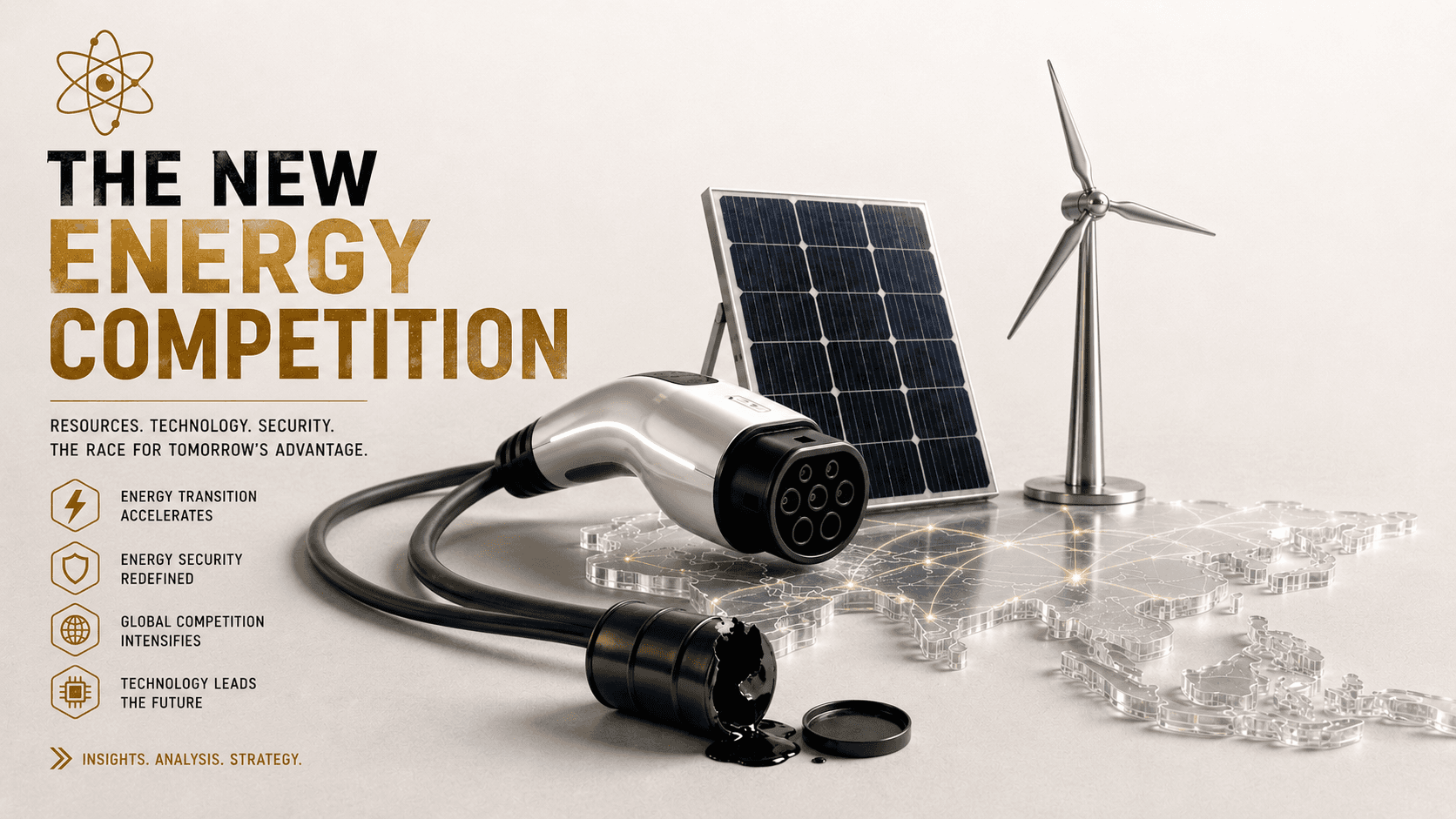
The New Energy Competition
Why energy security is becoming a defining strategic advantage.
15 min read
Introduction
For much of the last three decades, energy was viewed primarily as an economic issue.
Governments focused on efficiency, cost reduction and market integration. Businesses optimized supply chains assuming reliable access to fuel, electricity and critical resources.
That era is ending.
Today, energy has returned to the center of geopolitics, national security and economic strategy.
The competition is no longer simply about producing energy. It is about controlling resilient energy systems capable of withstanding geopolitical shocks, technological disruption and infrastructure failures.
The countries, companies and individuals who understand this shift early will be better positioned to navigate the next decade of uncertainty.
Energy Security Returns
The global energy system is undergoing a profound transformation.
For decades, policymakers assumed that increasingly interconnected markets would guarantee stable access to energy resources.
Recent events have challenged that assumption.
Supply disruptions, geopolitical conflicts, infrastructure vulnerabilities and strategic competition have demonstrated that efficiency alone is not enough.
Resilience is becoming the new priority.
Energy security now means more than securing oil and gas supplies.
It includes electricity generation, grid stability, energy storage, critical minerals, nuclear infrastructure and advanced manufacturing capacity.
The definition of energy security is expanding because the system itself is becoming more complex.
The New Energy Trilemma
Every nation faces a difficult balancing act.
Energy systems must simultaneously achieve three objectives:
Affordability
Energy must remain economically accessible to households and businesses.
High energy costs reduce competitiveness, increase inflation and create political pressure.
Reliability
Energy systems must continue operating during crises, natural disasters and geopolitical disruptions.
Reliability has become a strategic requirement rather than a technical preference.
Sustainability
Long-term environmental considerations remain important.
However, governments increasingly prioritize security and reliability when these objectives conflict.
The challenge is that improving one dimension often creates pressure on another.
This tension is likely to define energy policy for years to come.
Critical Minerals Become Strategic Assets
The future energy system depends on resources that were once considered niche commodities.
Lithium.
Copper.
Nickel.
Rare earth elements.
Graphite.
These materials now sit at the center of industrial competition.
Electric vehicles, batteries, renewable infrastructure, semiconductors and defense technologies all depend on access to critical minerals.
As demand grows, governments are increasingly treating supply chains as strategic assets.
Mining projects, refining capacity and transportation infrastructure are becoming matters of national importance.
The competition for these resources may become one of the defining economic stories of the next decade.
Energy And Geopolitical Power
Throughout history, energy has shaped geopolitical influence.
The difference today is that multiple energy systems are competing simultaneously.
Traditional fossil fuels remain essential.
Nuclear power is experiencing renewed interest.
Renewable generation continues expanding.
Energy storage technologies are advancing rapidly.
Artificial intelligence is increasing electricity demand.
The result is not a simple transition from one system to another.
Instead, the world is entering a period where multiple energy models coexist.
This complexity creates both opportunities and risks.
Countries capable of adapting to multiple energy futures may gain significant advantages.
Implications For Businesses
Energy is becoming a strategic variable rather than a background cost.
Businesses increasingly evaluate:
Grid reliability
Regional energy exposure
Supply chain vulnerability
Electricity price volatility
Infrastructure resilience
Competitive advantages may increasingly depend on access to stable and affordable energy.
Location decisions, investment strategies and operational planning are becoming closely linked to energy security considerations.
Organizations that treat energy as a strategic issue rather than a utility expense may gain significant long-term advantages.
Implications For Capital
Investors face a rapidly changing landscape.
Traditional assumptions about energy markets are becoming less reliable.
New opportunities are emerging across:
Grid modernization
Nuclear infrastructure
Energy storage
Critical minerals
Industrial electrification
Energy efficiency
At the same time, regulatory uncertainty and geopolitical risks continue increasing.
Understanding the interaction between technology, policy and security is becoming essential.
The energy sector is no longer a single market.
It is becoming an interconnected strategic ecosystem.
Conclusion
The next decade will not be defined by energy abundance or scarcity.
It will be defined by who controls resilient energy systems.
Energy security is becoming one of the most important strategic advantages available to nations, businesses and investors.
The challenge is no longer simply producing energy.
The challenge is building systems capable of adapting to an increasingly uncertain world.
Join the newsletter
Be the first to read our articles.


