

Global Fragmentation Accelerates
Why geopolitical realignment is becoming the defining force of the next decade.
12 min read
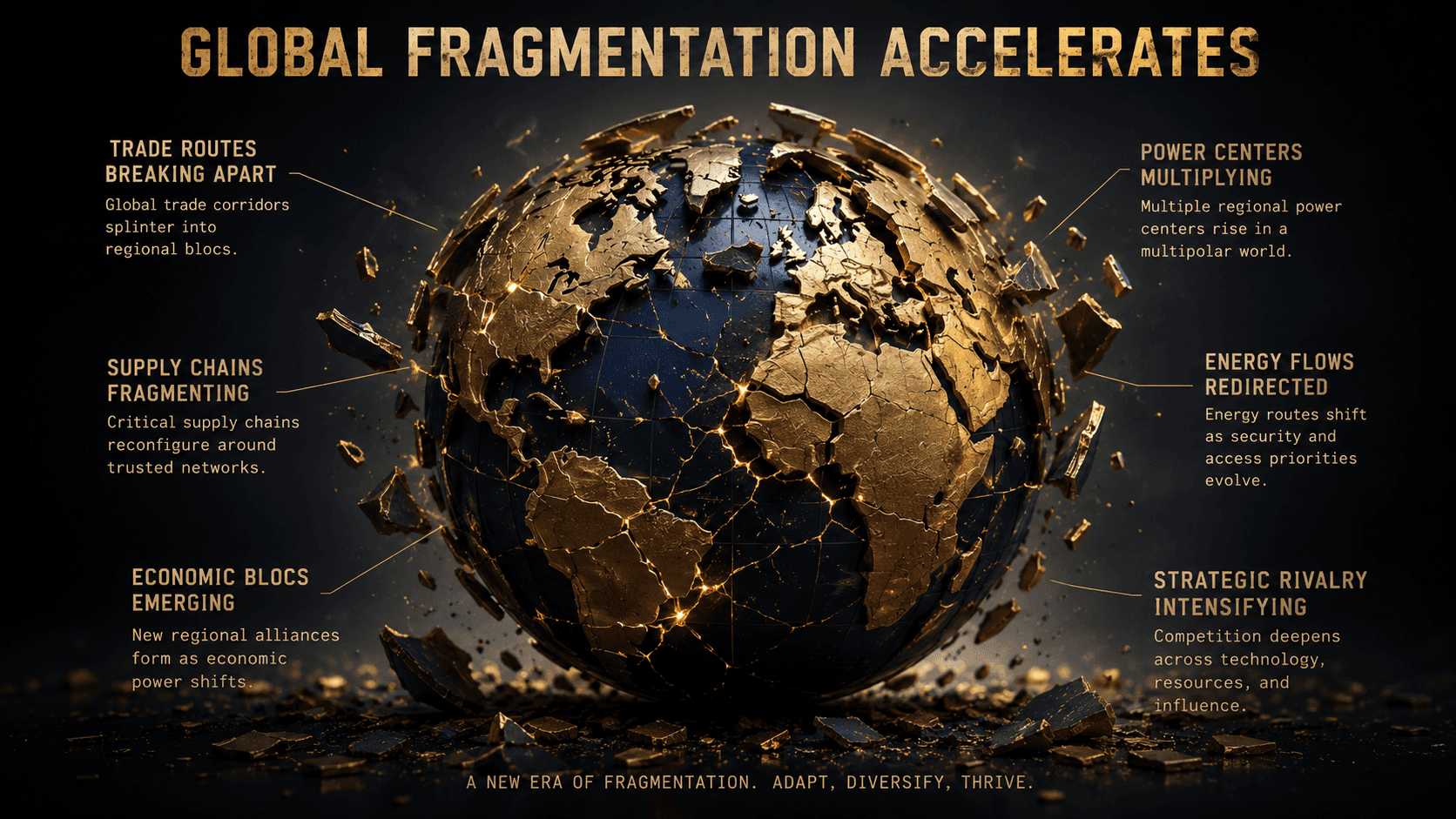
For decades, globalization was built on the assumption that economic integration would continue expanding. Capital, goods, technology and talent moved across borders with relatively low friction.
That assumption is now breaking down.
Around the world, governments are prioritizing resilience over efficiency, strategic autonomy over integration and security over optimization.
The result is a structural shift toward fragmentation.
This transition is reshaping supply chains, investment flows, industrial policy and geopolitical relationships.
Understanding this process early may become one of the most important strategic advantages of the coming decade.
Section 1
The End Of Hyper-Globalization
The global economy is not collapsing.
Instead, it is reorganizing.
Rather than a single integrated system, multiple regional systems are emerging simultaneously.
North America, Europe, China and a growing group of middle powers are increasingly building parallel capabilities in manufacturing, technology, energy and logistics.
This does not eliminate trade.
It changes its structure.
Section 2
Strategic Industries Become National Priorities
Semiconductors.
Energy.
Artificial intelligence.
Critical minerals.
Defense production.
These sectors are increasingly viewed through a national security lens.
Governments are intervening directly through subsidies, industrial policy and strategic investment programs.
The era of purely market-driven optimization is ending.
Section 3
Implications For Individuals, Business And Capital
Individuals face changing labor markets and relocation dynamics.
Businesses face higher operational complexity and supply chain risk.
Capital faces a world where geopolitical factors increasingly influence returns.
The common challenge is adaptation.
The common opportunity is preparation.
Conclusion
Fragmentation should not be viewed only as risk.
It is also a map of future opportunity.
The organizations and individuals who recognize structural shifts before they become obvious will be positioned to benefit from them.
Join the newsletter
Be the first to read our articles.


