

DAILY PULSE | September 18, 2026
Crude supply can recover faster than refineries. Shipping can reroute faster than ports and processing facilities can expand. AI investment can be approved faster than new electricity generation can be built. Capital can be allocated faster than turbines, transformers, fabs and transmission lines can be manufactured. The constraint therefore moves downstream.
13 min read
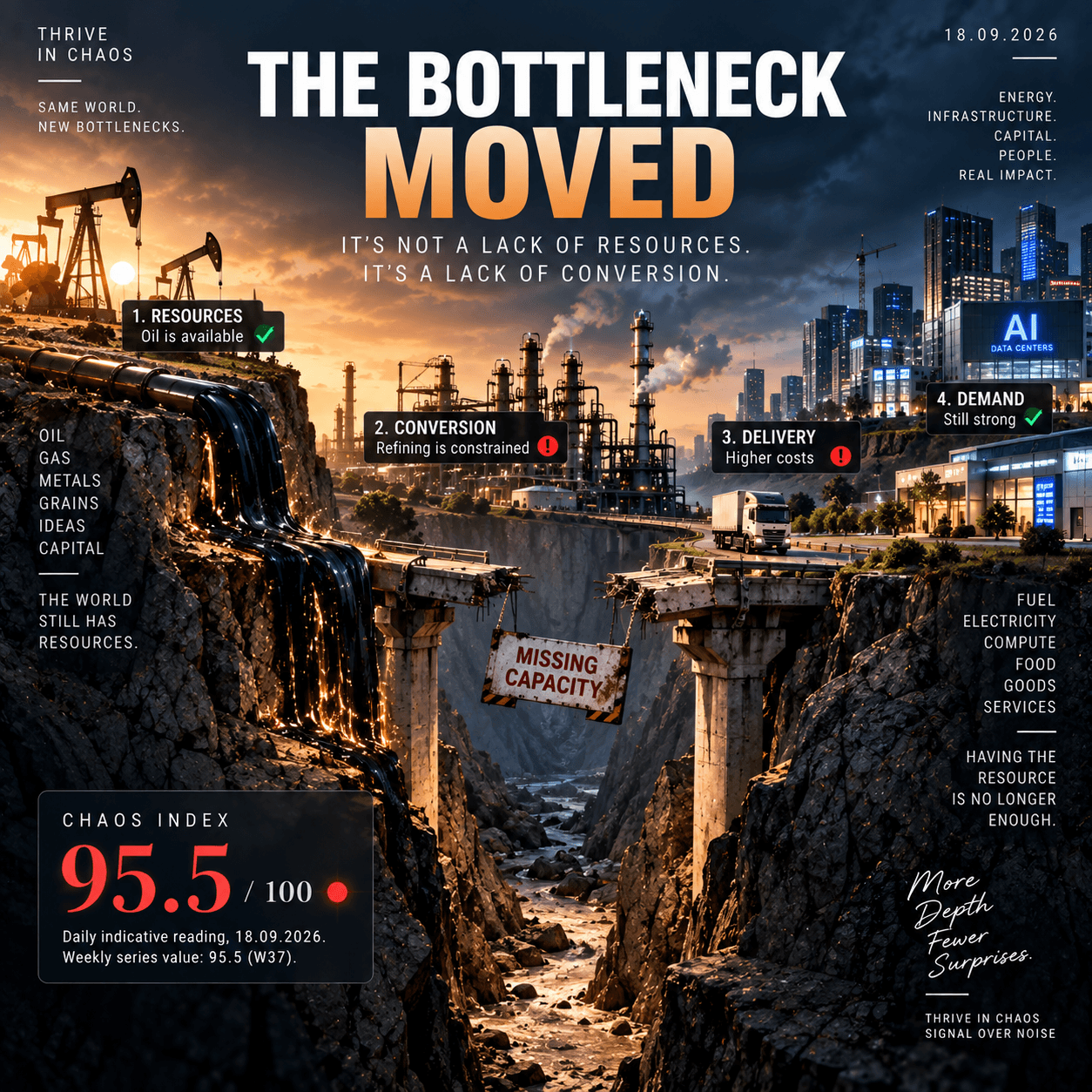
Chaos Index 95.5: The Bottleneck Moved
THRIVE IN CHAOS · DAILY Intelligence · September 18, 2026
Chaos Index: 95.5 / 100 🔴
Phase R · Multipolar Compression
System posture: DEFENSIVE
Daily indicative reading · Weekly series value: 95.5
The global system is showing an important form of adaptation. Oil can be rerouted, inventories can be released, ships can change destination and alternative suppliers can increase production. Yet the economic pressure is not disappearing. It is moving to the next layer.
The emerging constraint is no longer simply whether enough raw material exists. It is whether the system has enough functioning infrastructure to convert that material into something the economy can actually use.
That distinction matters. Crude oil without sufficient refining capacity does not solve a diesel shortage. Natural gas without generation and transmission capacity does not solve an electricity shortage. Semiconductors without power, cooling and data-centre capacity do not create usable AI compute.
The bottleneck is moving from resources toward the machinery that transforms resources into economic capacity.
1. Executive Assessment
The Chaos Index remains at an indicative 95.5, but today's development is not numerical. It is structural.
During the first phase of the current disruption, attention naturally concentrated on access to energy and transport routes. Could oil move? Would Hormuz remain usable? Could alternative suppliers compensate? Were strategic reserves sufficient?
Those questions still matter, but the system is increasingly demonstrating that it can adapt around some of them.
The harder problem begins after that adaptation succeeds.
Crude supply can recover faster than refineries. Shipping can reroute faster than ports and processing facilities can expand. AI investment can be approved faster than new electricity generation can be built. Capital can be allocated faster than turbines, transformers, fabs and transmission lines can be manufactured.
The constraint therefore moves downstream.
This is the central signal of September 18.
2. What Changed
The strongest evidence today comes from the widening gap between crude availability and refined-product availability.
Middle Eastern oil flows have shown meaningful adaptation despite severe disruption. Alternative routes, changed trade patterns and available upstream capacity have prevented the initial supply shock from becoming a complete physical breakdown.
Yet diesel remains exceptionally expensive.
That divergence tells us something important.
If the principal problem were still simply crude availability, improved crude flows should produce much greater relief further downstream.
They have not.
The system has discovered another constraint.
3. The Difference Between a Resource and a Useful Product
Modern economies rarely consume raw resources directly.
They consume transformed resources.
Crude becomes gasoline, diesel, jet fuel and petrochemical feedstock. Natural gas becomes electricity, heat, fertilizer and industrial energy. Copper becomes cables, transformers and electrical equipment. Semiconductor wafers become packaged chips, servers and functioning compute infrastructure.
Between the raw resource and the final economic service sits an enormous conversion layer.
For decades, this layer was often treated as sufficiently abundant to remain almost invisible.
That assumption is becoming less reliable.
4. Diesel Is Exposing the New Constraint
The current diesel market provides perhaps the clearest example.
Refinery outages and damage have reduced the system's ability to produce middle distillates at the same time that transport, agriculture, construction and industrial demand continue to require them.
This produces a counterintuitive situation.
Crude conditions can improve while diesel conditions remain extremely tight.
The market therefore stops asking only:
How much oil exists?
It begins asking:
How much usable fuel can the existing industrial system actually produce?
That is a much harder question.
5. Why Refining Capacity Matters More Than It Appears
A refinery is not merely another step in a supply chain. It is a conversion node.
When crude production falls, another producer may sometimes compensate.
When one shipping route becomes dangerous, another route may sometimes be used.
But when sophisticated refining capacity disappears, substitution becomes much more difficult.
Facilities are expensive, technologically complex and slow to build. Damaged installations cannot simply be replaced by moving a few vessels or signing a different supply contract.
This creates an asymmetry between the speed of disruption and the speed of reconstruction.
6. The Time Asymmetry
This may become one of the defining characteristics of the present environment.
A trade route can be disrupted in hours.
A refinery can be damaged in minutes.
A power plant can be taken offline rapidly.
A transformer can fail immediately.
But rebuilding the lost capacity can require months or years.
The system therefore operates with two very different clocks:
disruption time and replacement time.
When disruption becomes faster while replacement remains slow, scarcity accumulates even when the underlying resources remain available.
7. Adaptation Is Working — But Only Partially
It would be a mistake to interpret today's conditions as evidence that the global system has stopped adapting.
The opposite is true.
Adaptation is occurring continuously.
Oil is being rerouted. Cargoes are being redirected. Alternative infrastructure is being used. Governments are intervening. Companies are adjusting procurement. Financial markets are repricing risk.
This resilience matters.
But adaptation at one layer can expose scarcity at another.
That is exactly what appears to be happening now.
8. Hormuz Shows the Difference Between Adaptation and Normalization
Shipping through the Strait of Hormuz remains significantly impaired even as individual vessels and LNG movements demonstrate that the corridor is not completely unusable.
That distinction is essential.
A system does not need to stop completely to become economically damaging.
If throughput falls, insurance rises, schedules become uncertain and ships wait longer, the effective capacity of the route declines even though traffic continues.
The relevant question is therefore not simply whether Hormuz is open.
It is how much reliable throughput Hormuz can provide.
9. Throughput Is Becoming More Important Than Access
This leads to a broader principle.
Access is binary only on paper.
In reality, infrastructure has throughput.
A port may be open but congested.
A pipeline may operate but below capacity.
A refinery may function but with important units offline.
A power grid may provide electricity but have no spare capacity for new data centres.
A semiconductor fab may operate at full utilization while customers wait months for production slots.
The important variable is increasingly not access itself.
It is usable throughput under stress.
10. The Shock Has Moved Downstream
Earlier this week, the emerging pattern was that the original shock was moving downstream.
Today's evidence allows us to refine that conclusion.
The downstream economy is not merely receiving higher costs from the original disruption. It is beginning to reveal its own independent bottlenecks.
The sequence becomes:
resource disruption
→ alternative supply
→ partial stabilization
→ conversion bottleneck
→ expensive finished products
→ persistent inflation
→ monetary pressure
→ expensive capital.
At that point, the original shock has changed form.
11. Energy Prices Can Fall Without Solving the Energy Problem
This is why headline oil prices can become misleading.
A decline in crude prices normally suggests future relief for consumers.
Under normal conditions, that relationship is strong.
But if refining margins remain extreme, transportation is constrained or infrastructure is damaged, lower crude prices may not pass through efficiently.
Consumers do not purchase barrels of Brent.
They purchase gasoline, diesel, electricity, food, transport and manufactured goods.
The relevant price is therefore the delivered cost after the entire conversion chain.
12. The Inflation Mechanism Changes
This also changes the inflation story.
The first phase of an energy shock is relatively easy to understand: the resource becomes more expensive.
The second phase is more complicated.
Processing becomes scarce.
Transportation becomes expensive.
Insurance rises.
Replacement equipment costs more.
Companies maintain larger inventories.
Financing those inventories becomes more expensive.
The result can be persistent inflation even after the original commodity price begins to stabilize.
This is one reason why physical-system shocks can remain economically important long after financial markets begin pricing partial normalization.
13. Expensive Diesel Has an Unusually Wide Transmission Channel
Diesel deserves particular attention because it sits inside so many economic processes.
It moves trucks.
It powers agricultural equipment.
It supports construction.
It feeds mining and industrial machinery.
It influences logistics costs throughout the food system.
Higher diesel prices therefore do not remain inside the energy sector.
They spread into freight, agriculture, construction, retail distribution and ultimately household purchasing power.
The second-order effects are broad.
14. Food Becomes Part of the Same System
This is particularly important as the Northern Hemisphere approaches winter and many vulnerable countries enter a period of higher household energy expenditure.
Food affordability depends not only on harvest volumes.
It also depends on fertilizer, diesel, storage, refrigeration, shipping, insurance, currency stability and household income.
A world can therefore have sufficient aggregate food production and still experience serious food stress.
The constraint becomes affordability rather than absolute physical absence.
That distinction may become increasingly important into late winter and spring if energy and logistics pressures persist.
15. Capital Now Enters the Conversion Problem
The physical system cannot expand without financing.
Refineries require capital.
Power plants require capital.
Grid expansion requires capital.
Data centres require capital.
Ports, ships, warehouses, pipelines and semiconductor fabs all require enormous upfront investment.
This creates a feedback loop.
Physical scarcity produces inflation.
Inflation encourages monetary tightening.
Tighter monetary conditions increase the cost of financing.
Higher financing costs make new physical capacity more expensive.
The system therefore makes its own repair more costly.
16. The Feedback Loop
The emerging mechanism can be expressed simply:
Infrastructure disruption
→ reduced capacity
→ higher delivered prices
→ inflation persistence
→ tighter financial conditions
→ higher cost of replacement capacity
→ slower capacity expansion
→ persistent infrastructure scarcity.
This does not mean the loop must continue indefinitely.
High prices encourage investment and substitution.
But the adjustment may take considerably longer than markets accustomed to financial rather than physical bottlenecks expect.
17. AI Is Entering the Same Physical System
AI appears to belong to an entirely different story.
It does not.
The rapid expansion of AI compute increasingly requires enormous physical infrastructure.
The industry needs chips, servers, cooling, land, transmission equipment and, above all, electricity.
The scale of proposed power investments associated with AI data centres makes the connection increasingly explicit.
AI is becoming not only a software or semiconductor story.
It is becoming an energy infrastructure story.
18. Compute Is Becoming an Industrial Product
This changes how AI capacity should be understood.
Compute appears digital to the user, but industrial at the production level.
Every additional unit of large-scale compute requires physical assets.
Those assets require factories.
Factories require equipment.
Equipment requires metals and components.
Data centres require power.
Power requires generation and grids.
The apparent digital abundance of AI therefore rests on a physical production system that cannot expand at software speed.
19. The AI Bottleneck May Also Move
The first AI bottleneck was advanced chips.
Then attention moved toward semiconductor manufacturing capacity.
Now power availability is becoming increasingly important.
Next may come transformers, grid connections, turbines, cooling systems, land or financing.
The exact sequence will vary by geography.
But the underlying mechanism is the same.
When investment expands rapidly enough, scarcity migrates through the production chain until it reaches the slowest component.
20. Scarcity Is Becoming Dynamic
This suggests a broader change in how scarcity should be analysed.
Traditional analysis often asks:
What resource is scarce?
A more useful question may increasingly be:
Where is the bottleneck moving next?
Scarcity is not stationary.
Solving one constraint can simply expose the next.
More crude exposes insufficient refining.
More chips expose insufficient power.
More renewable generation exposes insufficient transmission.
More trade exposes insufficient port capacity.
More capital exposes insufficient engineering and construction capacity.
The bottleneck migrates.
21. This Changes Competitive Advantage
Companies that control the scarce conversion layer may gain an advantage even when they do not control the original resource.
A refinery can become more strategically valuable than crude production at a particular moment.
Grid capacity can become more valuable than land for a data centre.
A transformer manufacturer can become more important than the electricity generator waiting for equipment.
A port with spare capacity can gain bargaining power over producers that need access to markets.
This is a different economic structure from one organized primarily around resource ownership.
22. Capacity Owners Gain Optionality
This connects directly to the pattern identified earlier this week.
Resilience is increasingly becoming balance-sheet power.
An actor that owns independent capacity does not merely reduce risk.
It preserves options.
If one route fails, it can use another.
If one supplier fails, it can process material elsewhere.
If grid access becomes scarce, it may already own generation.
If financing tightens, it may have liquidity.
Optionality matters because the value of an alternative increases precisely when alternatives become scarce.
23. Second-Order Effects
The first-order effect is straightforward:
conversion capacity becomes expensive.
The second-order effects are more important.
Companies with capacity gain pricing power.
Companies without capacity accept worse contractual terms.
Governments begin treating private infrastructure as strategically important.
Long-term contracts become more attractive.
Inventory requirements rise.
Capital expenditure shifts toward redundancy.
Efficiency declines because systems maintain more spare capacity.
The cost structure of the economy gradually changes.
24. Third-Order Effects
The third-order effects can become structural.
Large companies may acquire distressed competitors primarily for their physical infrastructure rather than their market share.
States may subsidize domestic conversion capacity even when it is less economically efficient.
Infrastructure ownership may become a barrier to entry.
Industrial geography may shift toward locations with abundant power, logistics and political stability.
Capital markets may begin valuing spare capacity differently.
What looked inefficient in a stable world can become valuable insurance in an unstable one.
25. Forecast Gate
Today's developments deepen existing forecast families rather than justify creating another highly correlated short-term forecast.
New forecasts today: 0
Forecast resolutions due today: 0
The recent monetary-policy forecasts have already been resolved through the Founder Gate. The important task now is not to generate more predictions around the same mechanism, but to observe transmission.
The relevant chain remains:
Energy and infrastructure disruption
→ persistent delivered-cost inflation
→ monetary response
→ higher financing costs
→ slower capacity expansion
→ persistent physical constraints.
The critical test over the coming weeks is whether downstream prices begin normalizing as crude availability improves.
If crude prices fall while diesel, freight, electricity or other transformed-product costs remain unusually high, that would strengthen the conversion-scarcity thesis.
If those spreads compress quickly, the constraint is more temporary than today's evidence suggests.
26. Scenario Map — Next 7–30 Days
Scenario 1 — Conversion Scarcity Persists
Probability: 42%
Crude flows continue improving, but refinery outages, constrained maritime throughput and low inventories prevent comparable relief in refined products.
The result is an unusual combination: softer crude prices alongside stubbornly expensive diesel and transportation.
Indicative CI range: 94–97
This is the current base scenario.
Scenario 2 — Partial Capacity Normalization
Probability: 27%
Shipping throughput improves, refinery operations recover faster than expected and refined-product spreads begin narrowing.
The original energy shock remains important, but downstream pressure starts fading.
Indicative CI range: 91–94
This would represent genuine system normalization rather than merely lower headline commodity prices.
Scenario 3 — Bottlenecks Spread Across Sectors
Probability: 21%
Energy conversion constraints begin interacting more visibly with electricity, industrial equipment, shipping and AI infrastructure requirements.
Scarcity migrates from one infrastructure layer to another.
Indicative CI range: 96–99
The important feature would not be one dramatic shortage, but several capacity constraints beginning to reinforce one another.
Scenario 4 — New Physical Disruption
Probability: 10%
Another significant energy, refinery, shipping or infrastructure disruption occurs before existing capacity has recovered.
The system loses part of the redundancy currently preventing a larger reset.
Indicative CI range: 98–100
The main danger would be synchronization: a second shock arriving before the system has rebuilt capacity lost during the first.
27. Recommendations
Individuals
Do not use the headline oil price as a proxy for your actual cost environment.
Through September 22, compare the costs that directly affect your household — fuel, food, heating, transport and delivery — with your current autumn and winter budget.
The purpose is not to predict inflation precisely.
It is to identify whether falling commodity headlines are producing genuine relief in your own expenditure structure.
If they are not, preserve liquidity rather than assuming normalization has already arrived.
Time horizon: immediate to 1 month
Reversibility: High
Expected resilience uplift: Moderate
Business
Map one critical input from raw material to final delivery.
Do not stop at the supplier.
Follow the chain:
supplier → processing → energy → transport → port → insurance → financing → delivery.
Identify where your actual conversion bottleneck sits.
Then create one executable alternative by September 23.
A second supplier is not useful if both suppliers depend on the same refinery, port, grid connection, shipping corridor or financing channel.
Time horizon: 1–4 weeks
Reversibility: Medium
Expected resilience uplift: Real
Capital
Separate resource ownership from conversion-capacity ownership.
The two may behave very differently during the next phase of fragmentation.
Evaluate exposure to assets that convert nominal availability into usable economic capacity: refining, generation, transmission, semiconductor fabrication, ports, logistics, storage and other difficult-to-replace infrastructure.
The relevant question is not simply whether demand for the underlying resource will rise.
It is whether the asset controls a bottleneck that is difficult, expensive and slow to reproduce.
Time horizon: 1–6 months
Reversibility: Medium
Expected resilience uplift: Real
28. Decision Intelligence Layer
The most useful decision question today is not:
What will become scarce?
It is:
If today's bottleneck is solved, where does the constraint move next?
That question changes the way complex systems are analysed.
For energy, the sequence may move from crude to shipping, refining, diesel and financing.
For AI, it may move from chips to data centres, electricity, grids, transformers and generation.
For food, it may move from harvest volumes to fertilizer, diesel, storage, shipping, currency and household affordability.
For manufacturing, it may move from raw materials to components, machinery, electricity, logistics and skilled maintenance.
The important strategic advantage is therefore not perfect prediction.
It is seeing the dependency chain early enough to recognize where pressure is likely to migrate.
This gives us a more useful model:
Resource availability
→ conversion capacity
→ transport capacity
→ financing capacity
→ affordability
→ effective demand.
A system can have enough resources and still fail at any one of these layers.
That is why headline abundance and real-world scarcity can coexist.
Stability Principle
The world spent several decades optimizing systems around the assumption that capacity somewhere in the network would usually be available when needed.
That assumption allowed inventories to shrink, spare capacity to disappear and specialized infrastructure to become concentrated in fewer locations.
It produced extraordinary efficiency.
It also created long dependency chains.
The present environment is testing those chains one layer at a time.
The lesson is not that every household, company or country should maximize redundancy. That would be prohibitively expensive and would destroy much of the efficiency that makes modern economies productive.
The objective is more selective.
Identify the few bottlenecks whose failure would remove several choices at once.
Protect capacity there.
Because the most valuable asset in a fragmented system may not be the resource itself.
It may be the machine, route, grid, facility or financing channel that allows you to turn that resource into something useful when everyone else is trying to do the same thing.
The resource may be available. The real scarcity begins when too many people need the same machine to make it useful.
THRIVE IN CHAOS
Signal Over Noise
Analysis → Forecast → Recommendations
Join the newsletter
Be the first to read our articles.


