DAILY PULSE | August 17, 2026
The system is still functioning — but increasingly by consuming the reserves that protect it from the next shock.
13 min red
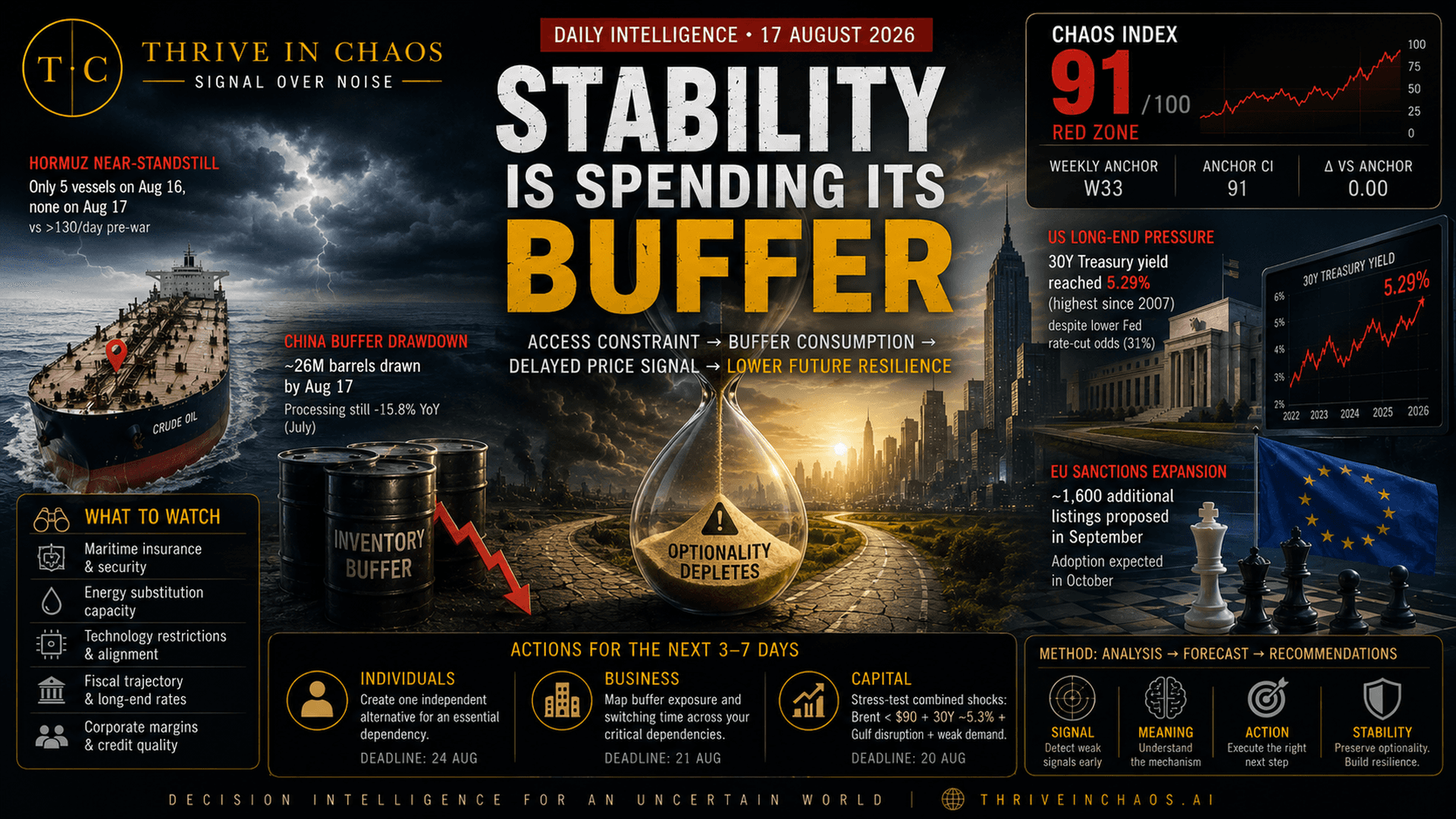
Chaos Index 91.0: Stability Is Spending Its Buffer
THRIVE IN CHAOS — DAILY PULSE
August 17, 2026
Chaos Index: 91.0 / 100 🔴
Phase: R
System Type: Multipolar Compression
Adaptation Mode: DEFENSIVE
Stress concentration: 11 of 11 systems elevated
The Chaos Index did not rise today.
That does not mean the system became safer.
The more important development is happening underneath the headline number.
Some of the world's most important systems are continuing to function not because the underlying constraints have disappeared, but because reserves are absorbing them.
Oil inventories are being drawn.
Alternative routes are being used.
Insurance and security mechanisms are compensating for impaired access.
Financial markets are absorbing weaker demand while long-term capital remains expensive.
This creates a dangerous form of apparent stability.
The system works.
But maintaining that continuity consumes the resources that would normally protect it from the next disruption.
Today's central mechanism is therefore:
ACCESS CONSTRAINT
→ BUFFER CONSUMPTION
→ DELAYED PRICE SIGNAL
→ LOWER FUTURE RESILIENCE
The distinction matters.
A buffer can prevent today's disruption from becoming today's crisis.
But every buffer is finite.
If the underlying constraint persists, the question eventually changes from:
“Can the system absorb the shock?”
to:
“How much capacity to absorb the next shock remains?”
Executive Summary
Four signals define today's reading.
First, commercial traffic through the Strait of Hormuz remains severely impaired.
The important point is no longer whether isolated vessels can physically transit the corridor.
The important variable is whether the route can operate at something approaching normal commercial scale under acceptable security, insurance and political conditions.
It cannot yet do so.
Second, China is using oil inventories to absorb part of the disruption.
This is stabilizing in the short term.
But inventories are stored resilience.
Drawing them preserves current consumption by reducing the reserve available for future disruptions.
Third, U.S. long-term borrowing costs remain unusually high even as weaker demand reduces expectations of near-term Federal Reserve tightening.
That creates an important divergence.
Short-term monetary pressure can ease while long-duration capital remains expensive.
Fourth, the European Union is preparing a significant expansion of sanctions against Russia.
Those measures are not yet operative and should not be treated as current restrictions.
But they reinforce a broader structural direction:
access to markets, technology, capital, logistics and commercial relationships is becoming increasingly conditional on political alignment.
Together, these signals do not justify another increase in the Chaos Index today.
The index remains:
91.0 / 100.
But the mechanism beneath that number is changing.
The system is increasingly paying for continuity by consuming buffers.
1. What Changed in the Index
Today's raw Chaos Index remains:
91.0 / 100
The block vector is:
A — 10.0
B — 9.5
C — 8.5
D — 7.0
E — 9.0
F — 8.5
G — 10.0
H — 10.0
I — 9.0
J — 7.5
K — 8.0
All eleven monitored systems remain elevated.
The daily change versus the Week 33 anchor is effectively zero.
That is analytically important.
A high-risk system does not need to produce a higher score every day.
Once several components are already close to maximum stress, new information may change the mechanism without materially changing the aggregate index.
That is what is happening today.
The index is stable.
The resilience underneath it is not necessarily stable.
2. Why a Stable 91 Is Not a Neutral Signal
At lower levels of systemic stress, a stable index can reasonably suggest that conditions have stopped deteriorating.
At 91, that interpretation becomes dangerous.
Several components are already operating close to the upper boundary.
Four blocks are effectively constrained by the non-compensatory floor used in the secondary diagnostic framework.
That means additional deterioration inside those systems may produce less movement in the headline metrics than it would at lower stress levels.
In practical terms:
the measurement system is approaching saturation in several domains.
That does not invalidate the index.
It changes how the index should be interpreted.
At extreme levels, the important question becomes less:
“Did the score rise?”
and more:
“What is happening to the system's remaining capacity to absorb another shock?”
3. Hormuz: Physical Access Remains Severely Impaired
The Strait of Hormuz remains one of the clearest physical constraints in the global system.
Traffic has not returned to anything resembling normal commercial conditions.
This distinction is critical.
A shipping lane can be geographically open while economically impaired.
A vessel may technically be able to transit.
But commercial throughput depends on more than geography.
It depends on:
security;
insurance;
crew willingness;
shipowner risk tolerance;
political authorization;
contractual obligations;
rerouting economics;
and the availability of alternative capacity.
This is why the relevant measure is not simply:
“Is Hormuz open?”
The better question is:
“At what effective commercial capacity can Hormuz operate?”
4. Physical Availability Is Not Operational Availability
This principle extends well beyond Hormuz.
Modern systems are increasingly governed by the difference between physical availability and operational availability.
A port can exist but lack insurance.
A supplier can exist but be sanctioned.
A bank can exist but lose access to payment rails.
A technology can exist but become export-controlled.
An energy plant can exist but lack cooling water.
A shipping route can exist but become commercially unacceptable.
The physical asset remains.
The decision option disappears.
This distinction is central to the current phase of global fragmentation.
The world does not need to divide into completely isolated blocs for optionality to decline.
Access can simply become conditional.
5. China's Inventory Draw Is the New Signal
The most important new energy signal today is not another headline from Hormuz.
It is what China is doing in response.
Chinese oil inventories are being drawn to compensate for part of the disruption.
That is exactly what strategic and commercial inventories are designed to do.
They convert a sudden supply disruption into a slower adjustment.
In the short term, this is stabilizing.
Refineries can continue operating.
Consumers can continue receiving fuel.
Prices do not need to absorb the entire physical shock immediately.
But there is a cost.
Inventory is finite.
6. Inventories Are Stored Resilience
It is useful to think about inventories differently.
Inventory is not simply stored product.
It is stored decision time.
A company with 60 days of critical inventory can survive a disruption longer than one with five days.
A country with strategic energy reserves can postpone emergency adjustments.
A household with financial reserves can absorb a temporary income interruption.
In each case, the buffer creates time.
Time creates options.
Options create Decision Space.
But when inventory is consumed, that Decision Space contracts.
This gives us a more useful interpretation of China's drawdown.
It is not merely an oil-market statistic.
It is the conversion of stored resilience into current continuity.
7. The Buffer Paradox
This creates what we can call the buffer paradox.
The stronger the buffer, the calmer the system can initially appear after a shock.
But that calm can hide the consumption of resilience.
Suppose supply falls by ten units.
A system with no inventory immediately shows the shortage.
Prices rise.
Production falls.
Consumption adjusts.
The disruption becomes visible.
Now suppose the system has twenty units of inventory.
It can replace the missing ten.
The visible system looks stable.
But half of its reserve has disappeared.
The first system looks more unstable immediately.
The second system may actually become more vulnerable to the next shock.
This is why price stability alone cannot measure resilience.
8. Why the Price Signal Can Be Delayed
Markets usually transmit scarcity through price.
But buffers interfere with that transmission.
Inventories can release supply.
Governments can subsidize costs.
Companies can absorb margin pressure.
Insurers can temporarily maintain coverage.
Central banks can provide liquidity.
Consumers can spend savings.
Each mechanism delays part of the adjustment.
This can create a misleading period in which:
physical stress remains high;
market prices remain manageable;
and decision-makers conclude that the system has absorbed the disruption.
Sometimes that conclusion is correct.
Sometimes the system has merely postponed recognition of the cost.
The difference depends on whether the underlying constraint disappears before the buffer does.
9. The Real Question for Hormuz
The central question is therefore no longer only how long Hormuz remains impaired.
It is:
How long can the surrounding system compensate?
That includes:
inventories;
alternative routes;
spare production;
shipping capacity;
insurance capacity;
refinery flexibility;
government reserves;
and demand adjustment.
If the physical disruption resolves before those buffers become materially depleted, the system can normalize.
If the disruption persists longer than the buffers, the delayed price and operational adjustment can become much more abrupt.
Duration now matters as much as severity.
10. A Shock Can Become More Dangerous Without Becoming Larger
This is an important systemic principle.
A disruption does not need to intensify to become more dangerous.
It only needs to last.
A severe five-day disruption can be manageable.
The same disruption lasting five weeks may become systemic.
The physical event is unchanged.
The surrounding buffers are not.
Every additional day consumes:
inventory;
working capital;
political tolerance;
insurance capacity;
maintenance flexibility;
and management attention.
The risk therefore accumulates through duration.
This is one reason why prolonged high Chaos Index readings matter even when the index itself stops rising.
11. U.S. Markets Are Showing a Different Buffer Problem
The second important development today comes from U.S. financial conditions.
Recent weaker demand has reduced expectations of near-term Federal Reserve tightening.
Normally, that would suggest some relief.
But the long end of the Treasury market is telling a different story.
Thirty-year Treasury yields remain around levels not seen for many years.
This means the market is separating two questions.
Question one:
Does the Federal Reserve need to tighten aggressively in the near term?
Question two:
What return will investors require to finance the United States over decades?
Those are no longer producing the same answer.
12. Short-Term Relief Is Not Cheap Long-Term Capital
This divergence matters.
A weaker economy can reduce short-term inflation pressure.
That can reduce expected central-bank tightening.
But it does not automatically make long-term financing cheap.
Long-term yields also reflect:
fiscal expectations;
debt supply;
term premium;
inflation uncertainty;
capital demand;
and investor confidence in future purchasing power.
So we can simultaneously have:
softer demand;
less immediate Fed pressure;
and expensive long-duration capital.
That is not normalization.
It is another form of stress rotation.
13. The AI Investment Boom Adds Another Layer
Large-scale AI infrastructure requires enormous amounts of capital.
Data centres.
Power infrastructure.
Transmission.
Semiconductors.
Cooling.
Networking.
Cloud capacity.
The investment requirement is measured not in millions, but increasingly in tens or hundreds of billions.
That capital demand competes inside the same financial system that must also absorb government borrowing and conventional corporate financing.
This does not mean AI investment alone determines long-term yields.
It does mean that the transition toward an AI-intensive economy is capital-intensive at exactly the moment when sovereign financing requirements are also large.
That combination deserves attention.
14. Cheap Money May Not Return With Lower Policy Rates
This has an important strategic implication.
Many business models still implicitly assume:
Fed cuts → lower financing costs → easier capital.
That relationship may become less reliable.
Policy rates can fall while long-duration borrowing costs remain structurally elevated.
If that happens, companies dependent on refinancing, infrastructure investment or long-payback projects may not receive the relief they expect.
The distinction between:
monetary easing
and
cheap capital
will become increasingly important.
15. Another Form of Buffer Consumption: Balance Sheets
Inventories are not the only buffers being consumed.
Balance sheets are buffers too.
A company can absorb higher transport costs through margins.
A household can absorb higher living costs through savings.
A government can absorb economic weakness through fiscal deficits.
A bank can absorb losses through capital.
Each response preserves continuity.
But each consumes financial resilience.
This creates the same pattern we see in energy:
current stability purchased with future flexibility.
16. The System Is Spending More Than One Buffer
This is what makes today's signal systemic rather than sector-specific.
Different parts of the global system are drawing different reserves simultaneously.
Energy systems draw inventories.
Companies draw working capital.
Households can draw savings.
Governments draw fiscal capacity.
Financial systems absorb larger debt issuance.
Supply chains consume redundancy.
The buffers are different.
The mechanism is the same.
A system under prolonged pressure begins to finance stability from its reserves.
17. EU Sanctions: Important, But Not Yet Operative
Another signal today concerns the European Union's planned expansion of sanctions against Russia.
The distinction between planned and operative measures matters.
A proposal is not the same as an implemented restriction.
Therefore this signal should not be used to increase the relevant Chaos Index block today.
But strategically, it reinforces a broader direction.
Economic access is increasingly shaped by political alignment.
That includes:
finance;
technology;
trade;
shipping;
energy;
industrial inputs;
and individuals or companies permitted to participate in particular markets.
The immediate quantitative effect is uncertain.
The structural direction is clearer.
18. From Globalization to Permissioned Globalization
The emerging system should not be described simply as deglobalization.
Trade continues.
Capital continues moving.
Technology continues spreading.
Energy continues crossing borders.
But access increasingly depends on conditions.
This produces something closer to permissioned globalization.
You can participate —
if your bank is accepted;
if your technology stack is compliant;
if your insurer provides coverage;
if your government is aligned;
if export controls allow the transaction;
if sanctions do not prohibit the counterparty;
if the infrastructure remains operational.
Global connectivity remains.
Friction accumulates inside it.
19. Why Conditional Access Consumes Buffers Faster
Conditional systems require more redundancy.
If one route can suddenly become unavailable, companies need alternatives.
If one payment rail can be restricted, they need another.
If one supplier can become politically inaccessible, they need inventory or dual sourcing.
If one technology ecosystem becomes incompatible, they need migration capability.
Every backup costs money.
This means fragmentation creates a permanent resilience tax.
Businesses must carry more:
inventory;
suppliers;
liquidity;
compliance;
legal capacity;
technology redundancy;
and geographic diversification.
Efficiency declines.
Optionality becomes more expensive.
20. The Efficiency-to-Resilience Transition
For several decades, the dominant business objective was optimization.
Reduce inventory.
Concentrate suppliers.
Increase asset utilization.
Centralize systems.
Lower working capital.
Maximize efficiency.
That architecture performs extremely well when access is predictable.
It performs much worse when access becomes conditional.
The strategic objective therefore changes.
From:
maximum efficiency
toward:
sufficient efficiency + preserved optionality.
This does not mean abandoning optimization.
It means recognizing that optimization without redundancy can become fragility.
21. The New Cost Is the Cost of the Next Decision
This is where today's signals connect directly to the THRIVE IN CHAOS framework.
Chaos is not simply disorder.
It is the increasing cost of the next decision caused by shrinking optionality.
Consider a company whose primary shipping route becomes unreliable.
At first it reroutes.
The alternative costs more.
Then insurance rises.
Then inventories fall.
Then financing costs increase.
Then customers resist price increases.
No single event destroys the company.
But every step makes the next decision more expensive.
That is the mechanism we are measuring.
22. Why Markets Can Look Calm While Optionality Declines
Financial markets aggregate expectations.
They do not directly measure physical resilience.
A market can therefore remain relatively calm if investors believe:
inventories are sufficient;
governments will intervene;
demand will weaken;
central banks will respond;
or disruptions will remain temporary.
Those expectations may be correct.
But the underlying system can still lose redundancy.
This creates a divergence between:
market stability
and
system resilience.
The longer that divergence persists, the more important it becomes to monitor physical and operational indicators directly.
23. Base Scenario — 7–30 Days
Our base direction is:
PERSISTENT CONDITIONAL ACCESS WITH CONTINUED BUFFER CONSUMPTION.
Confidence: Medium–High.
Under this scenario:
Hormuz remains commercially impaired rather than fully normalized;
security and insurance continue affecting effective shipping capacity;
China and other consumers use inventories and alternative supply arrangements to absorb part of the disruption;
oil prices remain volatile but do not necessarily reflect the full physical constraint immediately;
weaker U.S. demand reduces some short-term monetary pressure;
long-duration financing remains expensive;
technology and sanctions architecture continues moving toward more conditional access.
The key characteristic is not collapse.
It is continued operation at the cost of declining buffers.
24. Stress Scenario
The stress scenario develops if the underlying disruptions persist longer than the buffers can comfortably absorb.
Watch for:
accelerating inventory drawdowns;
reduced refinery flexibility;
persistent war-risk insurance premiums;
greater rerouting;
higher freight costs;
working-capital pressure;
corporate margin compression;
credit differentiation;
and signs that companies are exhausting easy substitutes.
Under this scenario, the delayed price signal begins to catch up with the physical constraint.
The system does not necessarily fail.
But adjustment becomes more expensive and less voluntary.
25. Escalation Scenario
A more severe scenario would combine buffer depletion with a new physical or financial shock.
Examples include:
further deterioration in Gulf shipping;
another major energy chokepoint disruption;
a sharp reduction in available insurance;
renewed oil-price acceleration;
a significant long-duration yield shock;
or faster-than-expected expansion of technology and sanctions restrictions.
The dangerous combination would be:
persistent physical constraint
+
depleted buffers
+
expensive financing.
That would reduce the system's ability to compensate through either inventories or capital.
26. Constructive Scenario
A constructive path remains possible.
Hormuz commercial traffic normalizes materially.
Insurance conditions improve.
Alternative supply routes remain available.
Inventory drawdowns slow.
U.S. demand stabilizes without a sharp deterioration in employment or credit.
Long-term yields retreat for reasons consistent with genuine normalization rather than economic weakness.
Technology restrictions remain selective rather than hardening into mutually exclusive blocs.
Under that configuration, buffers stop shrinking and begin rebuilding.
That distinction matters.
Real normalization requires more than lower prices.
It requires restoration of resilience.
27. Forecast Gate
Today's Forecast Gate produces:
NEW FORECASTS: 0.
This is intentional.
Several obvious candidate questions are already represented by existing forecast families.
Hormuz conditions are covered by open positions.
Long-duration U.S. rates are already represented.
Consumer weakness is represented.
Technology fragmentation is represented.
Adding another forecast simply because today's evidence is interesting would increase correlation without adding independent information.
Forecast discipline requires resisting that temptation.
A larger forecast ledger is not automatically a better forecast ledger.
The objective is independent calibration.
28. Forecast Resolution Discipline
One existing forecast requires attention.
W31-F3111 asked whether the U.S. 30-year Treasury constant-maturity yield would close at or above 5.30% on any day on or before August 16, 2026.
The resolution date has passed.
Observed market levels on August 17 approached that threshold, but August 17 is outside the forecast window.
Therefore later market movements cannot be used to retroactively resolve the position.
The outcome must be determined only from the original resolution criteria and the data inside the defined window.
This is not administrative detail.
It is essential to forecast calibration.
If resolution rules move after the fact, Brier scores become meaningless.
29. Recommendations for Individuals
Time horizon: next 7 days.
By August 24, identify one material dependency that combines at least two of the following:
cross-border access;
energy exposure;
single-provider dependence;
payment dependence;
digital-platform dependence;
or limited substitution capacity.
Then create one genuinely independent fallback.
The word independent matters.
A second payment card at the same bank is not necessarily redundancy.
A second supplier using the same logistics corridor is not necessarily redundancy.
A second cloud service dependent on the same underlying infrastructure may not be redundancy.
The alternative should fail for a different reason than the primary option.
The objective is not maximum self-sufficiency.
It is preserved optionality.
30. Recommendations for Business
Time horizon: by August 21.
Select the five dependencies whose interruption would have the largest operational effect.
For each, record:
inventory days;
primary route;
alternative route;
alternate supplier capacity;
insurance availability;
payment access;
legal or sanctions exposure;
technology compatibility;
switching time;
and the rate at which the current buffer is being consumed.
The new field that matters is:
BUFFER BURN.
A business may technically have a contingency plan.
But if the contingency consumes inventory faster than the disruption is likely to end, it is not a durable solution.
Management should know not only:
“Do we have a backup?”
but:
“How long can the backup operate?”
31. Recommendations for Capital
Time horizon: by August 20.
Stress-test a combined state:
Brent remains below $90
+
Gulf disruption persists
+
U.S. 30-year yields remain near 5.3%
+
consumer demand weakens.
This scenario is useful because it challenges several common assumptions simultaneously.
Low or moderate oil does not necessarily imply low physical energy risk.
Weaker demand does not necessarily imply cheap capital.
Lower short-term rate expectations do not necessarily imply lower long-term financing costs.
Market calm does not necessarily imply restored operating resilience.
Review exposure to companies that combine:
high refinancing needs;
thin margins;
large energy inputs;
low inventory;
single-route logistics;
or high capital expenditure requirements.
This is a risk diagnostic, not a recommendation to buy or sell securities.
32. What Not to Do
Do not conclude that a stable Chaos Index means the system has stabilized.
Do not interpret inventory drawdowns as new supply.
Do not assume that moderate oil prices prove the Gulf disruption is economically contained.
Do not assume that weaker U.S. demand automatically produces cheap financing.
Do not treat proposed EU sanctions as if they are already operative.
Do not add forecasts simply because new evidence supports an existing narrative.
Do not confuse multiple suppliers with independent suppliers.
And do not assume that a functioning system is a resilient system.
Each of those shortcuts would overstate what the evidence supports.
33. First-, Second- and Third-Order Effects
Persistent Hormuz Constraint
First order:
lower effective shipping capacity;
higher security requirements;
insurance disruption.
Second order:
rerouting;
higher freight costs;
inventory drawdowns;
longer delivery times.
Third order:
working-capital pressure;
supplier substitution;
margin compression;
strategic relocation of supply chains.
Chinese Inventory Drawdowns
First order:
replacement of disrupted current supply.
Second order:
reduced immediate price pressure;
continued refinery operation;
slower demand adjustment.
Third order:
smaller future buffer;
greater sensitivity to another supply shock;
potentially sharper repricing if disruption persists.
High U.S. Long-Term Yields
First order:
higher long-duration financing costs.
Second order:
pressure on mortgages, infrastructure, refinancing and capital-intensive projects.
Third order:
lower investment;
greater credit differentiation;
pressure on highly leveraged business models.
Expanding Conditional Access
First order:
more compliance and political restrictions.
Second order:
higher redundancy and switching costs.
Third order:
regionalized capital allocation;
technology ecosystem lock-in;
structurally lower global efficiency.
34. The Combined Mechanism
The most important insight today emerges when these effects are combined.
Physical access is constrained.
Inventories compensate.
Prices react less than expected.
Decision-makers interpret the muted price response as resilience.
Meanwhile, inventories decline.
Financing remains expensive.
Political conditions on access increase.
The system therefore becomes less flexible while appearing more stable than the physical conditions alone would suggest.
That is the mechanism:
CONSTRAINT
→ COMPENSATION
→ APPARENT STABILITY
→ BUFFER DEPLETION
→ LOWER OPTIONALITY
This is a more dangerous sequence than a simple price spike because it can delay adaptation.
35. Why Early Adaptation Is Cheaper
The value of optionality is highest before everyone needs it.
A second supplier is cheaper before a disruption.
Inventory is cheaper before a shortage.
Insurance is easier to obtain before a crisis.
Financing is easier to arrange before liquidity is needed.
Technology migration is easier before access restrictions harden.
The system therefore rewards early adaptation.
Not because every risk will materialize.
But because preserving alternatives is cheaper before those alternatives become scarce.
36. The Structural Lesson
The global system is not simply becoming more fragmented.
It is becoming more conditional.
And conditional systems require more buffers.
That produces a structural trade-off.
Efficiency requires fewer buffers.
Resilience requires more.
For decades, falling geopolitical friction allowed companies and countries to optimize aggressively.
Inventory fell.
Supply chains concentrated.
Production specialized.
Capital became global.
Technology ecosystems integrated.
The current environment reverses part of that logic.
The cost of resilience is rising because the number of conditions attached to access is rising.
That does not end globalization.
It changes its economics.
37. Human Development Layer
The same principle applies below the institutional level.
Preserving optionality is not only an infrastructure problem.
It is also a capability problem.
A person with only one income mechanism has less Decision Space.
A company with only one operational model has less Decision Space.
A society that has optimized away practical knowledge has less Decision Space.
Resilience therefore includes maintaining capabilities that may appear inefficient during stable periods.
Knowledge.
Skills.
Relationships.
Independent judgment.
The ability to adapt.
These are human buffers.
Unlike physical inventory, many of them become stronger through use rather than weaker.
That makes them particularly valuable in prolonged periods of structural uncertainty.
38. The Decision Intelligence Test
When a system appears stable after a major disruption, ask five questions.
1. What is absorbing the shock?
Inventory?
Government spending?
Insurance?
Savings?
Alternative routes?
Corporate margins?
2. Is that buffer renewable?
Can it rebuild quickly?
Or is it finite?
3. At what rate is the buffer being consumed?
Days?
Weeks?
Months?
4. What happens when the buffer reaches its operational minimum?
Higher prices?
Rationing?
Credit stress?
Production cuts?
5. Can I create an alternative before that point?
This turns abstract resilience into a measurable decision problem.
39. One Decision for Today
Ask:
WHAT IMPORTANT PART OF MY CURRENT STABILITY DEPENDS ON A BUFFER I AM NOT MEASURING?
For an individual, it might be savings.
For a business, inventory.
For a portfolio company, refinancing capacity.
For a country, strategic reserves.
For a supply chain, alternative-route capacity.
Then ask:
How quickly is that buffer being consumed?
And:
How long would it take me to replace it?
That is today's Decision Intelligence exercise.
40. Final Assessment
The key development on August 17 is not another increase in the Chaos Index.
The index remains:
91.0 / 100.
The important change is underneath the number.
Hormuz remains severely impaired.
But the global system is compensating.
China is drawing inventories.
Alternative mechanisms are absorbing part of the physical disruption.
Weaker demand is reducing some immediate monetary pressure.
Yet long-term U.S. financing remains expensive.
Meanwhile, the institutional architecture of global access continues moving toward greater conditionality.
None of this means the system is failing today.
That is precisely the point.
The system is functioning.
But part of that functioning is being financed by buffers.
Inventories.
Redundancy.
Balance sheets.
Insurance.
Fiscal capacity.
Alternative routes.
Political tolerance.
Time.
Those resources make systems resilient.
But resilience is not infinite.
If disruption ends before the buffers are materially depleted, the system can recover.
If disruption persists, apparent stability can give way to a faster adjustment later.
That is why today's central signal is:
STABILITY IS SPENDING ITS BUFFER.
The practical objective is not to predict exactly when a buffer will run out.
It is to identify which buffers your decisions depend on, measure how quickly they are being consumed, and preserve alternatives before switching becomes expensive.
Because in a high-chaos environment, the most important resource is often not the asset itself.
It is the number of choices that remain available when conditions change.
DAILY PULSE — August 17, 2026
Chaos Index: 91.0 / 100 🔴
Phase: R
System Type: Multipolar Compression
Adaptation Mode: DEFENSIVE
Stress concentration: 11/11
7–30 Day Direction:
Persistent Conditional Access with Continued Buffer Consumption
Confidence:
Medium–High
WATCH NEXT
• Hormuz commercial throughput
• Gulf war-risk insurance
• Chinese oil inventory drawdowns
• refinery throughput
• alternative shipping capacity
• Brent and refined-product spreads
• U.S. 30-year Treasury yield
• corporate refinancing conditions
• U.S. consumer demand
• credit spreads
• EU sanctions implementation
• AI and technology-access restrictions
THRIVE IN CHAOS
Decision Intelligence for an Uncertain World
Analysis → Forecast → Recommendations
Signal → Meaning → Action → Stability
Signal Over Noise
thriveinchaos.ai
AI intelligence system with human editorial oversight.
Forecasts represent probability-based analytical assessments, not certainties.
This material supports independent judgment and does not constitute financial, legal or investment advice.
Join the newsletter
Be the first to read our articles.