
DAILY PULSE | August 11, 2026
The world did not cross into a new regime today. But one of the most important risks we have been tracking changed character. Until now, the central question around the Strait of Hormuz was conditional access: the route could remain physically open while insurance, sanctions, political permissions and unresolved transit rules made normal commercial use increasingly difficult.
12 min red
Chaos Index 90.0: When Conditional Risk Becomes Physical Scarcity
THRIVE IN CHAOS — DAILY PULSE
August 11, 2026
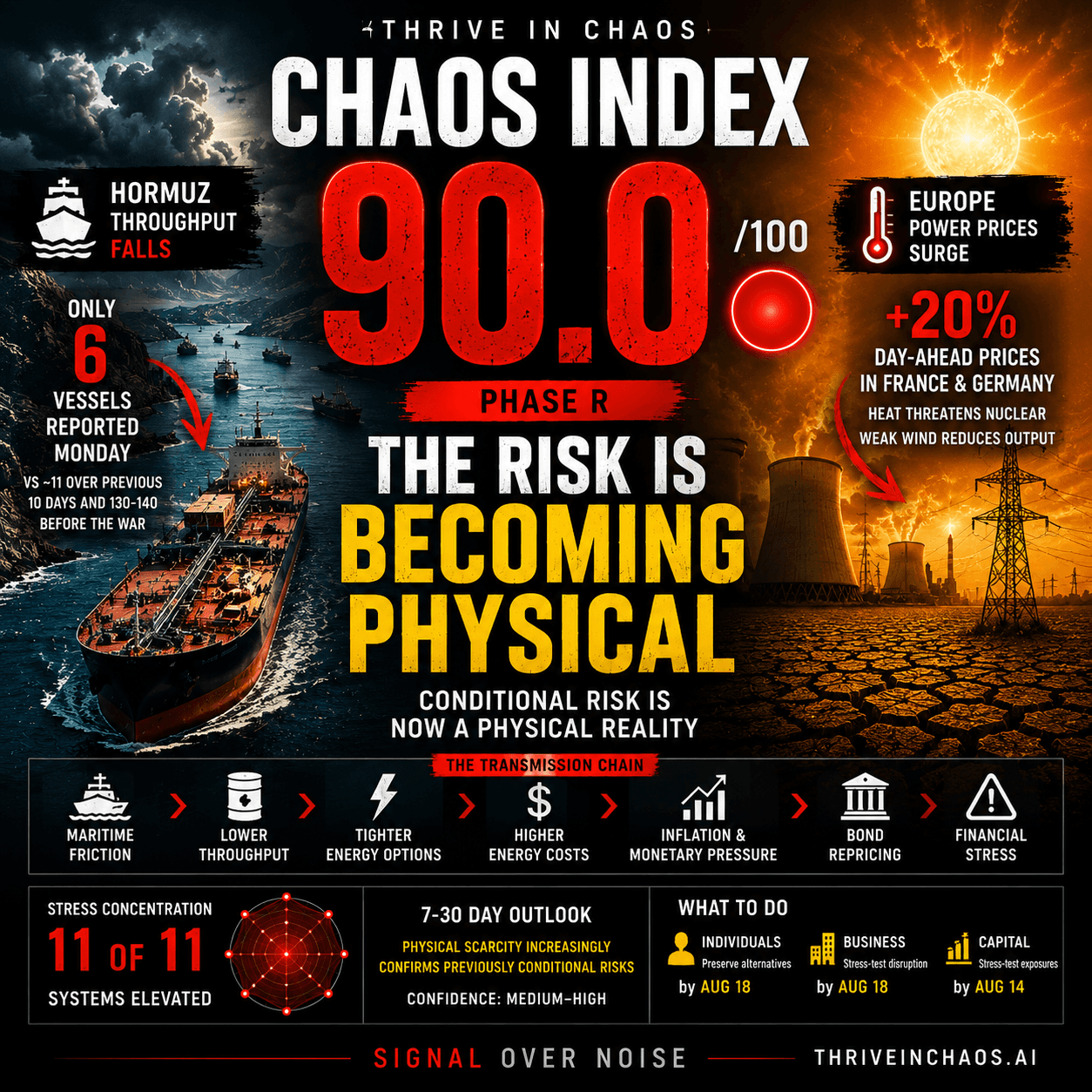
Chaos Index: 90.0 / 100 🔴
Phase: R
System Type: Multipolar Compression
Adaptation Mode: DEFENSIVE
Stress concentration: 11 of 11 systems elevated
The world did not cross into a new regime today.
But one of the most important risks we have been tracking changed character.
Until now, the central question around the Strait of Hormuz was conditional access: the route could remain physically open while insurance, sanctions, political permissions and unresolved transit rules made normal commercial use increasingly difficult.
On August 11, that risk became more tangible.
Only six vessels were reported transiting Hormuz on Monday, compared with roughly eleven over the previous ten days and around 130–140 before the war.
At almost the same time, another part of the energy system came under pressure.
French and German day-ahead electricity prices rose more than 20% as high temperatures threatened to constrain French nuclear generation while weak wind reduced available German output.
Individually, these are manageable developments.
Together, they reveal a more important mechanism:
geopolitical friction is beginning to coincide with physical energy-system constraints.
The issue is no longer simply whether energy remains available.
The question is how many alternatives remain available at acceptable cost.
That is why today's Chaos Index rises to 90.0.
Executive Summary
Three signals matter today.
First, Hormuz is moving from political uncertainty toward measurable operational impairment.
A route does not have to be formally closed to lose economic functionality. Commercial operators can reduce participation because of security risk, insurance conditions, sanctions uncertainty or unclear access rules.
Second, European heat is reducing generation flexibility.
When nuclear availability and wind generation weaken at the same time electricity demand remains elevated, the system becomes more dependent on expensive marginal generation — particularly gas.
Third, AI infrastructure is moving deeper into the financial system.
Nvidia and major financial institutions have announced large-scale compute-financing structures designed to mobilize third-party capital. The scale could eventually matter enormously, but disclosed commitments remain insufficient to justify a Chaos Index block increase today.
The common pattern is straightforward:
conditional risk is beginning to produce physical consequences.
1. What Changed in the Chaos Index
The confirmed DAILY Chaos Index rises from 88.4 on August 10 to 90.0 on August 11.
The movement is deliberately narrow.
Only three blocks change:
E: +0.5
G: +0.5
H: +0.5
The remaining eight blocks are unchanged.
The system classification remains:
Multipolar Compression
The adaptation posture remains:
DEFENSIVE
This is important.
A high Chaos Index does not mean that every negative headline should move every part of the model.
Scores should change only when the operating environment changes.
Today, there is evidence that it did.
2. Hormuz: From Conditional Access to Physical Throughput
The most important development is not another diplomatic statement about the Strait of Hormuz.
It is vessel behaviour.
Only six vessels were reported transiting the Strait on Monday.
A single day should not be mistaken for a permanent trend. Scheduling effects can matter. Operators can temporarily delay departures. Traffic may recover quickly if negotiations produce credible access conditions.
But the number is still significant.
It demonstrates something that political statements alone cannot:
commercial participants are acting as if the corridor remains materially impaired.
This distinction is fundamental.
A shipping route can be:
legally open,
physically passable,
and still commercially abnormal.
If insurers increase premiums, shipowners hesitate to enter, sanctions compliance becomes uncertain or future access terms remain unresolved, physical traffic can decline before any formal closure occurs.
That appears increasingly relevant in Hormuz.
3. Why Throughput Matters More Than Headlines
A political announcement tells us what institutions intend.
Throughput tells us how the system is actually behaving.
That difference becomes critical during periods of uncertainty.
Suppose governments announce that a route is available.
If carriers still refuse to use it, the practical supply-chain effect remains similar to partial disruption.
This creates three layers of transmission.
First-order effect
Lower physical shipping throughput.
Second-order effect
Higher freight, insurance, inventory and rerouting costs.
Third-order effect
Energy-price pressure, inflation transmission and additional monetary-policy constraints.
This is how geopolitical friction can migrate into the financial system.
4. Open Does Not Mean Normal
The old analytical framework asks:
Is Hormuz open or closed?
The better question is:
At what cost, under what conditions, and with how much usable capacity?
That is a much more useful measure of resilience.
The same principle applies across modern infrastructure.
A payment system may operate while certain transactions become impossible.
A port may operate while insurers refuse particular cargoes.
A power grid may remain stable while reserve margins collapse.
A market may remain liquid until everybody needs liquidity simultaneously.
The difference between existence and usable capacity is increasingly important.
5. Europe: Heat Is Removing Energy Flexibility
The second major signal comes from Europe.
French day-ahead electricity prices rose approximately 21.8% to €142.5/MWh.
German prices increased around 22.8% to €138.5/MWh.
The problem is not simply high temperatures.
It is the interaction between temperature, generation availability and demand.
Heat can limit some nuclear production because plants depend on cooling systems and environmental constraints on water discharge.
At the same time, weak wind reduces another relatively low-marginal-cost source of electricity.
Meanwhile, cooling demand increases.
The system therefore loses supply flexibility while demand remains elevated.
6. Why This Matters Beyond One Hot Week
If this were happening in isolation, the implications would be limited.
Weather changes.
Wind recovers.
Nuclear restrictions can ease.
But today's global environment matters because the constraint appears alongside elevated Gulf energy risk.
Europe may need greater reliance on marginal gas-fired generation precisely when the international energy system has less reliable shipping optionality.
This creates coupling between two previously separate problems:
climate-related generation stress
and
geopolitical energy-logistics stress.
The interaction is more important than either event individually.
7. The Transmission Mechanism
The mechanism to watch is:
Hormuz friction
→ reduced physical throughput
→ tighter energy optionality
→ higher marginal energy costs
→ inflation pressure
→ monetary-policy pressure
→ bond repricing
→ broader financial stress
Not every step must occur.
And the chain does not have to move in a straight line.
But this is the transmission architecture that matters.
It shows why a maritime event thousands of kilometres away can eventually affect financing costs, household budgets and corporate investment decisions.
8. Signal Three: AI Infrastructure Is Becoming Financial Infrastructure
A separate development deserves attention.
Nvidia and six financial institutions announced compute-financing platforms intended to mobilize more than $500 billion in third-party capital.
Nvidia could reportedly provide significant backstop support.
If implemented at scale, this would represent an important evolution in AI infrastructure.
The first phase of the AI buildout was dominated by hyperscaler balance sheets.
The next phase may rely increasingly on structured finance, asset managers, private capital and dedicated infrastructure vehicles.
That would distribute AI infrastructure risk much more widely through the financial system.
9. Why We Did Not Raise the AI or Financial Blocks Today
The headline number is large.
But large numbers are not enough.
There is an important difference between:
target financing capacity
and
committed, deployed capital.
Individual commitments, detailed financing terms and deployment schedules remain unclear.
Therefore this signal is recorded — but it does not produce an index increase today.
This is an example of a core THRIVE IN CHAOS principle:
announcement is not implementation.
10. Pattern of the Day: Physical Confirmation
Yesterday's dominant pattern was conditionality.
Today it moves one stage further.
We are beginning to see physical confirmation.
Hormuz:
fewer vessels.
Europe:
less generation flexibility.
Power markets:
higher marginal prices.
The transition matters.
Political uncertainty can remain theoretical for a long time.
Once it changes commercial behaviour, the consequences become harder to reverse cheaply.
11. Why This Is a Structural Signal
Modern systems were optimized around predictable access.
Companies reduced inventories.
Supply chains concentrated around efficient routes.
Electricity markets relied on interconnected capacity.
Capital structures assumed infrastructure could be financed cheaply.
That architecture works extremely well under stable conditions.
But when several systems become conditional simultaneously, the cost of resilience rises quickly.
Businesses need additional inventory.
Governments need reserve capacity.
Energy systems need redundancy.
Investors need larger risk buffers.
Individuals need more financial and logistical flexibility.
Efficiency declines.
But optionality increases.
The global economy is slowly repricing that trade-off.
12. Chaos Is the Rising Cost of the Next Decision
This is why THRIVE IN CHAOS does not define chaos simply as disorder.
A system can look orderly while becoming less resilient.
Chaos increases when the next decision becomes more expensive because:
there is less time,
fewer alternatives,
higher switching costs,
less liquidity,
weaker buffers,
or greater dependency.
This is precisely what today's signals show.
Hormuz technically remains accessible.
European power systems remain operational.
Financial markets remain open.
Nothing needs to collapse for the system to become less forgiving.
13. What a Chaos Index of 90.0 Means
A Chaos Index of 90.0 does not mean a 90% probability of catastrophe.
It indicates very high systemic pressure.
All 11 of 11 monitored systems remain elevated.
That is important because shocks do not arrive in an empty environment.
A new energy shock arrives while monetary systems are already constrained.
A logistics disruption arrives while businesses are already carrying higher financing costs.
A geopolitical event arrives while governments are already spending more on security and industrial policy.
The problem is cumulative load.
14. Base Scenario — 7–30 Days
Our base direction is:
Physical scarcity increasingly confirms previously conditional risks.
Confidence: Medium–High.
The most likely scenario is continued high-friction stability.
Hormuz remains partially functional but commercially abnormal.
European heat stress eases intermittently, but exposes the vulnerability of the generation mix.
Markets continue repricing energy, duration and currencies without a full systemic break.
Under this scenario, the Chaos Index can remain around current elevated levels without another dramatic geopolitical event.
15. Stress Scenario
The stress case develops if several signals persist simultaneously.
Watch for:
sustained Hormuz traffic below recent averages;
higher war-risk insurance;
Brent remaining above or moving materially beyond $90;
continued European spot-power stress;
further nuclear or wind constraints;
long-term sovereign yields breaking higher.
Under that scenario, the energy shock begins transmitting more directly into inflation and monetary expectations.
16. Escalation Scenario
A more severe scenario would require evidence of sustained physical denial of capacity.
Examples:
major attacks on Gulf shipping;
formal restrictions on transit;
persistent commercial withdrawal from Hormuz;
simultaneous loss of European generation;
rapid energy-price acceleration;
financial-market deleveraging.
This is not our base case today.
The correct response is not panic.
It is maintaining enough optionality to respond if probabilities change.
17. What to Watch Next
Hormuz vessel traffic
Does throughput recover toward the recent ten-day average?
Insurance
Do war-risk premiums decline with physical traffic, or remain elevated?
Brent
Does oil stabilize below $90, or move into a sustained higher regime?
French nuclear availability
Do expected heat-related constraints materialize and persist?
German wind output
Does generation recover quickly?
U.S. long-duration yields
The 30-year Treasury yield near 5.30% remains an important financial transmission threshold.
18. Recommendations for Individuals
The objective is not to dramatically change behaviour.
It is to preserve one inexpensive alternative.
By August 18, review commitments sensitive to fuel, transportation or cross-border logistics.
Examples include:
travel arrangements;
large fuel-dependent purchases;
international deliveries;
energy-sensitive household spending.
Ask:
If this becomes 10–20% more expensive next week, do I still have a reasonable alternative?
If the answer is no, optionality may already be too low.
19. Recommendations for Business
Businesses should move from general geopolitical monitoring to operational stress-testing.
By August 18, calculate the effect of:
a seven-day Hormuz disruption
and
a European power-price spike.
Include:
freight costs;
insurance;
inventory;
energy inputs;
delivery commitments;
customer penalties;
working-capital requirements.
Most importantly:
do not remove contingencies simply because a route is formally open.
Wait for physical throughput and insurance conditions to normalize together.
20. Recommendations for Capital
By August 14, stress-test exposures against:
Brent above $90;
U.S. 30-year Treasury yields near or above 5.30%;
renewed JPY instability;
higher European energy prices.
Focus on transmission channels rather than the original headline.
Energy risk can affect:
inflation expectations;
duration;
currencies;
carry trades;
industrial margins;
transportation;
insurance;
emerging markets.
Define action thresholds before the move happens.
That reduces the probability of making a forced decision after repricing.
21. What Not to Do
Do not assume:
six Hormuz vessels means permanent closure;
one heatwave means permanent European energy shortage;
a $500 billion AI financing target equals $500 billion of committed capital;
a Chaos Index of 90 means immediate collapse.
All four conclusions would exceed the evidence.
The signal is narrower.
Buffers are shrinking.
That is enough to matter.
22. First-, Second- and Third-Order Effects
Hormuz
First order: lower physical throughput.
Second order: higher insurance, freight and inventory requirements.
Third order: inflation and monetary-policy pressure.
European power
First order: higher electricity prices.
Second order: greater reliance on expensive marginal generation.
Third order: industrial competitiveness and inflation pressure.
AI financing
First order: more capital available for compute infrastructure.
Second order: infrastructure risk spreads beyond hyperscaler balance sheets.
Third order: utilization and residual-value assumptions become increasingly relevant to the wider financial system.
23. The Structural Shift
The global economy increasingly faces a difficult trade-off.
Efficiency requires concentration.
Resilience requires redundancy.
Efficiency says:
one optimal supplier;
one optimal route;
minimal inventory;
maximum utilization.
Resilience says:
multiple suppliers;
alternative routes;
inventory buffers;
unused capacity.
For decades, markets largely rewarded the first model.
The emerging environment increasingly rewards the second.
That transition is expensive.
But the alternative is losing decision space exactly when it is most valuable.
24. Final Assessment
The most important signal on August 11 is not that another crisis has started.
It is that previously conditional risk is beginning to produce measurable operating consequences.
Hormuz is still technically open.
But traffic is severely reduced.
Europe's electricity system is still functioning.
But heat and weak wind are reducing flexibility.
Financial markets are still functioning.
But energy and long-duration risks are becoming more tightly connected.
This is what a less forgiving system looks like before formal breakdown.
The system still works.
Keeping it working is becoming more expensive.
That is the practical meaning of today's Chaos Index 90.0.
The objective is not to predict the exact moment of rupture.
It is to preserve enough Decision Space that the next shock does not make the decision for you.
THRIVE IN CHAOS
Decision Intelligence for an Uncertain World
Analysis → Forecast → Recommendations
Signal → Meaning → Action → Stability
Signal Over Noise
thriveinchaos.ai
AI intelligence system with human editorial oversight.
Forecasts are probability-based analytical assessments, not certainties.
This material supports independent judgment and does not constitute financial, legal or investment advice.
Join the newsletter
Be the first to read our articles.


