

DAILY PULSE | August 10, 2026
First, monetary-policy risk in Japan is changing from a question of direction into a question of timing. Debate inside the Bank of Japan is increasingly focused on whether tightening may need to occur faster if weak-yen import costs and energy-related inflation remain persistent.
14 min red
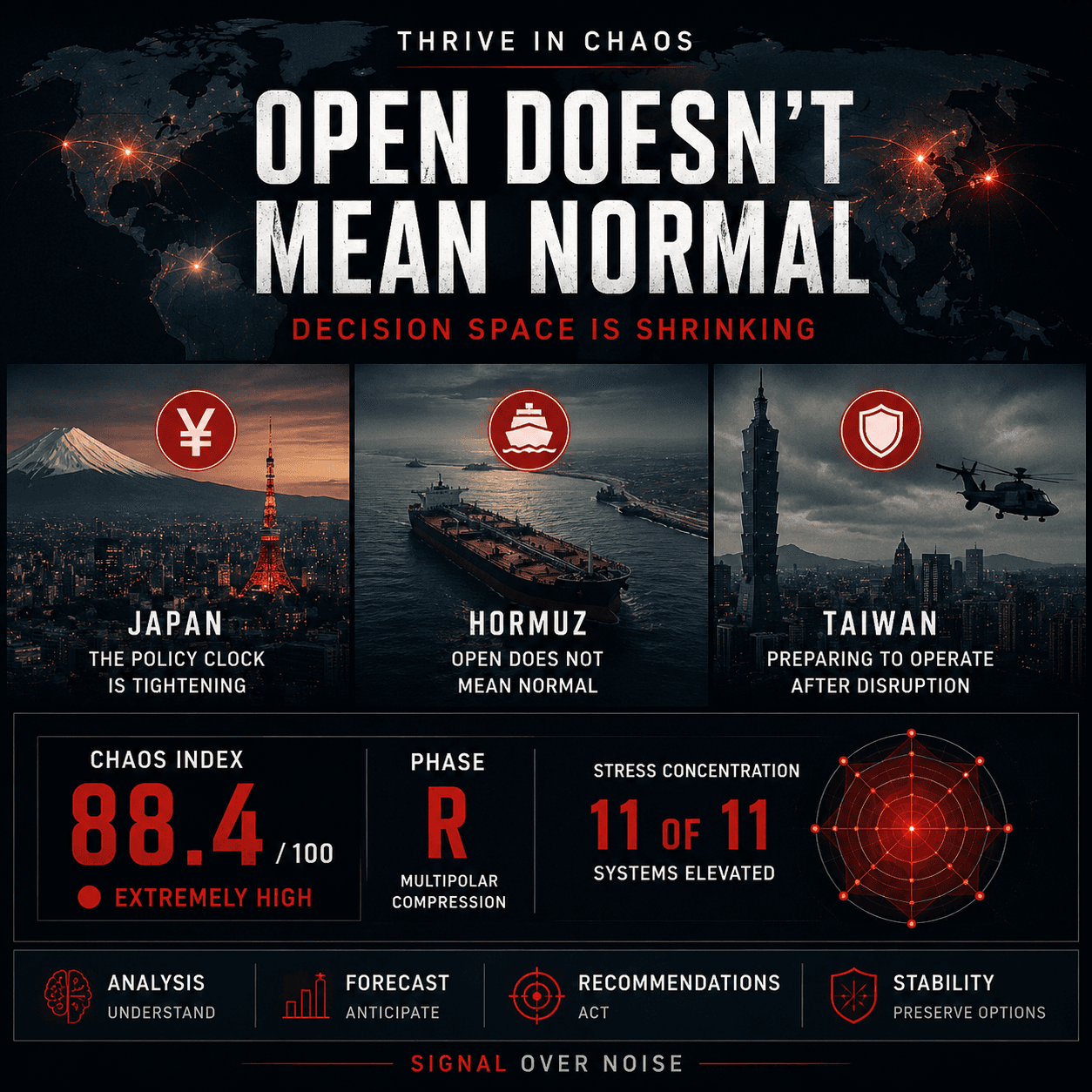
Chaos Index 88.4: Decision Space Is Tightening Without a New Regime Break
THRIVE IN CHAOS — DAILY PULSE
August 10, 2026
Chaos Index: 88.4 / 100 🔴
Phase: R
System Type: Multipolar Compression
Adaptation Mode: DEFENSIVE
Stress concentration: 11 of 11 systems elevated
The Chaos Index is THRIVE IN CHAOS's 0–100 measure of global systemic instability. It tracks not simply how many negative events are occurring, but how quickly the cost of the next decision is rising as buffers weaken, dependencies deepen and inexpensive alternatives disappear.
Today's reading is 88.4.
The important development is not the emergence of a new global crisis.
It is something less visible and potentially more consequential:
decision space is continuing to narrow.
Across monetary policy, energy logistics and resilience planning, systems remain operational — but the number of cheap, reversible and reliable choices available to decision-makers is declining.
That distinction matters.
A system does not have to fail before it becomes dangerous.
It becomes less forgiving when the cost of being wrong increases.
Executive Summary
Three developments define the August 10 reading.
First, monetary-policy risk in Japan is changing from a question of direction into a question of timing. Debate inside the Bank of Japan is increasingly focused on whether tightening may need to occur faster if weak-yen import costs and energy-related inflation remain persistent.
Second, the Strait of Hormuz continues to demonstrate the difference between physical access and commercially normal access. A route may remain technically passable while insurance, compliance, political conditions, transit arrangements and enforcement uncertainty raise the effective cost of using it.
Third, Taiwan's Han Kuang exercises provide further evidence that resilience planning is shifting away from the assumption that disruption can always be prevented and toward the ability to maintain critical functions after infrastructure and communications have been degraded.
These signals originate in different systems.
Their common effect is the same:
less room to wait, fewer frictionless alternatives and a higher cost attached to the next decision.
The base case for the next 7–30 days is therefore not a dramatic new global rupture.
It is continued conditionality.
Confidence: Medium.
1. What Changed Today
The Chaos Index increased from the founder-approved weekly anchor of 87.2 to a confirmed DAILY reading of 88.4.
The movement was deliberately limited.
Only two analytical blocks changed materially:
Financial Stress: +0.5
Energy: +0.5
The remaining nine blocks were unchanged.
This matters methodologically.
The purpose of the DAILY PULSE is not to force movement into the index because new headlines have appeared. A daily reading should change only when evidence indicates a meaningful change in the underlying operating environment.
Today's evidence supports higher pressure in monetary timing and energy-access conditions.
It does not justify declaring a new system type.
The prevailing system remains:
Multipolar Compression
The current adaptation posture remains:
DEFENSIVE
2. Signal One: Japan's Monetary-Policy Clock Is Tightening
The first material signal comes from Japan.
The relevant development is not simply that interest rates may eventually rise again.
Markets have been aware of that possibility for some time.
The more important question is:
How much longer can policymakers afford to wait?
Japan remains exposed to a difficult interaction between currency weakness, imported costs, energy prices and domestic inflation dynamics.
A weaker yen raises the local-currency cost of imported goods.
Energy is particularly important because Japan remains structurally dependent on imported fuel.
When currency weakness and energy costs reinforce each other, the inflation consequences are not confined to financial markets.
They propagate through transportation, industry, household costs and corporate margins.
That changes the policy problem.
The Bank of Japan is no longer evaluating monetary tightening in isolation.
It is balancing several competing risks:
tightening too quickly and weakening domestic demand;
tightening too slowly and allowing imported inflation to become more persistent;
destabilising government-bond markets;
encouraging additional yen weakness;
disrupting carry trades and cross-border capital flows.
The result is timing compression.
The cost of waiting increases even before the Bank of Japan changes policy.
Why This Matters Beyond Japan
Japan remains deeply integrated into global capital markets.
For years, low Japanese interest rates contributed to a global financial structure in which yen funding could be used to finance positions elsewhere.
That makes Japanese monetary policy relevant well beyond Japanese equities or government bonds.
A faster-than-expected shift in policy can affect:
JPY-funded carry trades;
sovereign duration;
global bond positioning;
currency volatility;
leveraged strategies;
capital flows into higher-yielding assets.
The risk is therefore not simply:
"Will the BOJ raise rates?"
The more useful question is:
"How much positioning assumes that the BOJ still has plenty of time?"
The narrower that timing window becomes, the more sensitive markets become to communication rather than actual policy moves.
This is why the financial-stress block increased today.
Counter-Evidence
The signal should not be overstated.
Japan still has meaningful reasons to proceed gradually.
Domestic growth remains an important constraint.
Underlying inflation could moderate.
Policymakers may judge that aggressive tightening would create more instability than continued patience.
Therefore the current signal does not imply that an immediate rate increase is inevitable.
It indicates something narrower:
the cost of postponing tightening appears to be increasing.
That is a meaningful difference.
3. Signal Two: Hormuz — Open Does Not Mean Normal
The second material signal concerns the Strait of Hormuz.
The conventional way to analyse a chokepoint is binary:
open or closed.
That is increasingly inadequate.
The more useful distinction is:
physically accessible or commercially normal.
A ship may be technically capable of passing through a route while the commercial system surrounding that route becomes increasingly difficult to use.
That can occur through:
higher insurance costs;
war-risk premiums;
sanctions uncertainty;
additional compliance requirements;
new transit arrangements;
informal political restrictions;
delays;
changing enforcement;
contractual repricing.
In other words:
physical flow can recover before economic friction disappears.
This is the core mechanism behind today's increase in the Energy block.
4. Why Conditional Access Matters
Global supply chains were largely built around an efficiency assumption:
if a route is open, firms can use it at broadly predictable cost.
That assumption becomes weaker when access turns conditional.
Conditional access creates several second-order effects.
First-order effect: transport costs rise
Higher insurance, security or compliance costs can increase the effective price of moving cargo.
Second-order effect: inventory requirements rise
Businesses respond by increasing buffers, duplicating suppliers or changing routes.
That raises working-capital requirements.
Third-order effect: efficiency declines
The system moves from optimising around the cheapest route toward paying for redundancy.
This is a structural change.
The immediate event may be temporary.
The behaviour it produces can persist.
5. Hormuz as an Optionality Problem
The Strait of Hormuz is not important only because of the volume of energy that moves through it.
It matters because alternative routes are limited.
That makes the region a classic example of decision-space compression.
When a system depends heavily on one route, the relevant measure of resilience is not simply whether that route is functioning today.
It is the cost of the alternatives if conditions deteriorate tomorrow.
Consider a simplified decision tree.
A company dependent on Gulf-linked shipping may face three options:
continue using the normal route;
pay more for insurance and security;
reroute through a more expensive or slower alternative.
If each alternative becomes more costly at the same time, the company still technically has choices.
But its decision space has shrunk.
This is central to the THRIVE IN CHAOS definition of instability.
Chaos is not simply disorder.
It is the rising cost of the next decision.
6. Signal Three: Taiwan Is Testing Continuity Under Disruption
Taiwan's Han Kuang exercises provide a different type of signal.
They do not justify an increase in geopolitical escalation today because the exercises were scheduled.
Treating every military exercise as a new escalation event would create systematic double counting.
However, the exercises remain analytically important.
The deeper signal is the type of resilience being tested.
Increasing attention is being placed on:
rapid infrastructure repair;
restoring runway operations;
communications under degraded conditions;
maintaining command continuity;
preserving military production;
operating after critical systems have been damaged.
This represents a broader transformation in resilience thinking.
Traditional resilience often focused on preventing disruption.
Modern resilience increasingly assumes:
some disruption will occur.
The objective then becomes maintaining essential function after the shock.
7. Why Taiwan Matters Structurally
This principle extends far beyond Taiwan.
Governments and businesses are increasingly recognising that full protection of complex systems is impossible.
Modern networks contain too many nodes.
Supply chains are too distributed.
Digital infrastructure is too interconnected.
The cost of defending every component becomes prohibitive.
As a result, resilience strategies shift toward:
redundancy;
rapid repair;
distributed capacity;
backup communications;
alternative suppliers;
reserve inventories;
operational continuity.
This is an important structural signal.
The world is slowly moving from an efficiency architecture toward a resilience architecture.
That transition itself has economic consequences.
Redundancy costs money.
Buffers consume capital.
Alternative suppliers are often more expensive.
Security requirements increase operating costs.
Resilience therefore reduces fragility but also reduces efficiency.
This trade-off is becoming one of the defining characteristics of the emerging global system.
8. Pattern of the Day: Conditionality
The three signals appear unrelated:
Japan — monetary policy.
Hormuz — energy logistics.
Taiwan — military resilience.
But the underlying pattern is consistent.
Conditionality is replacing certainty.
Policy remains available — but timing is constrained.
Trade routes remain available — but terms of access are less predictable.
Infrastructure remains usable — but resilience planning increasingly assumes degradation.
This produces an important system-level effect.
The world still functions.
But it requires more contingency planning to function safely.
That is the core signal.
9. The Difference Between Breakdown and Compression
This distinction is essential.
There are at least two different ways instability can increase.
The first is visible:
breakdown.
A port closes.
A financial institution fails.
A government collapses.
A military conflict begins.
The second is slower:
compression.
Insurance becomes more expensive.
Policy flexibility declines.
Supply chains require more redundancy.
Capital buffers increase.
Contracts become more complicated.
Decision windows shorten.
Nothing necessarily breaks.
But maintaining the same level of stability becomes more expensive.
Today's reading belongs primarily to the second category.
10. System Interpretation: Multipolar Compression
The current system type remains Multipolar Compression.
This describes an environment in which multiple centres of power, regulation, capital and security increasingly impose overlapping constraints on global activity.
Companies and individuals no longer optimise inside one broadly coherent system.
They increasingly operate across:
competing regulatory regimes;
competing security architectures;
competing payment systems;
competing trade blocs;
competing technology ecosystems.
The result is not necessarily complete fragmentation.
Instead, each decision contains more conditions.
A supplier may be economically attractive but politically risky.
A market may be large but sanctions-sensitive.
A route may be open but expensive to insure.
A technology may be superior but restricted by export controls.
This is what compression looks like operationally.
11. Why the Chaos Index Is Already High
A reading of 88.4 should not be interpreted as an 88.4% probability of catastrophe.
The Chaos Index measures system pressure, not the probability of one specific disaster.
Today's diagnostic picture shows broad stress rather than one isolated weak point.
Stress concentration: 11 of 11 systems elevated.
That is important.
When only one domain is under pressure, other parts of the system can often absorb the shock.
When many domains are simultaneously elevated, absorption capacity declines.
Fiscal buffers may already be constrained.
Supply chains may already contain redundancy costs.
Political institutions may already face legitimacy pressure.
Companies may already be carrying higher financing costs.
Households may already be absorbing higher living costs.
A new shock then arrives in a system with fewer unused buffers.
That is why identical shocks can produce very different consequences at different moments.
12. The Next 7–30 Days
Our base case is:
continued conditionality rather than a new systemic rupture.
Confidence: Medium.
The most likely direction is that pressure remains high while institutions continue adapting incrementally.
This means:
no assumption of immediate Hormuz closure;
no assumption of immediate BOJ shock tightening;
no assumption that Taiwan exercises automatically indicate near-term conflict.
But it also means none of these systems should be treated as fully normal.
The operating environment remains unusually sensitive to small changes in policy, access conditions and market expectations.
13. Base Scenario
Probability direction: Highest
The most likely scenario is continued high-pressure stability.
Hormuz remains accessible but commercially more complicated than the pre-crisis norm.
The BOJ remains cautious but markets increasingly price a shorter policy window.
Taiwan continues resilience preparation without an immediate transition into a new confrontation.
Under this scenario the Chaos Index may remain elevated without another major step higher.
The defining feature would be:
high friction without systemic rupture.
14. Stress Scenario
The stress scenario would emerge if several triggers begin reinforcing one another.
Examples include:
formal or semi-formal restrictions on Hormuz passage;
sharp war-risk insurance repricing;
renewed energy-price pressure;
disorderly yen weakness;
unexpectedly hawkish BOJ guidance;
simultaneous deterioration in another major geopolitical theatre.
The important issue would not be any one trigger.
It would be cross-system transmission.
For example:
Hormuz friction → energy prices → imported inflation → central-bank pressure → bond repricing → financial stress.
This is how separate events become a system.
15. Lower-Probability Escalation Scenario
A more severe scenario would require evidence that conditionality is turning into sustained denial of access or direct system disruption.
Possible indicators:
prolonged physical restrictions in Hormuz;
military confrontation affecting commercial transit;
abrupt monetary-policy repricing combined with liquidity stress;
unscheduled escalation around Taiwan;
simultaneous disruption across energy and financial systems.
We do not have sufficient evidence today to treat this as the base case.
The relevant task is therefore not to predict this scenario as inevitable.
It is to preserve the ability to respond if its probability rises.
16. What Would Change Our Assessment
The DAILY PULSE is designed to change when the operating environment changes.
The following developments would justify reassessment.
Hormuz
Watch for:
formal transit-fee mechanisms;
legally binding access rules;
persistent shipping delays;
war-risk premium increases;
significant changes in tanker traffic;
major sanctions enforcement changes.
Japan
Watch for:
explicit BOJ guidance toward a near-term rate increase;
inflation persistence;
renewed disorderly yen depreciation;
rapid changes in JGB yields;
evidence of carry-trade deleveraging.
Taiwan
Watch for:
unscheduled military mobilisation;
abnormal PLA activity;
unusual reserve mobilisation;
commercial aviation or shipping disruption;
changes in civilian continuity measures beyond planned exercises.
17. Recommendations for Individuals
The objective for individuals is not to react to every headline.
It is to preserve low-cost optionality.
1. Avoid irreversible decisions based on a single event
If a decision involves relocation, major currency conversion, large travel commitments or concentrated exposure to one jurisdiction, separate the immediate event from the structural trend.
The current signal supports caution.
It does not support panic.
2. Maintain payment redundancy
Where practical, avoid dependence on one payment channel, one currency or one financial institution for essential transactions.
The reason is not an expectation of immediate failure.
It is that cross-border payment systems are becoming increasingly exposed to political and regulatory conditions.
3. Preserve timing flexibility
If a large purchase, transfer or contractual commitment can be delayed at low cost until monetary or energy uncertainty becomes clearer, flexibility has value.
But delay itself should not become automatic.
The correct question is:
What is the cost of waiting versus the cost of committing?
Time horizon
Review by: August 24, 2026
18. Recommendations for Business
Businesses should treat today's environment as a continuity-management problem.
1. Audit Hormuz exposure
Identify:
suppliers dependent on Gulf shipping;
energy inputs;
freight contracts;
insurance arrangements;
sanctions-sensitive counterparties;
delivery obligations vulnerable to delay.
Do not stop at Tier-1 suppliers.
Many dependencies sit deeper in the chain.
2. Recheck force-majeure and delivery clauses
Commercial contracts written for a binary closure scenario may be inadequate for conditional access.
A route may technically remain open while costs or delays become commercially unacceptable.
Contract language should distinguish:
physical closure;
regulatory restriction;
insurance unavailability;
sanctions changes;
abnormal surcharges;
delivery-delay thresholds.
3. Calculate the cost of an alternative route before it is needed
The wrong time to discover the true cost of redundancy is after the primary route becomes impaired.
Companies should quantify:
alternative freight cost;
additional transit time;
working-capital requirements;
buffer inventory;
insurance differences;
customer-service implications.
4. Examine Japan-linked financial assumptions
Businesses with material yen exposure should stress-test:
financing costs;
hedging;
currency conversion;
Japanese demand;
supplier pricing.
Time horizon
Complete first review by: September 9, 2026
19. Recommendations for Capital
Capital should focus on transmission channels rather than headlines.
1. Stress-test JPY and carry exposure
The relevant risk is not simply yen appreciation or depreciation.
It is an abrupt change in expectations that forces leveraged positions to unwind.
Stress-test scenarios where:
BOJ guidance turns unexpectedly hawkish;
JPY strengthens rapidly;
global carry positions deleverage;
cross-asset volatility rises.
2. Review duration exposure
If global energy pressure interacts with renewed inflation concerns, the assumption of smooth monetary easing can weaken.
Duration sensitivity should therefore be tested against a scenario in which policy stays tighter for longer.
3. Separate energy price exposure from energy-system exposure
Energy-system risk includes more than oil prices.
Relevant exposures may include:
shipping;
insurance;
LNG;
refining;
petrochemicals;
industrial inputs;
emerging-market currencies.
4. Define triggers before changing allocation
Reactive decisions made after a major market move are often the most expensive.
Predefine conditions such as:
specific BOJ communication;
yen volatility thresholds;
energy-price ranges;
insurance repricing;
Hormuz traffic disruption.
The objective is not to forecast every move.
It is to know in advance what evidence would justify action.
Time horizon
Complete first stress test by: August 24, 2026
20. What Not to Do
High-index environments often produce two opposite errors.
The first is complacency.
The second is overreaction.
Both reduce decision quality.
Avoid:
treating every military exercise as imminent war;
treating every policy statement as a confirmed decision;
assuming an open trade route has returned to normal;
changing portfolio allocation because of one headline;
assuming yesterday's correlations will remain stable;
eliminating redundancy solely because it appears inefficient.
The correct objective is not maximum defensiveness.
It is maintaining enough flexibility to respond without being forced.
21. First-, Second- and Third-Order Effects
The central signals become more useful when we follow their transmission.
Japan
First order
Stronger expectations of monetary tightening.
Second order
JPY and bond-market repricing; pressure on carry trades.
Third order
Changes in global capital flows, leverage and risk appetite.
Hormuz
First order
Higher shipping, compliance and insurance friction.
Second order
Higher energy and logistics costs; larger inventory buffers.
Third order
Reduced corporate efficiency, higher working-capital needs and inflation transmission.
Taiwan
First order
Greater continuity planning.
Second order
More redundancy in infrastructure, communications and production.
Third order
A broader shift from efficiency-first systems toward resilience-first systems.
22. The Structural Pattern: Efficiency Is Losing Its Monopoly
For several decades the dominant optimisation objective was efficiency.
Reduce inventory.
Consolidate suppliers.
Centralise production.
Minimise redundancy.
Optimise capital.
This worked exceptionally well in a world where geopolitical and regulatory conditions were relatively predictable.
That world is changing.
Companies and governments increasingly pay for capabilities that appear inefficient under normal conditions:
reserve capacity;
duplicate suppliers;
strategic stockpiles;
alternative payment systems;
backup communications;
domestic production;
diversified logistics.
From a narrow accounting perspective these are costs.
From a resilience perspective they are options.
The economic system is therefore undergoing a quiet repricing of redundancy.
This is one of the deeper forces behind today's high Chaos Index.
23. Decision Space: The Metric Behind the Headlines
THRIVE IN CHAOS uses the concept of Decision Space to describe how many viable actions remain available at acceptable cost.
A system with large decision space has:
time;
alternatives;
liquidity;
redundancy;
political flexibility;
operational buffers.
A system with shrinking decision space has:
shorter deadlines;
fewer suppliers;
higher switching costs;
concentrated dependencies;
less fiscal room;
more political constraints.
Chaos increases when decision space contracts.
This explains why relatively small events can become disproportionately important.
The event may be small.
The system receiving it may already have very little room to adapt.
24. Stability Is Not the Absence of Change
A common mistake is to define stability as calm.
That is too narrow.
A system can look calm while becoming increasingly fragile.
Real stability is the ability to absorb change without losing essential decision capacity.
That means preserving:
buffers;
redundancy;
liquidity;
credibility;
institutional flexibility;
time.
The current environment should therefore not be judged by the absence of a dramatic new crisis today.
The more important question is:
How much capacity remains if another shock arrives tomorrow?
25. Final Assessment
The August 10 reading does not indicate that the global system has crossed into a new regime.
It indicates that the existing regime is becoming more demanding.
Japan illustrates a shrinking monetary-policy window.
Hormuz illustrates the growing difference between technical availability and commercially reliable access.
Taiwan illustrates the transition from disruption prevention toward continuity after disruption.
Together, these signals reinforce a central THRIVE IN CHAOS thesis:
the world is becoming less forgiving because maintaining the same level of stability increasingly requires more preparation, more redundancy and faster decisions.
The next major crisis does not need to be predicted precisely.
What matters is whether enough decision space remains when it arrives.
For individuals, this means preserving alternatives.
For business, it means knowing dependencies before they become constraints.
For capital, it means defining triggers before volatility forces action.
The objective is not to eliminate uncertainty.
It is to prevent uncertainty from eliminating your choices.
DAILY PULSE — August 10, 2026
Chaos Index: 88.4 / 100 🔴
Phase: R
System Type: Multipolar Compression
Adaptation Mode: DEFENSIVE
7–30 Day Direction: Continued Conditionality
Confidence: Medium
Watch Next
Hormuz commercial-access conditions
war-risk insurance pricing
BOJ policy communication
JPY volatility
energy-price transmission
unscheduled Taiwan-related military activity
About THRIVE IN CHAOS
THRIVE IN CHAOS is an AI-assisted Decision Intelligence system designed to transform complexity into structured analysis.
Analysis → Forecast → Recommendations
Our objective is not to predict every event.
It is to help individuals, businesses and capital preserve decision quality as uncertainty rises.
Signal → Meaning → Action → Stability
Signal Over Noise
thriveinchaos.ai
AI intelligence system with human editorial oversight.
Forecasts represent probability-based analytical assessments, not certainties.
This material is intended to support independent judgment and does not constitute financial, legal, medical or investment advice.
Join the newsletter
Be the first to read our articles.


