

DAILY PULSE | 5 September 2026
The global system is no longer paying only for the possibility that critical infrastructure might be disrupted. It is increasingly paying because the infrastructure itself is becoming directly involved in geopolitical confrontation.
15 min red
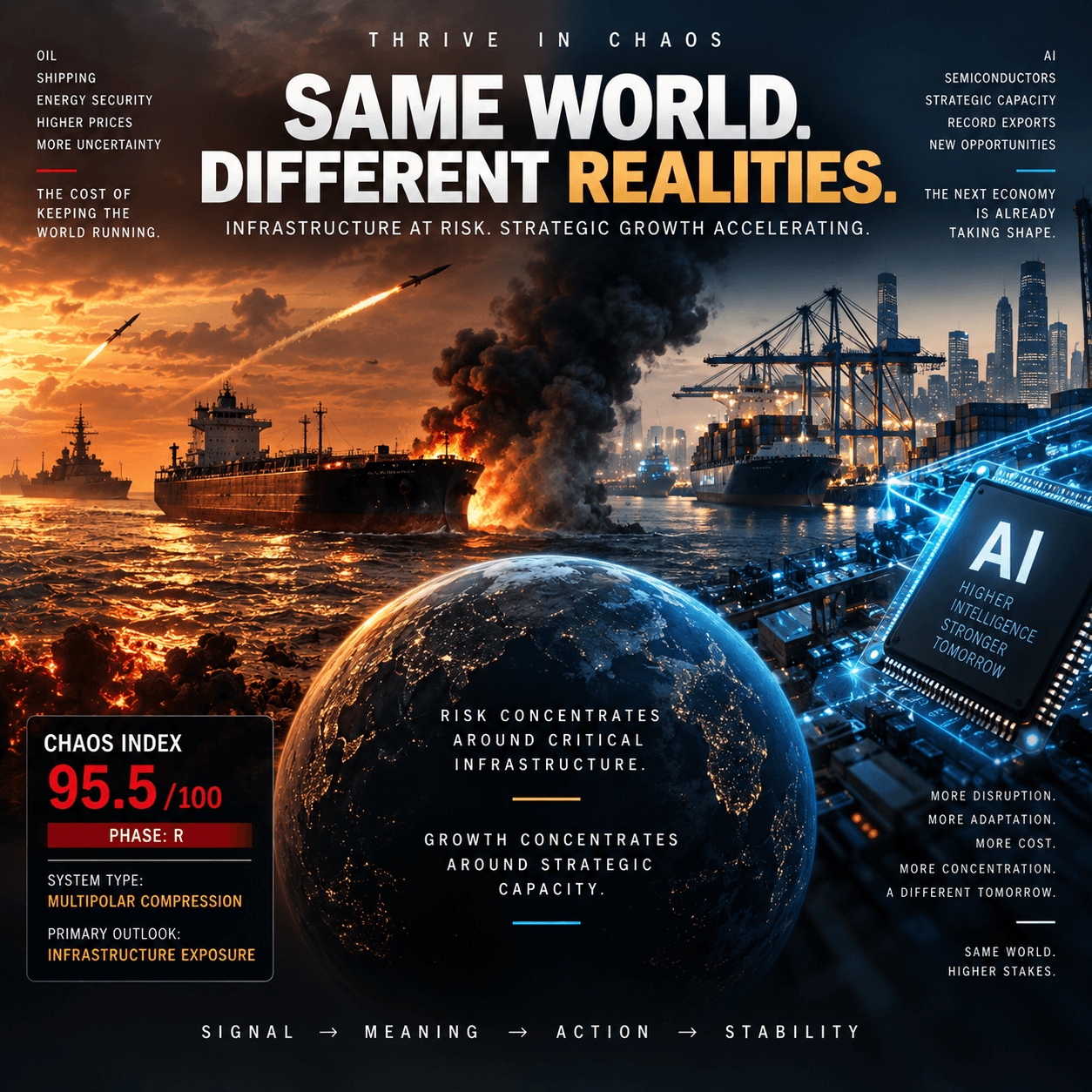
Chaos Index 95.5: When Critical Infrastructure Becomes Part of the Conflict
THRIVE IN CHAOS — DAILY INTELLIGENCE
5 September 2026
Chaos Index: 95.5 / 100 🔴
Phase: R
System Type: Multipolar Compression
Adaptation Mode: DEFENSIVE
Primary Outlook: Infrastructure Exposure
Decision Horizon: 7–30 Days
Confidence: High
Executive Assessment
The Chaos Index remains at 95.5, but today's stability in the headline number hides an important deterioration in the mechanism underneath it.
The global system is no longer paying only for the possibility that critical infrastructure might be disrupted.
It is increasingly paying because the infrastructure itself is becoming directly involved in geopolitical confrontation.
That distinction matters.
Following Iranian ballistic missile attacks targeting two U.S. Navy vessels, U.S. forces struck three Iranian oil tankers. One of the tankers was hit near Kharg Island, the centre of Iran's crude-export infrastructure and historically the route for roughly 90% of the country's crude exports.
This does not mean Iranian oil exports have stopped.
It does not mean Hormuz has closed.
And it does not justify mechanically increasing an already saturated Chaos Index.
But the transmission mechanism has changed.
Military escalation → Energy assets → Supply expectations → Energy prices → Transport and insurance → Households and businesses
This is a more direct connection between geopolitical conflict and the physical economy.
Brent December futures had already closed Friday at $96.28 per barrel before the latest tanker strikes. In the United States, gasoline prices for the Labor Day weekend are expected to average around $4.03 per gallon, illustrating how an external energy shock is already migrating into household budgets.
At the same time, another part of the global economy is moving in almost the opposite direction.
South Korea's exports have reached $709.4 billion year-to-date, already surpassing the previous full-year record, driven overwhelmingly by extraordinary demand for AI-related semiconductors.
These developments appear contradictory only if we assume that instability should weaken everything simultaneously.
It does not.
The emerging pattern is more selective:
Risk is concentrating around critical corridors.
Growth is concentrating around strategic capacity.
The system is not simply deteriorating.
It is becoming more uneven.
1. What Changed Today
The most consequential new development is the direct involvement of energy assets in the U.S.–Iran military confrontation.
After Iranian ballistic missiles targeted two U.S. Navy vessels, American forces struck three Iranian oil tankers. One of those attacks occurred near Kharg Island.
The immediate physical damage appears limited relative to the scale of the regional energy system. There has been no confirmed shutdown of Kharg's export infrastructure, and the tanker strike itself did not produce reports of major casualties.
That counter-evidence matters.
We should not jump from an attack near Kharg to the conclusion that Iranian crude exports are about to disappear.
But the location matters just as much as the immediate damage.
Energy infrastructure is moving closer to the centre of military retaliation.
That increases the probability that future escalation will be priced not only through expectations but through actual disruption to assets, insurance, logistics and supply.
2. Why Kharg Matters
Kharg Island is not simply another location on the Gulf map.
It is one of the central nodes of Iran's oil-export system.
Before the current conflict, roughly 90% of Iranian crude exports moved through infrastructure associated with the island.
This creates an asymmetry.
An attack does not need to destroy the entire export system to matter.
Even a limited increase in perceived vulnerability can affect tanker behaviour, insurance premiums, loading schedules, inventory decisions and crude pricing.
That is how modern infrastructure risk propagates.
The first economic effect of an attack may occur long before the infrastructure itself stops functioning.
3. Risk Is Becoming Physical
For much of the recent escalation, markets were primarily pricing probabilities.
Will Hormuz close?
Will Iran attack shipping?
Will the United States strike Iranian energy infrastructure?
Will insurance become unavailable?
Those probabilities remain relevant.
But the environment is changing because some of the feared events are beginning to occur in partial form.
Tankers are being attacked.
Commercial traffic remains impaired.
Energy infrastructure is increasingly exposed to military operations.
The relevant progression is therefore:
Threat → Risk premium → Physical attack → Operational adaptation → Higher delivered cost
This is an important transition.
The system is moving from paying for uncertainty toward paying for actual adaptation.
4. Hormuz Remains Open — but That Is No Longer Enough
The Strait of Hormuz continues to function.
That remains important counter-evidence against the most extreme energy scenarios.
There is no complete blockade.
Oil continues moving.
Alternative arrangements are being made.
The physical system has not failed.
But this should not be confused with normalization.
A shipping corridor can remain technically open while becoming commercially less efficient.
Companies can alter departure times.
Tankers can reduce visible AIS activity.
Insurers can reprice risk.
Operators can demand higher compensation.
Cargo owners can hold larger inventories.
Governments can deploy naval protection.
Every one of those adaptations has a cost.
The correct question is therefore no longer:
“Is Hormuz open?”
It is:
“What does it now cost to use Hormuz reliably?”
5. Oil Was Already Expensive Before Today's Escalation
December Brent futures closed Friday at $96.28 per barrel, their highest close since late July.
That is significant because today's tanker strikes occurred after energy markets had already absorbed weeks of geopolitical pressure.
The latest escalation therefore does not begin from a neutral baseline.
It is being added to an already expensive system.
This increases sensitivity to additional disruption.
A move from $60 to $70 oil creates one economic environment.
A renewed disruption when oil is already approaching $100 creates another.
The same percentage shock produces a larger absolute cost throughout the supply chain.
6. The Energy Shock Is Reaching Households
The transmission is becoming visible in the United States.
Average gasoline prices during the Labor Day weekend are expected to be approximately $4.03 per gallon, above the previous holiday record.
This matters beyond transportation.
Fuel is one of the most visible prices in the economy.
Households encounter it directly and repeatedly.
When gasoline rises, disposable income available for other purchases falls.
Businesses face higher transportation expenses.
Delivery costs rise.
Political sensitivity to inflation increases.
Inflation expectations can become more difficult to stabilize.
The chain is straightforward:
Crude → Refining → Distribution → Retail fuel → Household disposable income
The geopolitical shock is therefore no longer confined to oil futures.
It is entering everyday economic decisions.
7. There Are Still Important Buffers
The system is not without protection.
U.S. refinery utilization remains high.
Governments retain strategic reserves.
Producers outside the immediate conflict zone can increase supply.
Demand can adjust.
Companies can reroute cargoes.
These buffers are one reason we are not treating today's escalation as an immediate energy-system failure.
But buffers should be understood correctly.
They reduce the probability of catastrophic shortage.
They do not necessarily restore the previous price.
This distinction has appeared repeatedly during the current instability cycle.
Resilience preserves function.
It does not guarantee efficiency.
8. Yesterday's Monetary Constraint Has Not Disappeared
The previous DAILY identified another important mechanism: stronger U.S. employment reduces immediate recession risk but gives the Federal Reserve less reason to provide monetary relief quickly.
Today's energy developments reinforce rather than replace that mechanism.
A resilient labour market combined with expensive energy is particularly important.
Strong employment supports demand.
Expensive energy adds inflation pressure.
Together they reduce the argument for rapid monetary easing.
The emerging chain becomes:
Energy disruption → Higher prices
combined with
Labour resilience → Persistent demand
leading toward
Higher-for-longer monetary conditions
The system therefore faces physical and financial constraints simultaneously.
9. This Is How Costs Migrate Through the System
The last several DAILY reports have tracked the same process through different sectors.
A disruption initially appears in one location.
The system adapts.
Alternative suppliers are found.
Alternative routes are used.
Inventories increase.
Insurance changes.
Financing requirements grow.
Eventually, the original disruption becomes difficult to see because the system is still functioning.
But the cost has not disappeared.
It has migrated.
Today's energy developments provide another example.
A military confrontation in the Gulf can eventually appear as a larger household fuel bill thousands of kilometres away.
That is cost migration.
10. Infrastructure Is Becoming Strategic Terrain
This is the broader structural development.
Energy terminals, pipelines, ports, electricity systems, data centres, telecommunications networks, logistics hubs and semiconductor plants are no longer merely economic assets.
They increasingly possess strategic value.
That creates two consequences.
First, governments have stronger incentives to protect them.
Second, adversaries have stronger incentives to threaten them.
The same infrastructure becomes simultaneously more valuable and more vulnerable.
This is one of the defining characteristics of a fragmented global system.
11. The Problem Extends Far Beyond Oil
Kharg is today's example, but the mechanism is broader.
Consider a port handling critical exports.
A semiconductor fabrication plant.
A submarine communications cable.
A major electricity interconnector.
A cloud-computing region.
A railway junction.
A satellite ground station.
Their economic importance makes them valuable.
Their concentration makes them vulnerable.
The efficiency model of the previous globalization cycle frequently rewarded concentration.
The resilience model increasingly penalizes it.
This creates pressure for duplication, redundancy and geographic diversification.
All three require capital.
12. Redundancy Is Expensive by Design
For decades, companies optimized supply chains around efficiency.
Inventory was minimized.
Capacity utilization was maximized.
Production was concentrated where costs were lowest.
Transport networks were optimized for predictable flows.
That architecture works extremely well when disruption is rare.
It becomes less attractive when disruption becomes persistent.
The response is redundancy.
More inventory.
More suppliers.
More routes.
More spare capacity.
More security.
More geographically distributed infrastructure.
But redundancy looks inefficient under traditional accounting precisely because it means paying for capacity that may not be used most of the time.
The global economy is therefore beginning to exchange some efficiency for optionality.
13. The Cost of Resilience Keeps Rising
This exchange would be easier if capital were cheap.
It is not.
Companies need to build redundancy while financing costs remain elevated.
Governments need to protect infrastructure while sovereign yields are high.
Households need to absorb energy costs while mortgages and consumer credit remain expensive.
The result is a difficult combination:
More investment is required at exactly the moment when investment is more expensive.
This reinforces the monetary-constraint mechanism identified yesterday.
Physical resilience and financial resilience can no longer be analysed separately.
14. Ukraine Shows Another Form of Infrastructure Exposure
The same structural pattern is visible in Ukraine, although under much more severe conditions.
Kyiv has faced approximately ten days of almost continuous air attacks, increasingly involving faster jet-powered drones that are harder to intercept.
Energy and logistics infrastructure remain important targets.
The significant point, however, is not simply that attacks continue.
It is that society is adapting to persistent disruption.
Businesses operate.
People work.
Transport functions.
Public institutions continue.
The system has not normalized.
Instead, abnormal conditions are becoming incorporated into everyday operations.
That is a very different form of resilience.
15. Adaptation Is Not the Same as Recovery
This distinction matters well beyond Ukraine.
A system has recovered when the disruptive condition disappears and normal operating parameters return.
A system has adapted when it learns to function while the disruptive condition remains.
Those are not equivalent.
Adaptation can preserve output while consuming more resources.
It can preserve services while reducing convenience.
It can preserve security while requiring larger defence expenditure.
It can preserve trade while increasing logistics costs.
Increasingly, the global system is adapting rather than recovering.
That is consistent with Multipolar Compression.
16. Diplomacy Remains an Important Counter-Signal
The system is not moving in only one direction.
American representatives Steve Witkoff and Jared Kushner arrived in Moscow for renewed discussions as the Russia–Ukraine war continues.
The existence of active diplomatic channels matters.
It prevents us from treating escalation as a deterministic process.
Negotiation infrastructure remains available.
There are actors attempting to create bargaining space.
But the gap between the parties remains substantial, particularly around territory and Ukraine's future security position.
Diplomacy therefore acts as a counter-pressure.
It does not yet constitute a regime change.
17. Why We Should Not Build the Forecast Around One Negotiating Round
The existence of negotiations often generates strong short-term market and media reactions.
For Decision Intelligence, that is insufficient.
A genuine de-escalation signal would require more than meetings.
We would need to see changes in behaviour.
Lower strike intensity.
Operational pauses.
Movement on territorial positions.
Credible verification mechanisms.
Changes in military deployment.
Until those mechanisms appear, diplomacy should be treated as an important option rather than an established direction.
This preserves analytical discipline.
18. South Korea Shows the Other Side of the System
While energy infrastructure faces rising geopolitical risk, South Korea is experiencing an extraordinary export boom.
Year-to-date exports have reached approximately $709.4 billion, already exceeding the country's previous full-year record.
The primary driver is semiconductor demand associated with AI infrastructure.
Semiconductor exports during January–August increased dramatically, reaching approximately $281 billion.
This is not a small cyclical improvement.
It demonstrates the scale of capital being redirected toward strategic computing capacity.
19. High Chaos Does Not Mean Universal Economic Decline
This is one of the most important conceptual points.
A Chaos Index near 100 should not be interpreted as a prediction that every market, company or economy must decline.
Systemic instability redistributes opportunity.
Energy producers can benefit from expensive energy.
Defence companies can benefit from higher security spending.
Semiconductor producers can benefit from AI infrastructure investment.
Logistics providers can gain pricing power.
Cybersecurity demand can increase.
At the same time, energy-intensive manufacturers, highly leveraged businesses and consumers can lose purchasing power.
Chaos changes the distribution of returns.
It does not eliminate returns.
20. Growth Is Becoming More Concentrated
South Korea's semiconductor surge illustrates a larger pattern.
Capital is increasingly flowing toward industries considered strategically indispensable.
AI infrastructure.
Semiconductors.
Energy.
Defence.
Grid infrastructure.
Critical minerals.
Data centres.
Advanced manufacturing.
These sectors can attract investment even when benchmark borrowing costs remain high.
Other sectors face a much harsher financing environment.
This creates:
Strategic capital abundance alongside general capital scarcity.
That combination may become one of the defining characteristics of the next economic regime.
21. Concentration Creates Its Own Risk
Strategic concentration is not automatically positive.
The more growth depends on a narrow set of industries, the more exposed the system becomes to shocks within those industries.
South Korea's export strength is impressive.
But greater dependence on semiconductor demand also increases sensitivity to:
AI investment cycles,
technology restrictions,
China–U.S. competition,
electricity availability,
memory pricing,
and changes in data-centre capital expenditure.
Growth concentration therefore creates strength and vulnerability simultaneously.
This mirrors the infrastructure problem.
The most valuable nodes increasingly become the most strategically sensitive nodes.
22. First-Order Effects
Today's immediate effects are relatively clear.
Energy-security risk increases.
Oil retains a significant geopolitical premium.
Marine insurance and logistics remain vulnerable.
Household fuel costs rise.
Inflation relief becomes more difficult.
Expectations for rapid monetary easing remain constrained.
Strategic AI-related industries continue attracting disproportionate investment.
None of these developments alone indicates systemic collapse.
Together, they reinforce a high-cost adaptation regime.
23. Second-Order Effects
If this environment persists, businesses will gradually alter behaviour.
More inventory will be held.
Alternative suppliers will receive contracts.
Shipping routes will diversify.
Energy hedging will increase.
Security spending will rise.
Infrastructure redundancy will become easier to justify.
Working-capital requirements will increase.
Companies with weak balance sheets will find this adaptation harder.
Companies with strong balance sheets will gain relative advantage.
The result will be a gradual redistribution of competitive power.
24. Third-Order Effects
Over a longer horizon, the implications become more structural.
Countries may duplicate critical infrastructure.
Governments may intervene more heavily in strategic industries.
Trade may become more regional.
Energy security may receive priority over lowest-cost energy.
Industrial policy may increasingly determine capital allocation.
Businesses may sacrifice some efficiency for reliability.
Strategic sectors may capture a growing share of investment.
Smaller companies may face structurally higher resilience costs.
The global economy can therefore remain productive while becoming less economically uniform.
That is not deglobalization in the simple sense.
It is selective reconfiguration.
25. Chaos Index — Why It Remains 95.5
Today's block structure remains:
A — 10.0
B — 9.5
C — 10.0
D — 7.5
E — 10.0
F — 9.5
G — 10.0
H — 10.0
I — 10.0
J — 7.5
K — 8.0
Relative to the Week 35 anchor:
Block C: +1.10
Block F: +0.50
Therefore:
93.85 + 1.60 = 95.45
Displayed as:
CHAOS INDEX: 95.5 / 100 🔴
Today's tanker strikes do not justify increasing A above 10.
Energy pressure does not justify increasing C above 10.
Doing so would reward headline accumulation rather than systemic analysis.
At this level, the relevant information lies increasingly in the transmission mechanism, not in another increase in the headline score.
26. System Diagnostics
The system remains highly saturated.
Elevated blocks: 11 / 11
Binding floors: 8 / 11
Maximum block: 10.0
CI Tail: 10.0
Block dispersion: approximately 1.01
CI_NC weighted: approximately 93.71
These diagnostics reinforce an important methodological point.
When eight blocks are constrained by binding floors and several are already at maximum values, daily headline movements become less informative.
The analytical focus should shift toward:
Where is pressure moving?
Which buffers are being consumed?
Where is optionality shrinking?
Today, the answer is increasingly clear:
critical infrastructure and the financing required to protect it.
27. Scenario Map — Next 7–30 Days
Scenario 1 — Expensive Containment
Probability: 43%
Military confrontation remains intense but avoids major destruction of Gulf export infrastructure.
Hormuz stays operational.
Oil remains expensive.
Governments and companies absorb higher insurance, security and logistics costs.
The system continues functioning, but maintaining that function becomes progressively more expensive.
Expected CI range: 94–97
Scenario 2 — Partial De-escalation
Probability: 22%
Diplomatic channels begin producing operational effects.
Strike intensity falls.
Commercial shipping confidence improves.
Oil prices retreat.
The Federal Reserve receives some relief from the energy-inflation channel.
This would represent genuine improvement because physical and financial pressure would decline simultaneously.
Expected CI range: 91–94
Scenario 3 — Infrastructure Escalation
Probability: 27%
Additional tankers, terminals, ports or other energy assets are directly attacked.
Insurance costs rise further.
Shipping becomes more difficult.
Oil moves decisively above current levels.
Governments increase security deployments.
The economic transmission accelerates.
Expected CI range: 97–99
Scenario 4 — Critical Node Failure
Probability: 8%
A major Gulf export node suffers sustained disruption or Hormuz becomes materially less usable for commercial traffic.
Oil supply expectations change abruptly.
Energy prices spike.
Inflation expectations rise.
Central banks lose room to ease.
Financial and physical stress reinforce one another.
Expected CI range: 99–100
The low probability of Scenario 4 should not be confused with low importance.
Its consequence profile is asymmetric.
28. Forecast Gate
No new forecast is added today.
This is deliberate.
The Kharg/Hormuz escalation is already represented by existing Middle East maritime and energy-security forecast families.
Oil-price transmission is already covered.
AI semiconductor concentration reinforces existing AI-capex forecasts but does not yet provide a sufficiently independent causal family.
Adding forecasts simply because today's events are dramatic would weaken rather than strengthen the forecast system.
One existing forecast reached resolution.
The question was whether the average Brent price for August 2026 would exceed $80 per barrel.
The EIA monthly series reports an August average of approximately $91.08.
The forecast therefore resolves:
TRUE.
The value of this resolution is not merely that oil crossed a numerical threshold.
It confirms that elevated energy prices have persisted long enough to become an economic condition rather than a temporary intraday shock.
Decision Intelligence — Individuals
Today's household implication is straightforward.
Do not attempt to predict the exact oil price.
Instead, test whether your financial position remains comfortable if fuel costs increase another 10%.
Calculate the monthly impact.
Then identify one discretionary expense that could absorb that difference without requiring new consumer debt.
This is a small exercise, but it addresses the correct problem.
The objective is not forecasting gasoline prices.
The objective is preserving flexibility if they rise.
Action horizon: by 12 September.
Decision Intelligence — Business
For businesses, the relevant exposure may be hidden.
A company does not need to buy crude oil directly to be vulnerable to an energy shock.
Transport costs can rise.
Marine insurance can increase.
Packaging can become more expensive.
Suppliers can change surcharges.
Working-capital requirements can increase.
Identify every critical input where delivered cost would rise by more than 5% under either:
oil +10%
or
marine insurance +10%.
For the largest exposure, pre-approve one alternative supplier, route or operating response.
Do this before the alternative becomes necessary.
A backup option that still requires management approval during a disruption is only partially prepared.
Action horizon: by 12 September.
Decision Intelligence — Capital
The current environment requires separating two risk channels that can move simultaneously.
Energy prices can rise.
Long-term yields can also rise.
That combination creates very different winners and losers.
Before the September Federal Reserve meeting, test important positions against:
Brent at $105
and
long yields +25 basis points.
Pay particular attention to positions that lose under both conditions.
Those exposures have weak optionality in the current regime because neither economic resilience nor inflation pressure provides a natural hedge.
The objective is not to predict whether both conditions will occur.
It is to identify where the portfolio has no good response if they do.
Action horizon: before 16 September.
What Would Lower the Risk
The most meaningful positive signal would be a decline in the physical involvement of infrastructure in conflict.
We would want to see:
fewer attacks on tankers and energy assets,
normalization of Hormuz commercial traffic,
lower marine insurance premiums,
declining oil prices,
reduced strike intensity in Ukraine,
and diplomatic engagement beginning to alter operational behaviour.
At the same time, U.S. inflation pressure would need to ease sufficiently for monetary policy to regain flexibility.
One market rally would not be enough.
The important change would be a reduction in the cost of keeping the system functioning.
What Would Raise the Risk
Several developments would materially worsen the outlook:
direct damage to Kharg export facilities,
sustained interruption of Iranian crude exports,
a major tanker loss in or near Hormuz,
broader attacks on Gulf energy infrastructure,
rapidly rising marine insurance costs,
Brent moving decisively above $105,
or evidence that higher energy prices are lifting medium-term inflation expectations.
A simultaneous rise in energy prices and sovereign yields would be particularly important.
That would indicate that physical disruption and financial tightening were beginning to reinforce one another more strongly.
What We Watch Next
The next several days require watching mechanisms rather than headlines.
For the Gulf:
Are tanker attacks becoming systematic or remaining episodic?
Does Kharg continue operating normally?
Does Hormuz commercial traffic recover?
How do insurers respond?
For the United States:
Does the energy shock continue reaching retail prices?
Do inflation expectations move?
Does the stronger labour market continue pushing monetary expectations toward higher-for-longer?
For Ukraine:
Do diplomatic contacts begin changing military behaviour?
For technology:
Does AI-related capital expenditure continue accelerating despite expensive capital?
Together, these signals will tell us whether the current regime is merely absorbing another shock or entering a more durable phase of infrastructure exposure.
Structural Pattern
The sequence of the last several DAILY reports now forms a coherent system:
Disruption → Substitution → Higher Cost → Expensive Capital → Capital Concentration → Cost Migration → Monetary Constraint → Infrastructure Exposure
This is not a collection of unrelated daily stories.
It is a progression.
The system first absorbs disruption by finding alternatives.
Those alternatives cost more.
Financing those alternatives becomes expensive.
Capital concentrates around actors and sectors capable of paying.
Costs migrate toward businesses and households.
Economic resilience delays monetary relief.
And now critical infrastructure itself becomes increasingly exposed to geopolitical confrontation.
The next stage will depend on whether the system can continue adding resilience faster than the cost of resilience increases.
Decision Intelligence Layer
The most important analytical mistake today would be to ask whether the world economy is “strong” or “weak.”
It is increasingly both, depending on where we look.
South Korean semiconductor exports are booming.
U.S. employment remains resilient.
Energy consumers face rising costs.
Shipping faces greater security risk.
Governments face expensive borrowing.
Strategic sectors attract enormous capital.
Other sectors face increasingly selective financing.
This is not contradiction.
It is concentration.
The emerging economy is distributing resilience, capital and vulnerability unevenly.
The practical implication is significant.
Average conditions matter less.
Position within the system matters more.
A company attached to a strategic capital flow can experience extraordinary demand inside a high-chaos environment.
A company dependent on cheap energy, cheap financing and frictionless logistics can experience deterioration at exactly the same time.
This means decision quality increasingly depends on understanding where you sit in the transmission chain.
Stability Principle
Critical infrastructure becomes most dangerous when we confuse continued operation with normal operation.
A tanker route can remain open while becoming more expensive.
A city can continue functioning under constant attacks.
A supply chain can keep delivering through longer routes.
A company can maintain production using more expensive inputs.
An economy can continue growing under high interest rates.
All of these systems are functioning.
But each may be consuming buffers to do so.
Resilience should therefore not be measured only by whether the system continues working.
It should be measured by:
how much optionality remains after the system pays the cost of continuing to work.
Bottom Line
The Chaos Index remains at 95.5 / 100.
Today's events do not justify another mechanical increase in an already saturated index.
They do something more analytically important.
They show that the mechanism of instability is changing.
Military confrontation is moving closer to the infrastructure that carries energy through the global economy.
The system still has buffers.
Hormuz remains operational.
Kharg has not been shut down.
Refineries continue running.
Alternative supplies exist.
Diplomatic channels remain active.
Those facts matter and prevent the analysis from becoming deterministic.
But the cost of maintaining normal economic function is increasing.
At the same time, extraordinary growth in South Korean semiconductor exports demonstrates that instability does not destroy opportunity uniformly.
Instead, the emerging system increasingly concentrates both sides:
Risk concentrates around critical infrastructure.
Capital concentrates around strategic capacity.
This is the deeper meaning of Multipolar Compression.
The world economy is not simply becoming weaker.
It is becoming more selective about where resilience, capital and growth are allowed to accumulate.
The question for the next phase is therefore not merely:
Can the system keep functioning?
It probably can.
The more useful question is:
What must it spend, duplicate, protect and finance in order to keep functioning — and who can still afford to pay that price?
That is the signal to watch now.
THRIVE IN CHAOS
Signal → Meaning → Action → Stability
Analysis → Forecast → Recommendations
Signal Over Noise
Join the newsletter
Be the first to read our articles.


