

DAILY PULSE | 1 September 2026
The increase is concentrated rather than broad-based. Most of the system remains at the already elevated levels recorded in the weekly assessment. What changed today is the strength of the connection between energy risk, inflation and global financing conditions.
15 min red
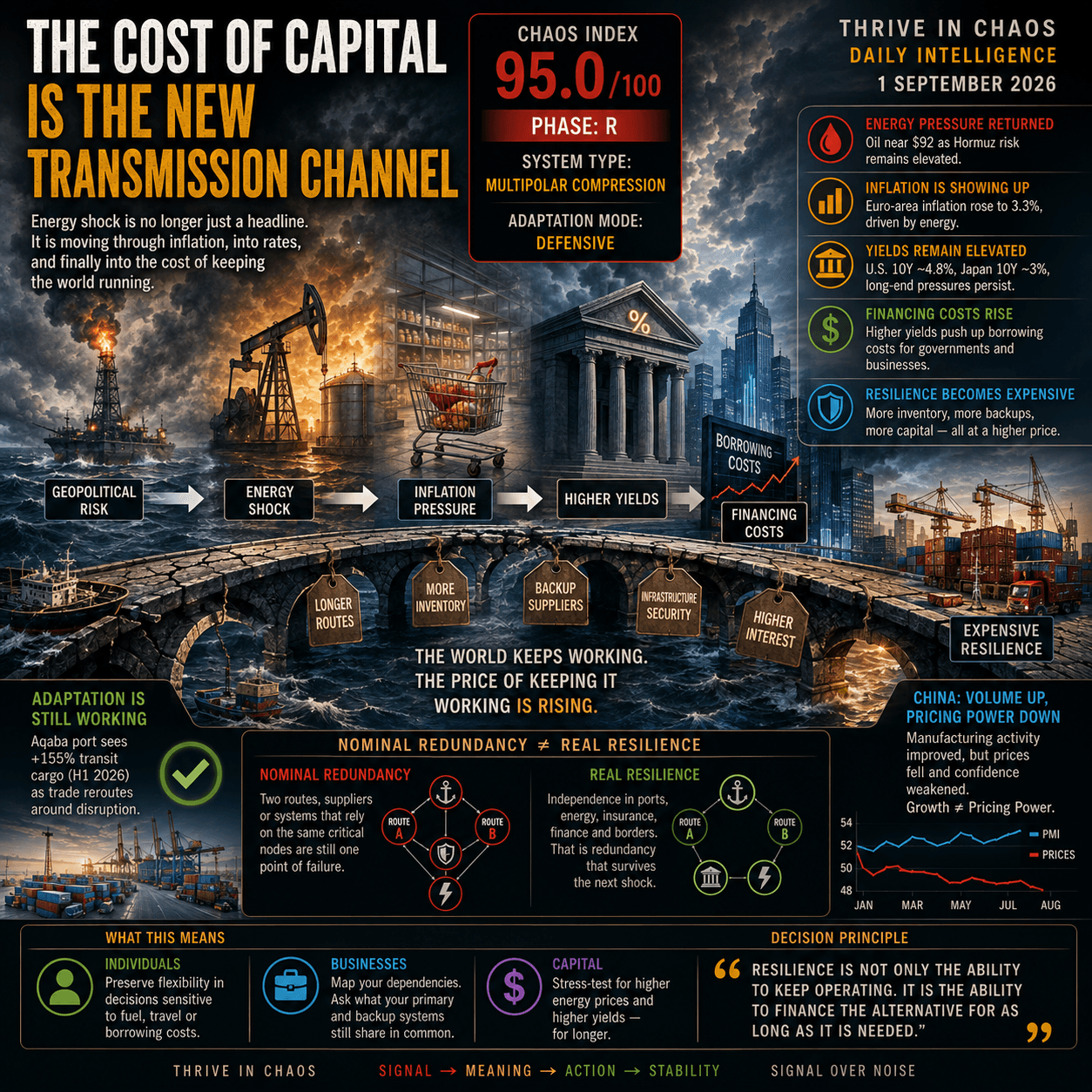
Chaos Index 95.0: The Cost of Capital Is Becoming the New Transmission Channel
THRIVE IN CHAOS — DAILY INTELLIGENCE
1 September 2026
Chaos Index: 95.0 / 100 🔴
Phase: R
System Type: Multipolar Compression
Adaptation Mode: DEFENSIVE
Primary Outlook: Cost-of-Capital Recoupling
Decision Horizon: 7–30 Days
Confidence: High
Executive Assessment
The Chaos Index rises to 95.0, from the current weekly anchor of 93.85.
The increase is concentrated rather than broad-based. Most of the system remains at the already elevated levels recorded in the weekly assessment. What changed today is the strength of the connection between energy risk, inflation and global financing conditions.
Yesterday's analysis focused on the return of recoupling. Renewed security pressure around the Strait of Hormuz pushed energy prices higher and started reconnecting geopolitical risk with inflation expectations and interest-rate expectations.
Today, that mechanism has moved one stage further.
Higher energy costs are no longer influencing markets only through expectations. They are beginning to appear in measured inflation data at the same time that sovereign borrowing costs are rising across several major economies.
That creates a more important transmission chain:
Energy shock → measured inflation → monetary pressure → sovereign yields → corporate financing → cost of adaptation
This matters because almost every resilience strategy requires capital. Companies need financing to carry more inventory, duplicate suppliers, maintain alternative logistics routes or build additional infrastructure. Governments need capital to protect energy networks, expand military capacity and finance industrial policy. When borrowing costs rise at the same time that the need for resilience increases, the cost of maintaining stability rises with it.
The system is therefore entering a new stage of stress.
The problem is no longer only whether disrupted systems can continue functioning.
The question is increasingly whether societies and businesses can afford to keep the alternatives running for long enough to matter.
1. What Changed Today
Several developments reinforce the same underlying mechanism.
Euro-area inflation rose to 3.3% in August, up from 2.9% in July. The important detail is that much of the increase came from energy, while underlying inflation continued to moderate.
At the same time, government borrowing costs remained under upward pressure across several major economies. U.S. ten-year Treasury yields moved close to 4.8%, Japan's ten-year yield reached around 3%, and long-term European yields also remained elevated.
Oil prices were still trading near the levels reached after the latest escalation around Hormuz.
Elsewhere, Russia attacked additional Ukrainian logistics and energy infrastructure, including facilities connected to alternative export routes. Meanwhile, Jordan's Aqaba port continued benefiting from cargo that had been diverted away from traditional Gulf routes.
China provided an important counter-signal. Private manufacturing data showed an improvement in factory activity, but pricing power and business confidence remained weak.
Taken together, these developments do not point toward generalized collapse.
They point toward a system that continues to function, but at a progressively higher economic cost.
2. From Risk Expectations to Measured Inflation
One of the biggest analytical mistakes during an energy shock is to focus only on the price of oil.
Oil prices matter, but what matters more is whether higher energy costs begin to alter the broader economic environment.
Yesterday, the principal transmission mechanism was still largely market-based.
Security risk around Hormuz raised oil prices. Higher oil prices increased inflation expectations. Inflation expectations increased the probability of tighter monetary policy.
Today, the picture became more concrete.
Euro-area headline inflation rose to 3.3%, with energy playing a major role in the increase.
At the same time, core inflation softened.
That distinction is important.
We are not yet seeing evidence that inflation has become broadly embedded across wages and domestic services again. The current signal is more specific: an external energy shock is pushing headline inflation higher even while part of the underlying domestic inflation process continues to cool.
This creates a difficult environment for central banks.
They may recognize that much of the inflation shock is external, but they cannot simply ignore it if households and businesses begin adjusting behaviour around higher energy costs.
3. Why Central Banks Have Less Room to Ignore Energy Shocks
A central bank does not control oil production, shipping security or military escalation.
What it controls is the price of money.
That means geopolitical shocks can force monetary authorities to respond to problems they did not create.
If an energy shock is brief, central banks can often look through it.
If it persists, the calculation changes.
Higher energy costs can feed into freight, food, manufacturing, utilities and consumer expectations. Even if core inflation initially remains contained, policymakers must consider the risk that the external shock becomes embedded in domestic pricing behaviour.
This is why the important question is no longer whether oil remains above a particular number.
The better question is:
Does the energy shock last long enough to alter the monetary path?
The probability of that outcome is increasing.
4. The Cost of Capital Is Becoming the New Transmission Channel
The most important development today is therefore not simply higher inflation.
It is the interaction between inflation and global borrowing costs.
Government bond yields are rising across several major markets at the same time.
This matters because sovereign yields are the foundation on which much of the private economy is priced.
Mortgages, corporate debt, infrastructure financing and long-duration investment all depend directly or indirectly on government borrowing costs.
Once sovereign yields rise, the effect spreads through the financial system.
The sequence becomes:
Geopolitical instability
→ Energy costs
→ Inflation pressure
→ Higher sovereign yields
→ Higher corporate financing costs
→ More expensive resilience
This is a much more powerful transmission mechanism than an isolated increase in oil prices.
5. Why This Matters for Resilience
During the past several years, businesses and governments have increasingly been told to become more resilient.
The recommendation is logical.
Companies should diversify suppliers.
Governments should maintain strategic reserves.
Ports should develop alternative routes.
Energy systems should add redundancy.
Data centres should secure multiple electricity sources.
Businesses should hold more liquidity.
But every one of these measures costs money.
Redundancy is expensive because it deliberately maintains capacity that may not be used under normal conditions.
Inventory is expensive because capital is tied up before it produces revenue.
Alternative suppliers are often more expensive because they sacrifice scale and efficiency.
Backup infrastructure is expensive because it duplicates existing infrastructure.
When borrowing costs rise, each of these decisions becomes harder.
The resilience problem is therefore increasingly becoming a financing problem.
6. The Hidden Trade-Off: Efficiency vs Optionality
For decades, companies were rewarded for eliminating unused capacity.
Supply chains became leaner.
Inventories became smaller.
Production became concentrated.
Capital structures became more optimized.
This reduced cost during stable periods.
The current environment reverses some of those incentives.
Companies now need more optionality.
They need multiple suppliers, additional inventory, alternative shipping routes and larger liquidity buffers.
But optionality is economically inefficient in the traditional sense.
The real question is therefore no longer whether redundancy is efficient.
The question is whether the company can afford not to have it.
This distinction becomes much more important when the cost of capital is high.
7. Ukraine Shows the Next Weakness in the Redundancy Model
Ukraine provides a useful example.
When major Black Sea infrastructure becomes unavailable, trade does not stop completely. Cargo shifts toward Danube ports, road routes and western rail connections.
That is precisely what a resilient system should do.
The problem is that alternative infrastructure can also become a target.
Russian attacks have increasingly affected ports, energy systems, export infrastructure and logistics nodes connected to those substitute routes.
This changes the structure of the problem.
The previous question was:
Do we have an alternative route?
The more important question is now:
How independent is the alternative route from the primary route?
If both systems rely on the same border crossing, electricity network, insurer or logistics hub, the real level of redundancy may be much lower than it appears.
8. Nominal Redundancy vs Real Redundancy
This distinction is important for business planning.
Imagine a company has two suppliers.
On paper, that looks diversified.
But both suppliers may use the same port.
Both may depend on the same electricity system.
Both may finance trade through the same banking network.
Both may ship through the same maritime chokepoint.
The company has two suppliers, but only one underlying system.
That is nominal redundancy.
Real redundancy requires the alternative to remain functional when the primary system is impaired.
The difference is increasingly important as disruptions move deeper into shared infrastructure.
9. Aqaba Shows That Adaptation Still Works
The picture is not uniformly negative.
Jordan's Aqaba port is benefiting from cargo that would normally travel through Gulf routes.
Transit cargo volumes have increased sharply as businesses search for alternatives to disrupted or more expensive routes.
This matters because it demonstrates that global trade is still highly adaptive.
When a route becomes unreliable, companies do not simply stop moving goods.
They reroute them.
They use new ports.
They add trucking.
They change distribution centres.
They change suppliers.
The global system continues functioning because it is capable of substitution.
But substitution comes at a price.
10. Longer Routes Preserve Function, Not Efficiency
A longer logistics route can be strategically useful even when it makes little economic sense under normal conditions.
Goods that once travelled by a short maritime route may now arrive through another port and then move hundreds of kilometres by road.
The system remains functional.
But transport costs increase.
Transit times rise.
Working capital requirements increase.
Inventory buffers become larger.
The cost is not removed.
It is redistributed.
This has become one of the defining characteristics of the current global system:
disruption rarely disappears immediately; it migrates into another part of the cost structure.
11. The Price of Stability Is Rising
This leads to a broader conclusion.
The global system is demonstrating a remarkable ability to absorb repeated shocks.
Trade continues.
Energy continues moving.
Financial markets continue functioning.
Manufacturing continues operating.
The problem is that maintaining this continuity is becoming progressively more expensive.
Insurance costs more.
Financing costs more.
Infrastructure security costs more.
Inventory costs more.
Alternative logistics cost more.
Political fragmentation raises compliance costs.
Technology fragmentation increases duplication.
Stability is still possible.
But it requires more resources.
12. China Shows Why Growth Alone Is Not Enough
China's latest manufacturing data provides an important counterpoint.
The private manufacturing PMI rose to 51.5, signalling expansion.
Production improved.
New orders improved.
Export demand strengthened.
Those are positive signals.
But businesses also reduced selling prices, while confidence weakened.
This suggests that production can recover while pricing power remains weak.
That distinction matters because revenue growth and profitability are not the same thing.
A company may sell more goods while earning less on every unit.
The broader lesson is similar to what we are seeing elsewhere.
Operational improvement does not automatically produce financial improvement.
13. Volume Recovery vs Margin Recovery
This is a useful framework beyond China.
Many parts of the global economy may continue operating at reasonable volumes while margins deteriorate.
Why?
Because energy becomes more expensive.
Financing becomes more expensive.
Insurance becomes more expensive.
Logistics becomes more expensive.
Compliance becomes more expensive.
The business can remain operational while becoming less profitable.
This is another reason why traditional economic indicators may underestimate the level of stress.
Output can remain stable while optionality declines.
14. First-Order Effects
The immediate consequences of today's developments are relatively straightforward.
Energy prices remain elevated.
Inflation pressure is stronger in Europe.
Government borrowing costs remain high.
Alternative logistics routes continue absorbing displaced trade.
Ukraine's substitute logistics infrastructure remains exposed to attack.
China's manufacturing activity improves, but pricing power remains weak.
These are the visible effects.
15. Second-Order Effects
The second-order consequences are more important for decision-making.
Companies are likely to keep larger cash reserves.
Treasurers may become more cautious about refinancing.
Infrastructure projects will require higher expected returns.
Governments will devote more money to security and redundancy.
Companies may delay marginal investment projects.
Inventory carrying costs will increase.
Longer shipping routes will consume more working capital.
Consumers will feel the combination of energy and borrowing costs.
None of this requires a global recession to matter.
16. Third-Order Effects
If these conditions persist, the structure of the economy begins to change.
Companies with strong balance sheets gain an advantage over highly leveraged competitors.
Governments with stronger fiscal capacity can build resilience more easily.
Large technology companies can finance infrastructure that smaller competitors cannot replicate.
Strategic industries become increasingly concentrated around actors with access to cheap capital.
Supply chains become more regional.
Redundant infrastructure becomes part of national security policy.
Capital strength therefore becomes a strategic capability rather than simply a financial metric.
17. The New Strategic Divide
The emerging divide may no longer be only between efficient and inefficient economies.
It may increasingly be between actors that can finance redundancy and actors that cannot.
That applies to governments.
It applies to companies.
It also applies to households.
Those with sufficient reserves can absorb higher prices and wait for conditions to normalize.
Those operating with thin margins must react immediately.
This is one reason systemic shocks can widen inequality even when headline economic growth remains positive.
18. Why the Chaos Index Rises to 95.0
Today's increase comes from Block C, which moves from 9.0 in the weekly anchor to 10.0.
The contribution is:
+1.10 points
This moves the Daily Chaos Index from:
93.85 → 94.95
Rounded for publication:
95.0 / 100
Other block scores remain unchanged.
The increase reflects one specific analytical judgment:
financial conditions are now absorbing a larger share of the geopolitical and energy shock.
19. System Diagnostics
The index remains heavily saturated.
Elevated blocks: 11 / 11
Binding stability floors: 7
Maximum block: 10.0
CI Tail: 10.0
The non-compensatory index should therefore be treated as a lower bound rather than as a precise measure of incremental deterioration.
At this level, the number itself becomes less informative than the interaction between blocks.
The important question is not whether the index moves from 95 to 96.
The important question is which systems are becoming connected.
Today, the strongest connection runs through finance.
20. Multipolar Compression
The System Type remains Multipolar Compression.
Nothing in today's evidence justifies changing it.
The defining feature of this environment is that several independent systems are increasingly constrained at the same time.
Energy constrains monetary policy.
Monetary policy constrains investment.
Security constrains logistics.
Logistics constrains working capital.
Technology competition constrains supply-chain choice.
Fiscal pressure constrains government adaptation.
The system remains functional because adaptation continues.
But every adaptation consumes more resources.
That is the essence of the current compression.
21. Scenario Map — Next 7–30 Days
Scenario 1 — Expensive Stability
Probability: 50%
The global system continues operating without a major new breakdown.
Hormuz remains risky but functional.
Oil remains elevated.
Central banks remain restrictive.
Alternative trade routes continue carrying displaced volume.
Growth slows, but the system avoids a synchronized crisis.
This is the most likely path.
The main consequence is not collapse.
It is a higher cost of maintaining normal operations.
Expected CI range: 94–96
Scenario 2 — Partial Normalization
Probability: 22%
Security conditions improve.
Oil risk premiums decline.
Bond yields stabilize.
Inflation pressure eases.
Alternative logistics routes remain functional.
This would reduce the degree of recoupling and restore some of the asynchronous normalization seen previously.
Expected CI range: 91–94
Scenario 3 — Financing Stress Broadens
Probability: 20%
Energy remains expensive while sovereign yields continue rising.
Corporate refinancing becomes more difficult.
Capital-intensive sectors weaken.
Governments face greater fiscal trade-offs.
Companies begin cutting discretionary investment to protect liquidity.
This would represent a shift from geopolitical stress into broader financial stress.
Expected CI range: 96–98
Scenario 4 — Multi-Buffer Failure
Probability: 8%
A major Gulf disruption coincides with another important logistics or infrastructure failure.
Energy prices rise sharply.
Central banks become more restrictive.
Alternative routes become saturated or unavailable.
Financing markets reprice aggressively.
This remains a tail scenario rather than the base case.
But the system is vulnerable because several buffers are already under pressure.
Expected CI range: 98–100
22. Forecast Gate
No new forecasts are added today.
This is intentional.
The strongest developments are already represented by existing forecast families covering energy prices, central-bank policy, Gulf security and logistics disruption.
Creating another forecast because yields rose today would add apparent precision without adding independent information.
Forecast quality depends on independence and resolution discipline, not volume.
Several positions with a 31 August resolution date also remain subject to separate founder resolution. They should not be closed using approximate or intraday substitutes where the original question requires an official close, settlement or published end-of-day figure.
23. Decision Intelligence
The most useful decision question today is not:
Will interest rates rise further?
Nor is it:
Will energy prices stay high?
The better question is:
How much of your resilience depends on cheap capital?
A contingency plan that requires continuous refinancing may not be resilient in a high-rate environment.
A backup logistics route that doubles working-capital requirements may eventually become unusable.
A distributed energy system that requires large debt financing may be strategically attractive but financially difficult.
Resilience must therefore be evaluated in two dimensions:
Operational resilience
and
Financial resilience
Both are required.
24. Individuals
The current environment does not justify broad defensive behaviour.
It does justify preserving flexibility.
For the next week, avoid unnecessarily locking in decisions that are highly sensitive to energy prices, borrowing costs or short-notice international transport.
If a major purchase, trip or financing decision can be delayed several days at little cost, that optionality has value.
The objective is not to predict the next headline.
It is to avoid being forced into a decision at exactly the wrong moment.
25. Business
Businesses should move beyond the question of whether a backup exists.
By 8 September, identify one critical process and map three things:
the primary route,
the alternative route,
and the infrastructure both routes still share.
Then identify the saturation point of the alternative.
This is especially important for logistics, energy, financing and critical suppliers.
A backup that relies on the same underlying node is not independent redundancy.
26. Capital
Capital should be stress-tested against a regime where energy remains elevated and benchmark yields rise another 50–100 basis points.
The largest vulnerabilities are likely to be found in businesses with:
high leverage,
long-duration cash flows,
large refinancing requirements,
capital-intensive expansion plans,
and limited pricing power.
The important risk is not necessarily an immediate equity-market crash.
The more persistent risk is slower cash conversion and declining optionality.
27. What Would Lower the Risk
We would become more constructive if several developments appeared together.
Oil risk premiums would need to decline.
Hormuz security would need to stabilize.
European headline inflation would need to soften again.
Sovereign yields would need to stop rising.
Alternative logistics routes would need to remain functional without accelerating congestion.
Corporate credit conditions would need to remain orderly.
One positive indicator would not be sufficient.
The important signal would be a weakening of the transmission chain itself.
28. What Would Raise the Risk
We would become more concerned if energy and financing conditions continue deteriorating at the same time.
Key warning signals include:
additional maritime incidents around Hormuz,
oil remaining materially above recent levels,
continued increases in global sovereign yields,
further inflation surprises,
central banks explicitly linking energy risk to tighter policy,
broader attacks on alternative logistics infrastructure,
and signs that companies are cutting investment because financing costs have become prohibitive.
The most dangerous development would not be another isolated shock.
It would be evidence that the shock is propagating through several systems simultaneously.
What We Watch Next
Over the next 72 hours, the focus is on oil prices, Hormuz security, sovereign yields and central-bank communication.
Over the next week, the important question is whether the rise in borrowing costs stabilizes or becomes self-reinforcing.
Over the next month, the key structural question is whether businesses and governments can continue financing redundancy without materially reducing investment elsewhere.
That is the boundary between expensive stability and genuine systemic deterioration.
Structural Pattern
The pattern is becoming clearer.
First, the system is disrupted.
Then alternatives appear.
Those alternatives restore function.
The alternatives require additional capital.
Financing becomes more expensive.
The cost of maintaining the alternative begins to challenge the alternative itself.
The system therefore enters a new cycle:
Shock → Adaptation → Recovery → Higher Cost → Financing Constraint
This is different from a traditional crisis model.
The system may continue functioning for a long time.
But its operating cost keeps increasing.
Stability Principle
A system is not truly resilient simply because an alternative exists. It is resilient when the alternative can remain operational, independent and financially sustainable for as long as it is needed.
That is the threshold that matters now.
Bottom Line
The Chaos Index rises to 95.0 / 100.
The global system is not moving toward immediate generalized failure.
It is doing something more subtle.
It is preserving function through increasingly expensive adaptation.
Energy shocks are feeding inflation.
Inflation is feeding borrowing costs.
Higher borrowing costs are making resilience harder to finance.
Alternative logistics routes continue functioning, but some of those routes are becoming targets or bottlenecks themselves.
Manufacturing can continue expanding even while pricing power declines.
The global economy therefore remains operational, but the cost of maintaining that operation is rising.
Yesterday's question was whether recovery could survive the next shock.
Today's question goes one level deeper:
Can the system afford to keep paying for resilience?
That may become one of the defining questions of the next stage of global fragmentation.
THRIVE IN CHAOS
Signal → Meaning → Action → Stability
Analysis → Forecast → Recommendations
Signal Over Noise
Join the newsletter
Be the first to read our articles.


