

DAILY PULSE | 08 AUGUST 2026
The strongest signal of the last 24 hours is not a new escalation event by itself. It is a change in the architecture of access. Iran indicated that an arrangement with Oman concerning the Strait of Hormuz is close, but explicitly separated such an agreement from reopening the waterway. At the same time, the UAE reported another Iranian attack on an ADNOC tanker. Diplomatic progress and operational security are therefore moving on different clocks.
14 min red
THRIVE IN CHAOS — DAILY PULSE
08 AUGUST 2026
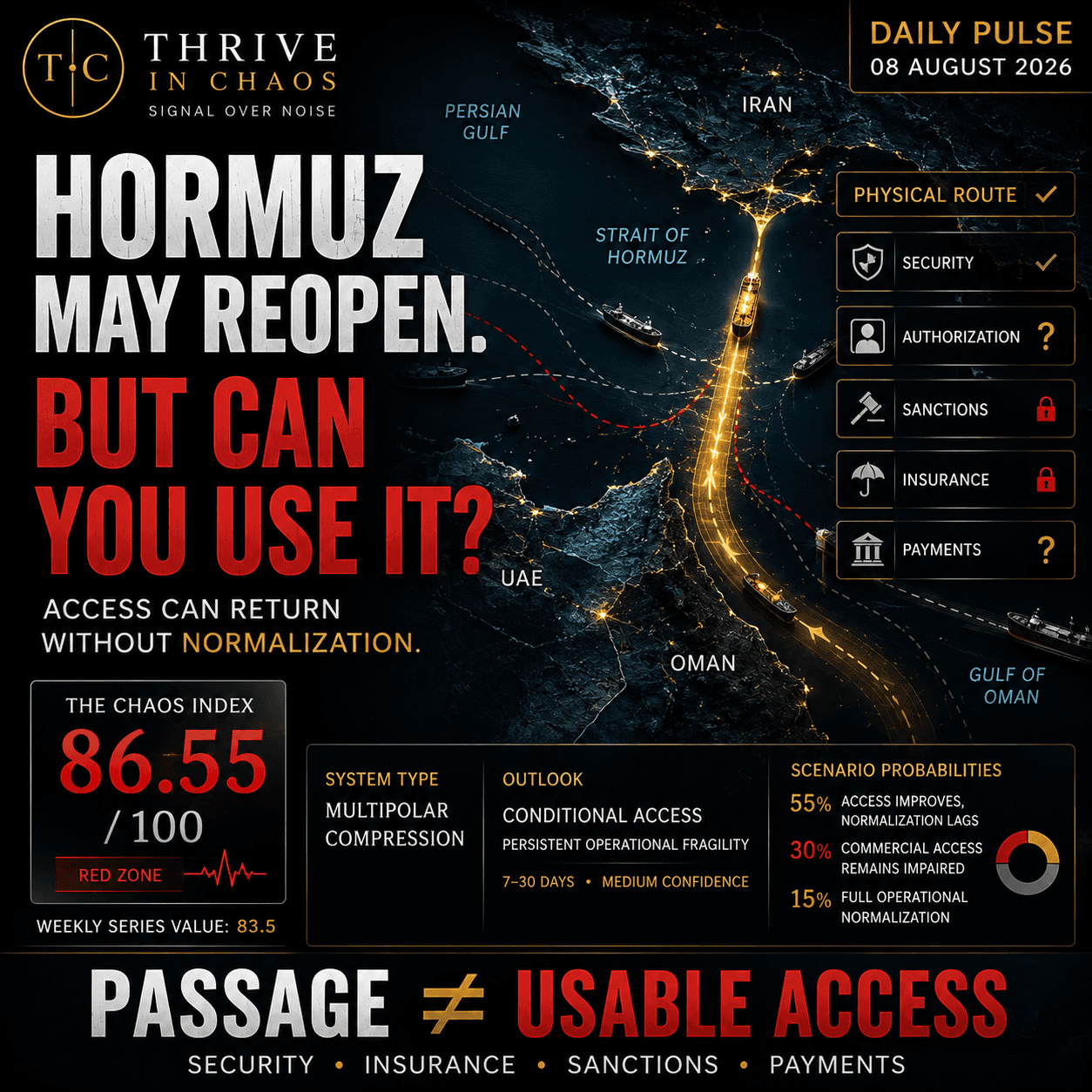
Daily candidate: 86.55 / 100 🔴 RED
System Type: Multipolar Compression
1. EXECUTIVE SUMMARY
The strongest signal of the last 24 hours is not a new escalation event by itself. It is a change in the architecture of access.
Iran indicated that an arrangement with Oman concerning the Strait of Hormuz is close, but explicitly separated such an agreement from reopening the waterway. At the same time, the UAE reported another Iranian attack on an ADNOC tanker. Diplomatic progress and operational security are therefore moving on different clocks.
This produces today's central pattern:
ACCESS CAN RETURN WITHOUT NORMALIZATION
The distinction matters because the constraint is migrating from physical availability toward conditional usability.
A maritime route may technically exist while commercial use remains constrained by security, authorization, sanctions, insurance, payment architecture and liability. The effective chokepoint is therefore becoming institutional as well as geographical.
Three additional developments reinforce this mechanism.
First, the U.S. Senate passed the Lindsey O. Graham Sanctioning Russia and Iran Act of 2026 by 86–11. The legislation could permit tariffs of up to 100% against countries heavily dependent on Russian oil and gas, although House passage remains uncertain. Pressure can therefore propagate beyond sanctioned producers toward third-country buyers.
Second, Russia and Ukraine continued long-range attacks against infrastructure. Russia launched six ballistic missiles and 151 drones overnight, while Ukraine reported strikes on the Ilsky and Syzran refineries. Physical energy-system vulnerability therefore remains elevated outside the Gulf as well.
Third, the U.S. import front-loading cycle appears to be approaching its peak. Businesses accelerated imports to avoid prospective tariffs and higher fuel-related costs. That supports near-term inventories but pulls demand forward, potentially producing weaker subsequent trade volumes without an equivalent collapse in underlying consumption.
Taken together, the system is exhibiting a common mechanism:
constraints are migrating from simple physical scarcity toward rules governing access to available capacity.
The resulting candidate Chaos Index is 86.55/100, versus the weekly raw anchor of 82.9. This is an indicative daily reading, not a new weekly series point.
2. GLOBAL SCAN — TOP 5
1 — Strait of Hormuz: negotiation ≠ reopening
Domain: Geopolitics / Energy / Trade
Signal type: Enforcement
Importance: Very High
Iran said it is close to finalizing an arrangement with Oman regarding the Strait of Hormuz but stated that the agreement itself would not automatically reopen the waterway. Tehran continues to connect reopening with additional U.S. conditions and compensation.
The important development is therefore not simply that negotiations are progressing.
It is that physical passage has become separable from the political conditions governing access.
This converts Hormuz from a binary chokepoint—
open / closed
—into a layered one:
route → authorization → security → insurance → sanctions → liability → commercial use
Why it matters
The market can price diplomatic improvement before commercial normalization actually occurs.
Shipping companies, insurers, banks and cargo owners require more than navigability. They require an operating environment in which the voyage can be legally cleared, insured, financed and completed at acceptable risk.
First-order effect
Reduced probability of permanent physical closure.
Second-order effect
Persistent freight, insurance and compliance premiums despite diplomatic progress.
Third-order effect
Companies begin optimizing supply chains around usable access, rather than merely available infrastructure.
System implication: High.
3. GLOBAL SCAN — EVENT 2
UAE reports another attack on an ADNOC tanker
Domain: Geopolitics / Energy
Signal type: Timing
Importance: Very High
The UAE reported another Iranian missile attack against a tanker owned by ADNOC.
The importance of the incident comes primarily from its timing.
It occurred while diplomatic negotiations concerning Hormuz were reportedly advancing.
That produces a divergence:
political risk expectations ↓
while
operational maritime risk remains ↑
Why it matters
Diplomatic agreements can change expectations immediately.
Operational normalization requires accumulated evidence.
Shipowners and insurers are therefore unlikely to treat a political agreement as equivalent to restored maritime security.
First-order effect
Continued risk to Gulf shipping.
Second-order effect
Insurance and freight premiums may remain elevated even if headline geopolitical risk falls.
Third-order effect
Commercial traffic becomes a better normalization indicator than diplomatic announcements.
The relevant question becomes:
Are independent commercial operators returning?
—not simply:
Has an agreement been announced?
4. GLOBAL SCAN — EVENT 3
U.S. Senate expands the potential sanctions architecture
Domain: Institutions / Energy / Trade
Signal type: Diffusion
Importance: High
The U.S. Senate passed a major Russia-Iran sanctions package by 86–11.
Among its mechanisms is authority for tariffs of up to 100% against countries heavily dependent on Russian oil and gas. House passage remains uncertain, so this should not yet be treated as enacted policy.
The structural significance lies elsewhere.
Sanctions pressure can migrate:
producer → buyer → buyer's exports → global trade relationships
Why it matters
Traditional sanctions primarily target the sanctioned entity.
Secondary mechanisms can make participation in another country's energy system itself a source of trade exposure.
The number of economically affected actors therefore increases without requiring additional physical disruption.
First-order effect
Higher compliance uncertainty for buyers of Russian energy.
Second-order effect
Potential pressure on third-country trade relationships with the United States.
Third-order effect
Energy sourcing becomes partly a market-access decision, rather than purely a price decision.
This reinforces today's broader pattern:
access is increasingly conditional on institutional alignment.
5. GLOBAL SCAN — EVENT 4
Russia–Ukraine infrastructure war continues
Domain: Geopolitics / Energy / Infrastructure
Signal type: Diffusion
Importance: High
Russia launched six ballistic missiles and 151 drones against Ukraine overnight.
Ukraine reported strikes against the Ilsky and Syzran oil refineries in Russia, causing fires.
The significance is not an isolated refinery strike.
It is the continued diffusion of war pressure from the battlefield into distributed economic infrastructure.
First-order effect
Local disruption of refining and civilian infrastructure.
Second-order effect
Additional pressure on air-defense inventories, refinery utilization and regional fuel logistics.
Third-order effect
Energy-system resilience becomes increasingly dependent on redundancy and distributed capacity rather than nominal national production capacity.
The Gulf and Russia/Ukraine therefore represent two different manifestations of the same vulnerability:
energy availability does not guarantee reliable energy access.
6. GLOBAL SCAN — EVENT 5
U.S. import front-loading approaches exhaustion
Domain: Trade / Supply Chains / Business
Signal type: Timing
Importance: Medium–High
The earlier surge in U.S. container imports driven by attempts to avoid tariffs and higher fuel-related costs is approaching its end.
August volumes are expected to remain relatively strong before declining later in 2026, while ocean transportation costs remain elevated.
This creates an important analytical distortion.
A company importing early moves future demand into the present:
future imports → current inventories
The later decline in import volumes therefore does not necessarily represent an equivalent decline in final demand.
First-order effect
Higher near-term inventories.
Second-order effect
Weaker subsequent import volumes.
Third-order effect
Macro indicators become harder to interpret because adaptation itself changes the timing of measured economic activity.
This is particularly important for TIC:
resilience actions increasingly alter the signals used to measure the system.
7. REGIONAL AUDIENCE SCAN
United States
Primary transmission mechanism:
sanctions + tariffs + logistics costs
The immediate risk is less physical shortage than increased cost and complexity of accessing globally sourced goods and energy.
Import front-loading temporarily cushions inventories but shifts weakness into subsequent periods.
Audience relevance: High.
Europe
Primary transmission mechanism:
energy + sanctions + infrastructure exposure
Europe remains exposed to both Gulf energy conditions and Russia-related sanctions architecture.
Even partial Hormuz normalization may not immediately eliminate insurance and freight premiums.
Audience relevance: Very High.
Middle East
Primary transmission mechanism:
security → shipping → energy exports
This remains the highest-sensitivity region in today's scan.
The decisive indicator is increasingly not diplomatic progress but restoration of ordinary independent commercial traffic.
Audience relevance: Very High.
Asia
Primary transmission mechanism:
energy import dependency + secondary sanctions exposure
Asian energy buyers face two overlapping risks:
physical access to Gulf supplies and institutional access to Russian energy.
A country can therefore have sufficient suppliers but declining freedom to choose among them.
Audience relevance: High.
Emerging Markets
Primary transmission mechanism:
fuel costs + shipping + currency + sanctions spillovers
Countries with limited fiscal capacity face asymmetric exposure because higher transport and energy costs consume a larger share of available policy space.
Audience relevance: Medium–High.
8. FINAL EVENT SELECTION
Five events survive the Daily selection process:
Rank | Event | Structural relevance |
|---|---|---|
1 | Hormuz agreement does not automatically reopen Strait | Very High |
2 | New attack on ADNOC tanker | Very High |
3 | U.S. Senate Russia-Iran sanctions package | High |
4 | Russia–Ukraine infrastructure strikes | High |
5 | U.S. import front-loading reaches turning point | Medium–High |
The events should not be interpreted as five independent stories.
They form three interacting mechanisms:
A. Physical access
Hormuz + tanker security + refinery infrastructure.
B. Institutional access
Sanctions + authorization + insurance + payment/compliance architecture.
C. Temporal adaptation
Front-loading shifts economic activity through time and changes the information contained in subsequent trade data.
9. CROSS-SIGNAL SYNTHESIS
The strongest interaction is:
A × H — Geopolitics × Energy
Hormuz remains the immediate transmission channel, but the nature of the constraint is changing.
The earlier regime was predominantly:
physical disruption → scarcity → price
The emerging regime is more complex:
physical availability → conditional access → differentiated cost
That difference is strategically important.
Under physical scarcity, most actors face approximately the same shortage.
Under conditional access, actors face different outcomes depending on:
jurisdiction,
insurance,
banking access,
political alignment,
contractual structure,
logistics redundancy,
compliance capacity.
The result is asymmetric fragmentation.
Some actors regain access earlier than others.
10. PART 1 CONCLUSION
The last 24 hours do not provide strong evidence that global instability is entering a normalization phase.
They provide evidence of something more specific:
the system is learning to operate while access remains conditional.
Hormuz may eventually reopen.
That alone would not restore the previous operating environment.
The emerging bottleneck is increasingly defined by the combination of:
Security × Authorization × Sanctions × Insurance × Liability
rather than geography alone.
This produces today's working thesis:
ACCESS CAN RETURN WITHOUT NORMALIZATION.
And the more general structural proposition behind it:
The next stage of fragmentation may be defined less by whether capacity exists than by who is permitted, insured, financed and secure enough to use it.
Daily Chaos Index candidate: 86.55 / 100 🔴
Weekly series: 83.5
Direction: elevated / conditional normalization
11. PATTERN OF THE DAY
ACCESS CAN RETURN WITHOUT NORMALIZATION
The central analytical mistake today would be to treat reopening and normalization as synonyms.
They are not.
A route is physically open when ships can move through it.
A route is commercially normalized when ordinary commercial actors can use it:
legally;
repeatedly;
predictably;
insurably;
financeably;
at tolerable cost.
Hormuz is increasingly moving toward the first condition without clear evidence of the second.
The effective operating chain is therefore no longer:
OPEN → TRADE
It is:
ROUTE EXISTS
↓
AUTHORIZATION
↓
SECURITY
↓
SANCTIONS COMPLIANCE
↓
INSURANCE
↓
PAYMENTS
↓
LIABILITY
↓
COMMERCIAL USE
Every additional layer creates another point where access can fail.
That is why an agreement may reduce geopolitical risk without restoring the previous commercial regime.
12. THE DEEPER STRUCTURAL PATTERN
The system is moving from scarcity of capacity toward conditional access to capacity.
This distinction applies well beyond Hormuz.
Old constraint
There is not enough capacity.
Examples:
insufficient oil;
closed port;
destroyed pipeline;
unavailable shipping lane.
Emerging constraint
Capacity exists, but access depends on conditions.
Examples:
sanctions;
insurance restrictions;
political authorization;
payment channels;
export controls;
tariff exposure;
security guarantees.
This produces a different form of fragmentation.
Under physical scarcity, almost everyone faces the same shortage.
Under conditional access, different actors experience different versions of the same system.
One company can move cargo.
Another cannot insure it.
A third can insure it but cannot legally make the payment.
A fourth can pay but risks secondary sanctions.
A fifth has an alternative corridor and suffers little disruption.
The system therefore becomes asymmetrically fragmented.
13. CHAOS INTERPRETATION
Chaos is shifting from disruption toward permission
The current environment illustrates the TIC definition of chaos particularly well.
Chaos is not simply the number of adverse events.
It is the increasing cost of the next decision as optionality contracts.
Consider a business sourcing energy through the Gulf.
In a simple system, it asks:
What is the price?
In the current system, it increasingly has to ask:
Can the cargo transit?
Who authorizes it?
Will the insurer cover it?
Can my bank process payment?
Does the transaction expose me to sanctions?
Is the vessel acceptable to the port?
Can the arrangement change next week?
What happens if another tanker is attacked?
The number of conditions attached to the same decision increases.
The physical commodity may exist.
The cost of accessing it rises because the decision architecture becomes more complex.
That is shrinking optionality.
14. FIRST-ORDER EFFECTS
The immediate effects remain relatively straightforward.
Hormuz diplomacy
Can reduce:
oil risk premium;
market volatility;
perceived probability of full closure.
Continuing attacks
Can increase:
tanker insurance;
security requirements;
freight rates;
reluctance among independent shipowners.
Sanctions legislation
Can raise:
compliance uncertainty;
third-country trade risk;
legal costs;
political risk premiums.
Infrastructure strikes
Can reduce:
refinery availability;
logistics redundancy;
usable energy-processing capacity.
The critical issue is that these effects can occur simultaneously.
15. SECOND-ORDER EFFECTS
The more important consequences appear when businesses adapt.
Companies begin to:
hold larger inventories;
reroute cargo;
diversify suppliers;
pay more for insurance;
use more intermediaries;
increase compliance staffing;
shorten contract duration;
avoid politically exposed counterparties.
Each action improves resilience locally.
But collectively these adaptations make the global system:
less efficient, more redundant and more expensive.
That is not system failure.
It is a transition from an efficiency-optimized system toward an access-optimized system.
16. THIRD-ORDER EFFECTS
If conditional access becomes persistent, the structure of global competition changes.
The decisive strategic asset becomes less:
Who owns the resource?
and increasingly:
Who can guarantee access to the resource?
That creates value around:
secure ports;
trusted logistics networks;
insurance capacity;
compliant payment rails;
alternative pipelines;
storage;
domestic refining;
politically protected trade corridors.
Control over access layers can become as important as control over physical production.
This is a larger structural shift than today's Hormuz negotiations alone.
17. FROM GLOBALIZATION TO ACCESS NETWORKS
The previous globalization model largely assumed that a commercially attractive transaction would normally be executable.
Price coordinated access.
The emerging environment adds a different hierarchy:
price + permission + security + compliance
This changes supply-chain optimization.
The old question was:
Where is production cheapest?
The new question becomes:
Where can production still reach me under adverse political conditions?
That pushes firms toward:
dual sourcing;
regionalization;
politically compatible suppliers;
strategic inventory;
domestic substitutes;
protected infrastructure.
Efficiency is progressively exchanged for optionality.
18. WHY TODAY'S INDEX REMAINS ELEVATED
Candidate CI: 86.55 / 100 🔴
The daily candidate stands 3.65 points above the weekly raw anchor of 82.9.
This does not mean that the entire global environment deteriorated by 3.65 points overnight.
It reflects a 24-hour signal set that concentrates heavily in several already stressed blocks.
The strongest contribution comes from the combination of:
geopolitical conditionality;
maritime security;
institutional restrictions;
sanctions diffusion;
infrastructure vulnerability.
All 11 blocks remain elevated in today's candidate calculation.
The experimental non-compensatory diagnostic is approximately 88.38, but the stability-floor mechanism binds in two blocks. It therefore needs to be interpreted as a lower-bound diagnostic, not as a more precise alternative public index.
The important point is not the extra decimal precision.
It is that the stress is broad rather than isolated.
19. SIGNAL VS NOISE
SIGNAL 1
Iran says an Oman agreement is insufficient by itself to reopen Hormuz.
This is material because it explicitly separates an agreement from operational access.
SIGNAL 2
A fresh tanker attack occurs while diplomacy advances.
This shows that political progress and physical risk are not yet converging.
SIGNAL 3
Sanctions architecture is moving toward third-country dependency.
The significance is not only Russia or Iran.
It is the possibility that access to the U.S. market becomes conditional on another country's energy sourcing decisions.
SIGNAL 4
Infrastructure remains a direct target in the Russia–Ukraine war.
The conflict continues to affect energy-processing and logistics capacity beyond battlefield territory.
SIGNAL 5
Businesses are changing the timing of trade flows.
Front-loading means future trade data will increasingly contain the effects of adaptation itself.
NOISE
“Hormuz deal close = crisis nearly over.”
No.
A political framework is one necessary layer.
Commercial normalization requires several others.
“The route is open, therefore energy flows normalize.”
Not necessarily.
Shipowners, insurers and banks must also participate at scale.
“Sanctions only affect the sanctioned country.”
Increasingly false.
Secondary mechanisms distribute costs through buyers and trading partners.
“Lower future import volumes automatically mean collapsing demand.”
Not when previous months were artificially raised by front-loading.
Timing matters.
“One more tanker attack means negotiations have failed.”
Also unsupported.
Security deterioration and diplomatic progress can coexist temporarily.
The key issue is whether they converge over the following weeks.
20. OUTLOOK — 7 TO 30 DAYS
BASE CASE — 55%
CONDITIONAL ACCESS IMPROVES, NORMALIZATION LAGS
Hormuz diplomacy produces a usable but politically constrained passage architecture.
Some commercial traffic returns.
However:
insurance remains elevated;
legal questions remain;
independent shipowners return slowly;
security incidents continue intermittently.
Expected market effects
energy risk premium gradually softens;
freight remains above normal;
volatility declines unevenly;
regional assets experience selective relief.
System interpretation
Access improves faster than trust.
STRESS CASE — 30%
ACCESS ARCHITECTURE FAILS TO SCALE
A new major attack, sanctions conflict or insurance restriction prevents commercial participation from broadening.
The route may remain physically navigable but commercially impaired.
At the same time, infrastructure strikes elsewhere continue.
Expected effects
renewed energy-price pressure;
freight and insurance spike;
companies rebuild inventories;
monetary-policy flexibility deteriorates;
import-dependent economies suffer disproportionate pressure.
System interpretation
Formal access exists, practical access contracts.
IMPROVEMENT CASE — 15%
OPERATIONAL NORMALIZATION BEGINS
A durable Hormuz mechanism is accompanied by:
sustained independent tanker traffic;
fewer attacks;
accepted insurance terms;
workable payment mechanisms;
lower freight;
predictable authorization.
Expected effects
energy risk premium declines materially;
inventories normalize;
freight falls;
businesses dismantle emergency routing;
system optionality begins to recover.
System interpretation
Political agreement becomes operational repair.
This is the threshold required before TIC should call the corridor normalized.
21. WHAT TO WATCH
1. Independent Hormuz vessel traffic
Do not count only state-backed or specially authorized voyages.
Confirmation threshold
Two consecutive weeks of broad commercial traffic growth.
Why:
Commercial behavior is harder to fake than diplomatic intent.
2. Tanker insurance
Watch:
exclusions;
war-risk premiums;
acceptance of transit-payment structures;
liability clauses.
Why
Insurance determines whether physical access becomes economically usable.
3. Payment architecture
Watch whether banks can legally process:
transit fees;
Iranian-related charges;
shipping payments.
Why
A route without payment rails is not commercially normalized.
4. Further Gulf attacks
Especially:
tankers;
terminals;
ports;
refineries;
pipelines.
Escalation threshold
Repeated attacks that materially reduce independent commercial participation.
5. U.S. House action on sanctions legislation
Senate passage alone does not create the final regime.
Why
House progress would materially increase the probability that energy sourcing becomes linked to broader U.S. market access.
6. Russia refinery disruption
Watch:
duration of outages;
refined-product availability;
export changes;
repair time.
Why
Repeated refinery disruption turns isolated attacks into a capacity constraint.
7. U.S. container imports
Future declines should be decomposed into:
demand weakness
versus:
previous front-loading.
Otherwise the data can be misread.
22. RECOMMENDATIONS
👤 INDIVIDUALS
Horizon: by 22 August
Add approximately one additional month of essential expenses to liquid reserves before increasing discretionary leverage or risk exposure.
Why
Current instability can transmit through:
fuel;
freight;
imported goods;
interest rates.
Financial-market relief can arrive before these costs normalize.
Trigger for greater caution
If tanker attacks continue while household transport or energy costs rise despite diplomatic progress.
Optionality effect
Preserves optionality.
The recommendation creates a larger decision window if prices or employment conditions deteriorate.
🏢 BUSINESS
Horizon: by 31 August
Map every Gulf- or tariff-sensitive shipment to at least one alternative that is physically, legally, financially and insurably usable.
Do not record only an alternative port or supplier.
For every alternative confirm:
physical route;
insurance;
payment mechanism;
sanctions compliance;
available capacity;
estimated landed cost.
Why
The emerging risk is not merely route closure.
It is discovering during a disruption that the supposed alternative cannot actually be used.
Trigger
Independent commercial Hormuz traffic fails to normalize or insurers introduce additional exclusions.
Optionality effect
Strongly preserves optionality.
📈 CAPITAL
Horizon: by 22 August
Reclassify energy, logistics and industrial exposures by access dependency rather than commodity direction alone.
Separate:
commodity-price exposure;
route exposure;
insurance exposure;
sanctions exposure;
political-access exposure.
Why
Two businesses benefiting from the same oil price can possess radically different operational optionality.
Trigger
Advance of U.S. secondary sanctions legislation, persistent Hormuz conditionality or additional tanker attacks.
Optionality effect
Preserves portfolio flexibility by identifying hidden access concentration.
23. DAILY DECISION FRAME
For the next several weeks, do not ask only:
Is the system reopening?
Ask four different questions:
1. Is physical capacity available?
2. Is access legally permitted?
3. Is access commercially insurable and financeable?
4. Is the operating regime predictable enough to commit capital?
Only when all four improve does normalization become credible.
STABILITY PRINCIPLE
PASSAGE IS NOT THE SAME AS USABLE ACCESS.
The system becomes more stable only when capacity, permission, security and commercial usability begin moving in the same direction.
THRIVE IN CHAOS
Decision Intelligence for an Uncertain World
Analysis → Forecast → Recommendations
Signal → Meaning → Action → Stability
Signal Over Noise
thriveinchaos.ai
AI intelligence system with human editorial oversight.
Join the newsletter
Be the first to read our articles.


